
Preparing Your Home for a Beagle Puppy
Preparing Your Home for a Beagle Puppy - The beagle puppy arrives in your home in a matter of days, and the question you should be asking right now is not whether you are ready — it is whether your home is ready. These are not the same thing. A motivated, enthusiastic owner in an unprepared space will spend their first week with a beagle reacting to crises rather than building the relationship they imagined.
This article is for families and individuals who have chosen a beagle puppy and want practical, breed-specific guidance on getting every corner of their home ready before arrival day. Not generic puppy advice — beagle-specific preparation, grounded in what this breed actually does, how it thinks, and where it will find the gaps in your setup that you did not know were there.
Beagle home prep is not an afternoon project. Done properly, it is a room-by-room, garden-to-kitchen exercise that accounts for a nose-led, food-obsessed, vocally expressive, escape-capable animal. The good news: if you do it before the puppy arrives, the first week looks very different from the one most beagle owners describe.
 QUICK ANSWER
What does beagle home prep involve?
Beagle home prep involves puppy-proofing every room at ground level, securing the garden with minimum 1.8-metre fencing and gap-free base barriers, setting up a correctly sized crate in a low-traffic zone, designating a fixed feeding area with slow-feeder bowls, preparing appropriate toys, and aligning household rules before the puppy arrives. Breed-specific hazards — bins, toxic plants, escape routes — require individual attention.
Understanding the Beagle Before Preparing the Home
Every preparation decision in this guide flows from the beagle's defining traits. A home prepared without this understanding will have the right items in the wrong places, or miss the hazards entirely because they do not look like hazards to a human eye.
The traits that shape every preparation decision:
- Scent hounds first. Beagles follow their nose with a single-mindedness that overrides almost every other impulse. Any gap at ground level — under a gate, between fence panels, under a garden shed — is a potential exit the moment an interesting scent appears on the other side. This is not selective obedience. It is the breed functioning exactly as it was designed to.
- Oral fixation and chewing. Beagle puppies are aggressive chewers from the moment their teeth come in, and their ground-level curiosity means anything within reach is investigated orally first. Cables, shoes, table legs, children's toys, houseplants — all at risk.
- Vocality. Beagles bay, howl, and whine with volume and conviction. Crate placement, garden access timing, and the physical layout of sleeping areas all need to account for a dog that will be heard through walls and floors.
- Pack animals. Beagles are not designed for isolation. Preparation should reflect that the puppy will need company, routine, and gradual alone-time training from day one — not an expectation of independence.
- Food obsession. Beagles are among the most food-motivated dog breeds. This affects where food is stored (sealed containers in high or locked locations), how feeding areas are set up (consistent location, spill-resistant bowls), and how easily the dog will access bins, bags, and low cupboards if given the opportunity.
Keep these five traits in mind as you work through each section of this guide. They are the lens through which every preparation decision should be made.
Puppy-Proofing the Interior
Ground level is everything. Beagle puppies operate at floor and low-furniture level for the first several months of their life, and the hazards in your home exist at exactly that height. A useful preparation exercise: crouch at puppy height in each room and look horizontally. What you see from that vantage point is approximately what your beagle will investigate within the first hour of arrival.
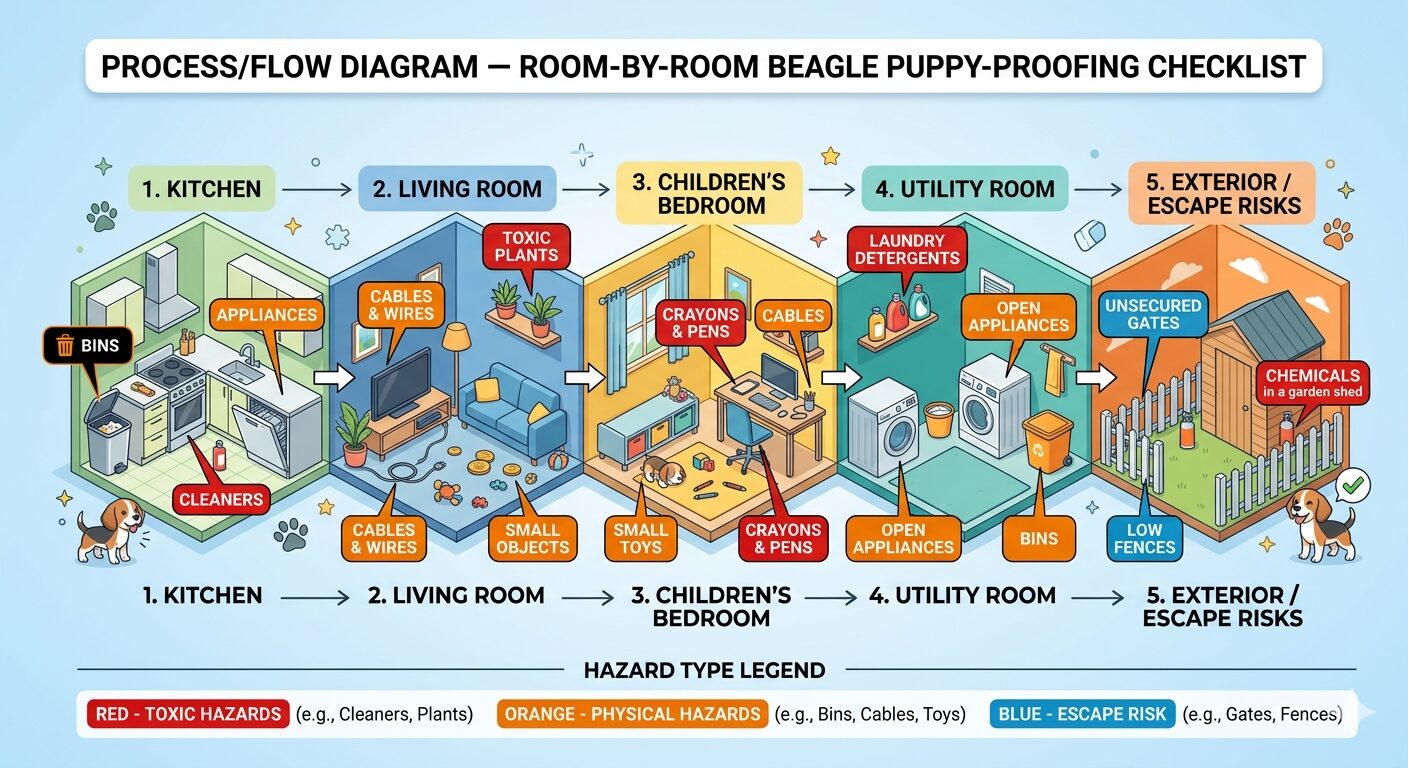
Kitchen and utility room:
- Rubbish bins. A standard pedal bin is insufficient. Beagles will access a pedal bin with relative ease, motivated by scent. Replace with a lidded, weighted bin — or move the bin to a locked cupboard.
Food storage. Any bag of kibble, box of treats, or accessible food item at or below counter height will be located and acted upon. Store all food in sealed containers in high cupboards or a locked pantry. - Low cupboards with cleaning products. Secure with childproof locks or relocate chemicals to a high shelf. Dishwasher tablets, bleach, and concentrated cleaning products are among the most common household toxins ingested by dogs.
- Washing machine and tumble dryer. Always check inside before closing the door. Beagle puppies have been known to climb into warm, open appliances, particularly in the early weeks when they are seeking warmth and enclosed spaces.
Living areas:
- Cables and cords. Television cables, charger leads, and lamp cords are chewing hazards and electrocution risks. Use cable covers, cable management clips, or relocate cables entirely behind furniture or skirting-level trunking.
- Houseplants. Common houseplants toxic to dogs include pothos (devil's ivy), peace lily, dieffenbachia, philodendron, and sago palm. Remove these from rooms the puppy will access, or relocate to a completely inaccessible height. A beagle puppy will investigate and chew a plant at ground level without hesitation.
- Remote controls, spectacle frames, and similar items. These carry strong human scent and are reliably targeted. Develop a habit of raising these items above the puppy's reach when not in use.
- Reclining furniture. Footrests and reclining mechanisms can trap or injure a small puppy that has chosen to rest underneath. Establish a rule about furniture positions when the puppy is loose.
Children's bedrooms:
Often the most hazardous room in the house for a puppy. Small toys, food wrappers, open bins, craft materials, and hair ties — all ground-level, all attractive to a beagle nose. Decide before arrival whether the puppy has access to children's rooms, and prepare accordingly. If access is permitted, the same puppy-proofing rigour applied to the rest of the house must be applied here.
Using baby gates and playpens:
A puppy playpen or a series of baby gates allows you to create a designated safe zone — typically the kitchen or a gated section of the living area — within which the puppy can move freely during the settling-in period without access to the full house. This is not restriction for its own sake. It is management: the dog cannot practice unwanted behaviours in spaces where it has not yet been supervised, and you are not managing hazards across every room simultaneously while also managing a new puppy.
Crate Setup and Den Environment
The crate is one of the most important investments you will make for your beagle puppy's early life, and setting it up correctly — before the puppy arrives — is the difference between a dog that takes to the crate within days and one that resists it for weeks.
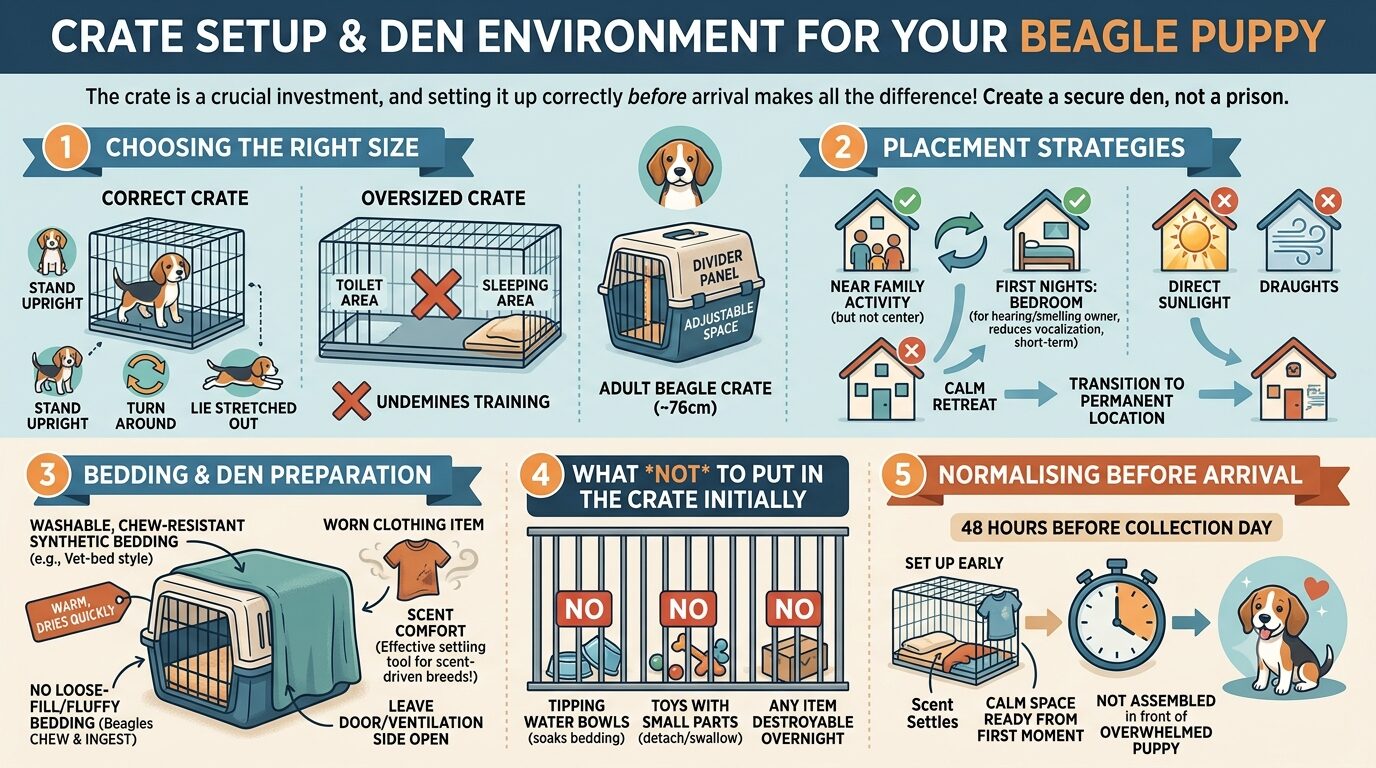
Choosing the right size:
The crate must be large enough for the puppy to stand fully upright, turn around comfortably, and lie stretched out — but not so large that it loses the den-like enclosure that makes it feel secure. An oversized crate allows the puppy to toilet in one end and sleep in the other, which actively undermines crate training. If you are purchasing a crate sized for an adult beagle (approximately 76cm), choose one with a divider panel that allows you to reduce the internal space initially and increase it as the puppy grows.
Placement:
- Away from direct sunlight and draughts.
- Close enough to regular family activity that the puppy does not feel isolated — but not in the centre of constant noise and movement, which prevents the crate from functioning as a calm retreat.
- For the first nights, many owners find that placing the crate in the bedroom reduces night-time vocalisation significantly. The puppy can hear and smell the owner and settles more readily. This is a practical short-term arrangement; transition to a permanent location once the puppy is sleeping reliably.
Bedding and den preparation:
- Washable, chew-resistant synthetic bedding (vet-bed style) that retains warmth and dries quickly. Avoid loose-fill or fluffy bedding in the early weeks — beagles will chew and potentially ingest it.
- A worn item of the owner's clothing in the crate during the first nights. Scent comfort is a genuinely effective settling tool for a breed as nose-driven as the beagle.
- Cover three sides of the crate with a blanket to create a den atmosphere. Leave the door side and sufficient ventilation uncovered.
What not to put in the crate initially:
Water bowls that tip and soak bedding, toys with small parts that can be detached and swallowed, or any item the puppy could destroy and ingest overnight.
Normalising the crate before the puppy arrives:
Set the crate up at least 48 hours before collection day. Place bedding and any worn clothing inside. This allows the scent to settle and means the crate is ready as a calm space from the puppy's first moment in the home, rather than being assembled in front of an already-overwhelmed new arrival.
Bed and Sleeping Area
Whether you choose crate sleeping, a standalone dog bed, or a designated puppy room, the sleeping arrangement needs to be decided, set up, and committed to before arrival day — not adjusted night by night in response to the puppy's vocalisation.
Bed selection for beagles:
Beagles are natural burrowers. They will seek out enclosed, nest-like spaces and push bedding into a pile before settling. Beds with raised, bolstered sides or hooded/cave designs suit the breed's instinct to nest and are generally preferred over flat mats. Choose a washable cover — puppy sleeping areas require frequent laundering in the early weeks.
Consistency from night one:
The sleeping area should be consistent from the first night. Changing it — moving the crate, switching from crate to bed, relocating the puppy to a different room — increases anxiety and delays settling. Decide before the puppy arrives and commit to the arrangement for at least the first four to six weeks.
Managing the first nights:
The first two to three nights will typically involve crying, whining, and howling. This is expected.
What helps:
- A warm water bottle (covered in a blanket, not direct contact with the puppy) provides the warmth of littermate contact.
- A ticking clock placed near the crate approximates heartbeat rhythm and has a mild settling effect for some puppies.
- Low-level background sound — a radio at very low volume, or a white noise application — reduces the silence that amplifies the puppy's distress.
What to avoid:
Responding to vocalisation by immediately returning to the puppy or removing them from the crate. This trains the puppy that vocalisation produces the desired outcome (your return) and will reliably increase rather than decrease the behaviour over subsequent nights.
Feeding Area Setup
Beagles are food-obsessed, and a well-designed feeding area is not a luxury — it is a management system that reduces resource guarding, mess, bloat risk, and counter-surfing habits that, if allowed to develop, become persistent problems.
Fixed location:
Choose a consistent feeding location in a low-foot-traffic area, away from the main household movement path. Feeding in the middle of a busy kitchen produces anxiety during meals and increases the likelihood of food guarding behaviour. Fix the location from day one and maintain it throughout the dog's life.
Bowl selection:
- Slow-feeder bowls are a first purchase, not an optional upgrade. Beagles eat rapidly, and fast eating is directly associated with gastric bloat risk and excessive gas. A slow-feeder bowl that requires the dog to work around ridges or compartments to access food extends eating time from 30 seconds to several minutes. This is both a health benefit and a behavioural one.
- Non-tip, weighted, or suction-based bowls prevent the beagle from sliding the bowl across the floor — and, more importantly, from picking it up and relocating it to a preferred spot.
- Fresh water at all times. A second, separate water station from the food bowl. Wall-mounted dispensers or weighted spill-resistant bowls work well for puppies; standard lightweight bowls will be relocated or tipped within the first session.
Food storage:
- Sealed containers stored in high or locked cupboards. A bag of kibble left at ground level — even in a cupboard — will be located by scent and accessed given sufficient time and motivation. Beagles have been reported locating sealed food bags through cupboard doors by smell. Do not test this with an unsupervised puppy.
- Establishing feeding routines from day one - Fixed meal times (typically two to three meals per day for a beagle puppy under six months), no feeding from the table, and clear family rules about approaching the puppy during meals. Consistent feeding routines reduce food anxiety and the resource guarding behaviour that food-anxious dogs develop over time.
Safe Play Areas and Toy Selection
A beagle puppy needs physical and mental stimulation from the first day in the home, and the play environment should be ready before arrival — not assembled on the day.
Designating a safe play zone:
- A puppy playpen or gated room creates a defined, supervised play zone where the puppy can explore freely without access to hazards. This is particularly useful during the first weeks when the household is still learning the puppy's behaviour patterns and the puppy is still learning the household's layout.
- Toy selection for beagles specifically - Beagles are scent-driven animals with strong oral instincts, and their toy preferences reflect both.
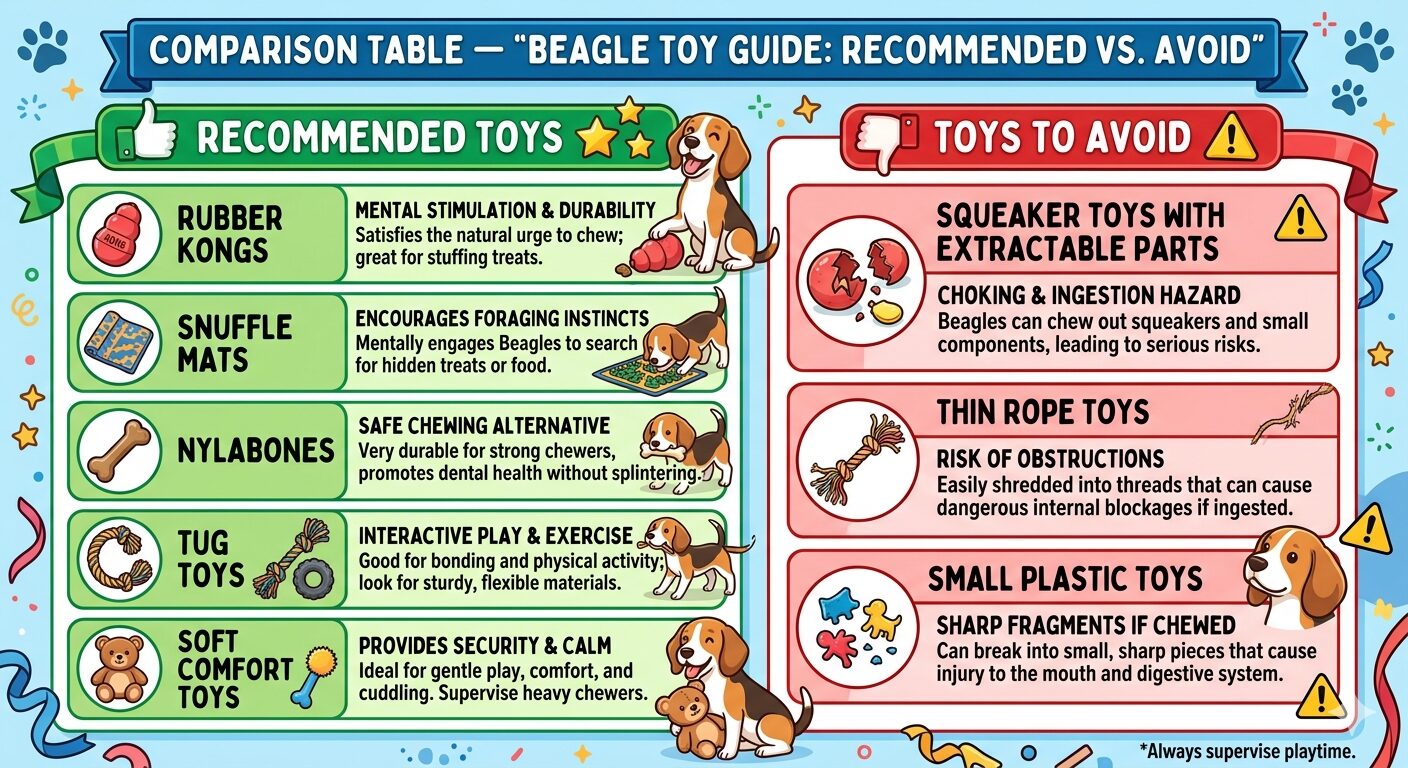
The most effective toy types are:
- Durable chew toys, rubber Kongs, Nylabones, and natural chews (bully sticks, deer antlers) that satisfy the chewing impulse without disintegrating quickly. Cheap plush toys will be destroyed and potentially ingested within minutes.
- Snuffle mats and scent puzzle toys, these engage the beagle's primary instinct — following a scent trail — in a controlled, indoor format. A snuffle mat with kibble worked into the fibres will occupy a beagle puppy for significantly longer than any physically active toy.
- Tug toys, appropriate for interactive play with the owner, with a clear start and stop signal to establish that the toy — not the human — is the object of the game.
- Soft comfort toys for downtime, the beagle puppy will carry and mouth a soft toy during calm periods. Choose a design without small detachable parts (button eyes, squeaker mechanisms that can be extracted).
What to avoid
Toys with squeakers that can be removed and swallowed, toys with small detachable accessories, thin rope toys that shed fibres, and anything with small plastic parts. The beagle's oral determination means it will extract and swallow anything that can be extracted.
Rotating toys
Rotate a subset of toys out of the rotation weekly, returning them as "new" items. This maintains novelty and reduces the boredom-driven destruction that comes when a beagle has exhausted the novelty of everything available.
The frozen Kong strategy
Prepare a Kong stuffed with the puppy's food (softened kibble, or a small amount of puppy-safe wet food) and freeze it the night before the puppy arrives. This becomes an immediate occupation tool for the first unsettled hours — a familiar food scent in an unfamiliar home, delivered through a format that takes time to access.
Beagle-Proofing the Garden
Garden security for a beagle is not a matter of preference — it is a safety requirement. A beagle in an unsecured garden will escape. This is not a training problem; it is a breed characteristic. The beagle follows its nose, and once a scent trail leads under a fence or through a gap, the question of whether the dog wants to escape is irrelevant. The response is automatic and the exit will be used.
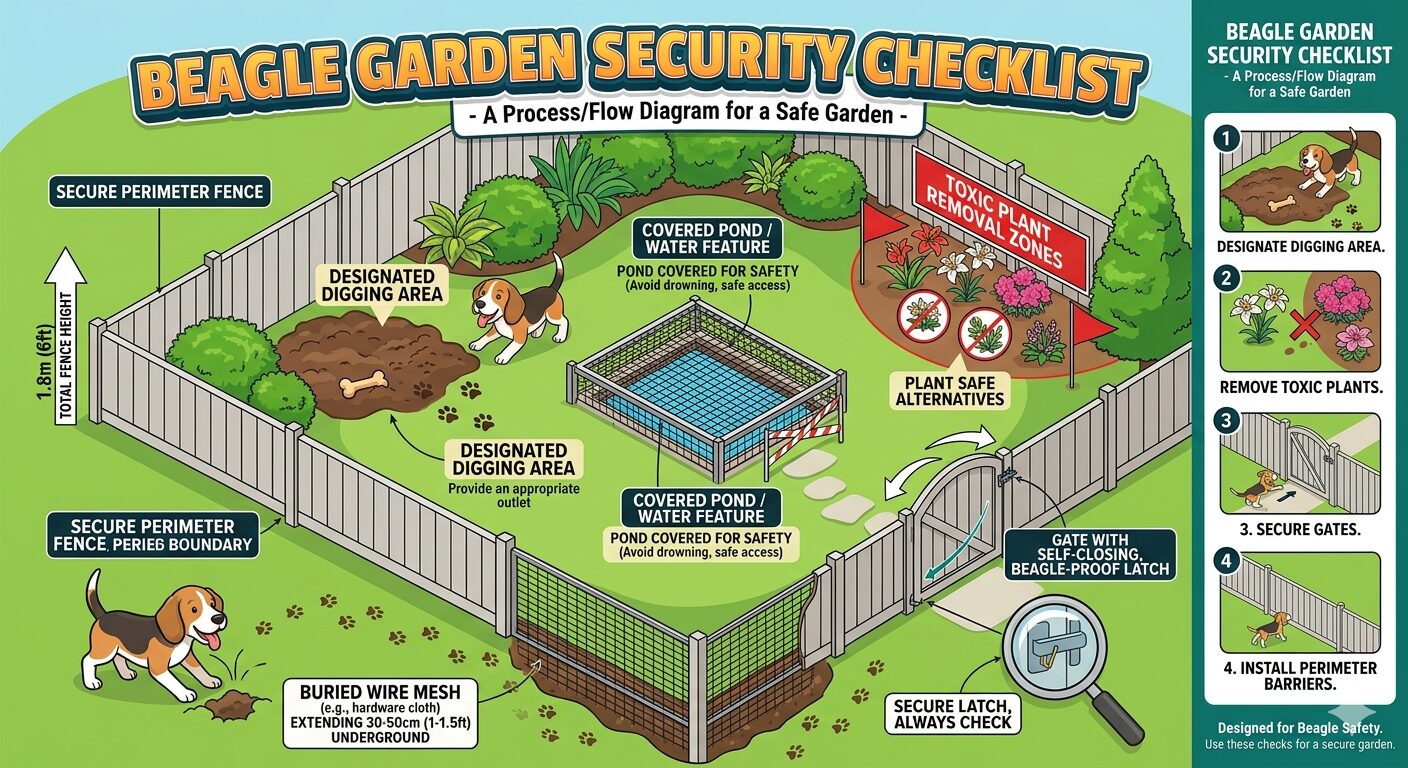
Fencing height and integrity:
- A minimum height of 1.8 metres (6 feet) is the standard recommendation for beagles. Beagles are not exceptional climbers or jumpers, but they are exceptional diggers and gap-finders. Height alone is insufficient without ground-level integrity.
- Inspect every fence panel, post, and gate join for gaps. A gap of 15–20cm at the base is sufficient for a beagle puppy to work through or enlarge. A human looking at the fence will see a small gap; a beagle following a scent will see an exit.
Digging prevention:
- Bury galvanised wire mesh horizontally along the base of the fencing — extending 30–40cm inward from the fence line at a depth of approximately 20cm. This prevents tunnelling without punishing or deterring the dog from the area.
- Concrete edging along the base of fence panels is an alternative for solid boundaries. It is more permanent but also more effective.
Gate security:
- Self-closing gate mechanisms prevent gates from being left open — which, during the first weeks with a new puppy, will happen at least once despite everyone's best intentions.
- A lockable gate latch, positioned too high for the puppy to manipulate, is a separate precaution from the self-closing mechanism.
- Brief every family member and regular visitor: the gate must be fully closed and checked before entering or leaving the garden.
Garden hazards:
- Slug pellets and pesticides. Metaldehyde-based slug pellets are highly toxic to dogs and must be removed or replaced with dog-safe alternatives (ferric phosphate-based products are safer but should still be stored securely).
- Fertilisers. Bone meal fertilisers are particularly attractive to dogs by scent and can cause intestinal obstruction in large quantities.
- Cocoa mulch. Contains theobromine (the same compound that makes chocolate toxic to dogs). Common in garden centres. Do not use this product in any garden a dog will access.
- Toxic garden plants. Common garden plants toxic to dogs include foxglove, daffodil bulbs, azalea, rhododendron, wisteria, and laburnum. Conduct a specific plant audit before the puppy arrives. A comprehensive list is available from the Dogs Trust and similar animal welfare organisations.
Ponds and water features:
Young puppies can drown in shallow water. Ponds, water features, and uncovered water butts must be securely covered or fenced off before the puppy arrives. Curiosity and water are a dangerous combination in the first weeks.
Designated digging zone:
Some owners find that providing a sandbox or defined soft-soil area — initially seeded with buried treats — redirects the digging instinct constructively. This is worth establishing from the start rather than as a corrective measure after the flower beds have been excavated.
Safety Hazards A Comprehensive Audit
Beyond the room-by-room and garden preparation, several cross-cutting hazards deserve specific attention.
Fire and heat sources:
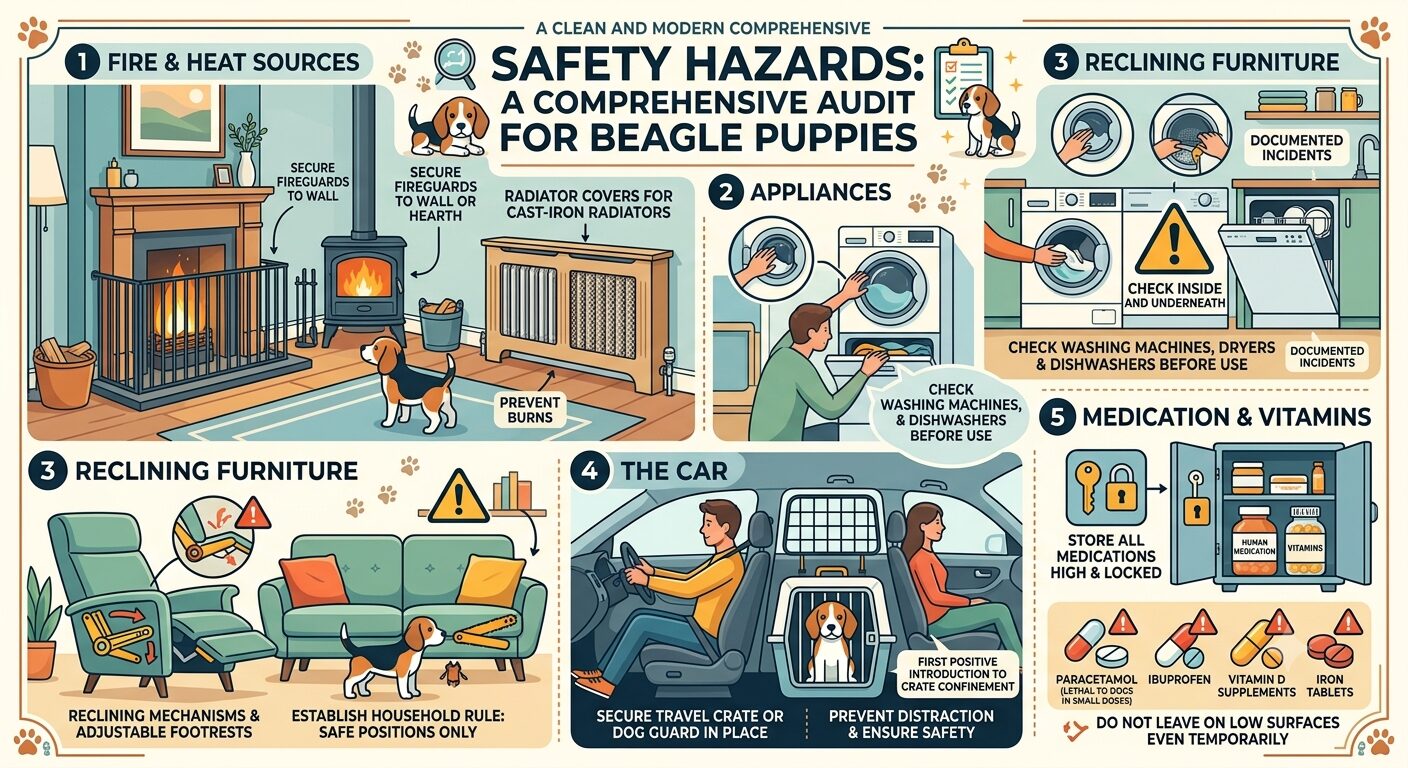
Open fires, wood-burning stoves, and log burners require fireguards secured to the wall or hearth. A beagle puppy investigating a warm hearth will approach closer than is safe. Radiators, particularly the older cast-iron style, can cause burns on contact — radiator covers are a practical solution in rooms the puppy will use.
Appliances:
Check inside washing machines and tumble dryers before every use during the period the puppy has free access to the utility room. Check underneath dishwashers when open. These are not theoretical risks — they are documented incidents.
Reclining furniture:
Reclining mechanisms and adjustable footrests can trap or crush a puppy that has found a warm spot underneath. Establish a household rule about furniture positions when the puppy is moving freely in that room.
The car:
If the puppy will travel home from the breeder by car — and they will — a secure travel crate or dog guard should be in place before collection day. A puppy loose in a car is a distraction risk and a safety risk for the puppy. The travel crate from the collection journey also serves as the first positive introduction to crate confinement, which is worth arranging deliberately rather than as an afterthought.
Medication and vitamins:
Human medications and vitamins are among the most common dog poisoning incidents recorded by veterinary practices. Paracetamol (lethal to dogs in small doses), ibuprofen, vitamin D supplements, and iron tablets are particularly dangerous. Store all medications in a high, locked cabinet. Do not leave medication on low surfaces even temporarily.
Introducing the Puppy to the Household
Physical preparation is complete. Social preparation is equally important and equally likely to affect the puppy's first week.
Resident dogs:
If there is already a dog in the household, a neutral-territory introduction — outside, in a space neither dog considers theirs — before bringing the new puppy into the home is advisable. Prepare a separate safe space for the puppy within the home (the crate in a gated area) where the resident dog cannot follow. Unsupervised interaction in the first week creates unnecessary tension during a period when both animals are adjusting.
Cats:
Beagles have a prey drive that is manageable but requires early, careful introduction. Ensure the cat has permanent access to at least one dog-free room with a cat-flap or high-level entry point. The first introductions should be controlled — beagle on a lead, cat at liberty. Allow the cat to set the pace of the relationship. Do not force contact. For more on managing multi-pet introductions, Beagles in Family Homes offers detailed guidance on the beagle's behaviour across different household configurations.
Children:
Brief children on puppy handling rules before the puppy arrives — not on the day. Key rules: no picking the puppy up without a supervising adult present; no rough play; no taking toys or food from the puppy; no approaching the puppy when it is in its crate. These rules protect both the puppy and the children, and they are most effective when established as household norms before excitement overrides them.
Limiting visitors in the first week:
- Restrict visitors for the first five to seven days. The puppy needs time to form a bond with its primary household before being overwhelmed by new people, new scents, and the social demands that visitors bring. A puppy that is over-stimulated in its first week takes longer to settle, and the settling period determines much of the behavioural foundation that follows.
- Understanding that early behaviours like nipping, vocalisation, and exploratory chewing are instinct-led rather than defiant is a principle that applies across breeds — the CorgiCrew guide to Common Corgi Behaviour Problems and Solutions offers a useful framework for any owner navigating these early weeks, with detailed explanations of how breed instinct drives domestic behaviour.
Family Readiness and Household Alignment
The most consistently overlooked dimension of home preparation is human preparation. A house that is physically ready for a beagle puppy but occupied by a household that has not agreed on basic rules will produce a confused puppy and a frustrated family within the first week.
Agree on the rules before the puppy arrives:
- Where does the puppy sleep?
- Is the puppy allowed on furniture, and if so which pieces?
- Who is responsible for night waking in the first week?
- Who feeds the puppy, and when?
- What are the rules about feeding from the table?
- Which rooms does the puppy have access to?
These decisions need to be made collectively and communicated to everyone in the household before the puppy arrives. Inconsistency in rules is one of the most reliable sources of beagle behavioural problems. If one family member enforces the rules and another does not, the puppy learns that rules are optional — a lesson that is much easier to teach than to undo.
Planning for the first week:
Who will be home? How much time can realistically be given to the puppy during work and school hours? How will night waking be shared? These are practical logistics, and resolving them in advance prevents the resentment and fatigue that an unplanned first week reliably produces.
Registering with a vet before the puppy arrives:
Identify a local veterinary practice and register before collection day. Book the first health check appointment for within 48–72 hours of the puppy arriving home — most responsible breeders will include a health certificate, but a first-owner veterinary check is both good practice and, in many purchase agreements, a contractual requirement. Understand the vaccination and microchipping timeline so you are not caught off guard by the schedule.
First-night kit:
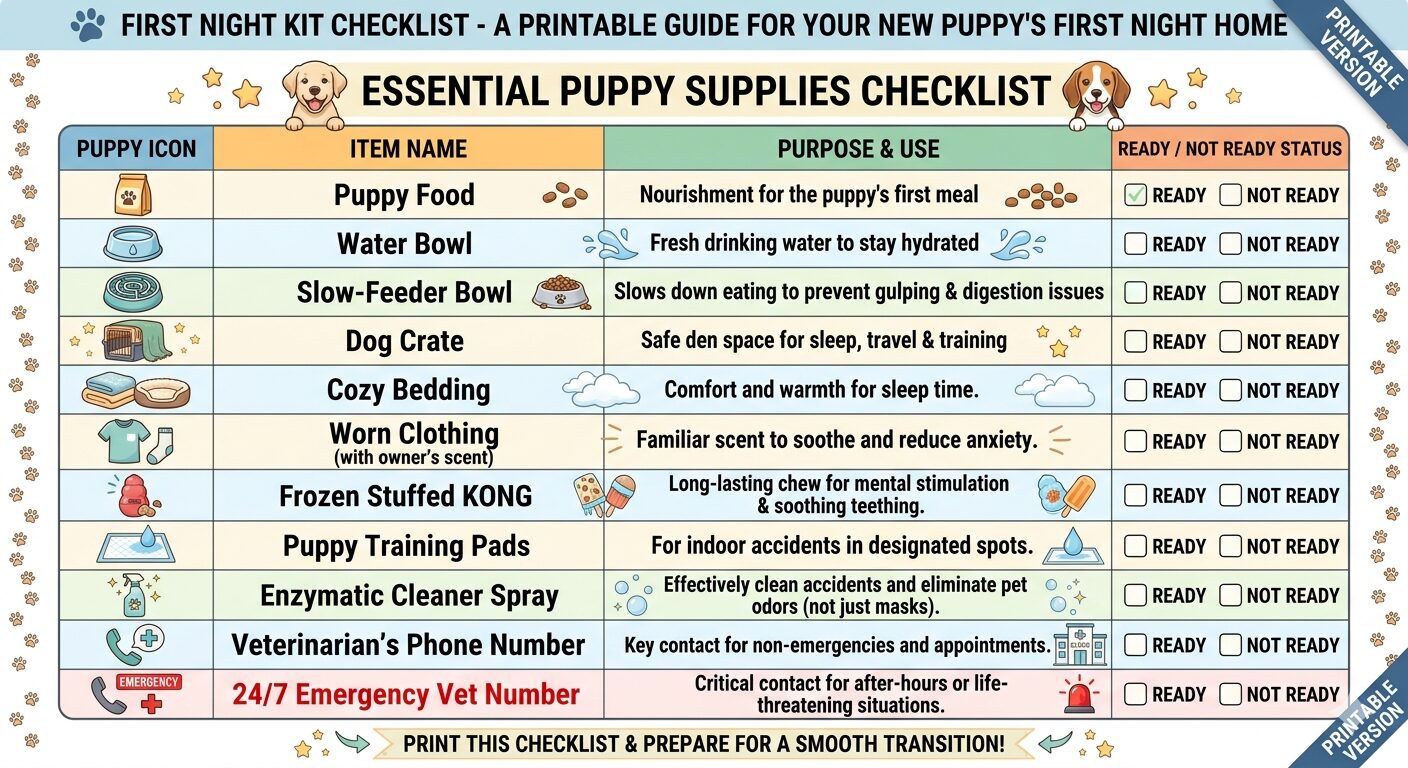
Prepare everything in one location before the puppy arrives.
- Food (the same brand and formula the breeder was using — abrupt food changes cause digestive upset in new puppies)
- Water bowl and slow-feeder food bowl
- Crate with bedding and worn clothing item
- Frozen Kong prepared the evening before
- Puppy pads (for overnight accidents during the first weeks of toilet training)
- Enzymatic cleaning spray for accidents
- Your vet's phone number and the nearest emergency veterinary practice
Having this assembled before the puppy arrives means the first evening is calm and organised rather than frantic. That calmness communicates itself to the puppy.
 EXPERT INSIGHT
 EXPERT INSIGHT
From a beagle breed specialist and experienced puppy mentor:
"The question I am asked most often by new beagle owners in the week before their puppy arrives is: 'What is the one thing I need to do?' The honest answer — and it is not the answer people want — is that the one thing is checking the garden fence. Not once, but twice, at ground level, looking for gaps rather than heights.
Beagle owners who have lost a dog to a road accident almost always describe the same sequence: a gap they knew about and meant to fix, a smell on the other side of the fence, and thirty seconds of inattention. The beagle did not misbehave. It followed its nose through a gap that should have been closed.
The other thing that experienced beagle owners consistently report — and this one surprises people — is that the frozen Kong is not a treat. It is a tool. A Kong stuffed with the puppy's own food and frozen overnight, given exclusively when the puppy is in the crate or left alone for a period, builds a powerful positive association with the crate and with short absences in a way that no amount of reassurance can replicate. Start it on night one. The puppy learns to associate the crate with the arrival of the Kong, and that association will serve you for the dog's entire life."
 FAQ
 FAQ
1. What do I need before my beagle puppy comes home?
At minimum: a correctly sized crate with bedding and a worn clothing item, a slow-feeder bowl and water bowl, a frozen Kong prepared in advance, the same food the breeder was feeding (to avoid digestive upset from an abrupt food change), puppy pads, enzymatic cleaning spray, and an appointment booked with a registered vet within 48–72 hours of arrival. Prepare these items in a single location the evening before collection day.
2. How high does a fence need to be for a beagle?
A minimum of 1.8 metres (6 feet). But height alone is insufficient — beagles are diggers and gap-finders, not climbers. The base of every fence panel and gate must be gap-free and dig-proofed with buried wire mesh or concrete edging. A standard 1-metre garden fence is not suitable for a beagle at any age.
3. Can I leave a beagle puppy alone during the day?
Not for extended periods during the first weeks. Beagles are pack animals and prolonged isolation causes genuine distress, particularly in the early settling period. Build alone time incrementally — start with two to three minutes and extend gradually over weeks. Use departure enrichment (a frozen Kong given exclusively when you leave) to create a positive association with your absence. For working households, a dog walker or pet sitter for midday visits is a practical solution until the puppy is older and more settled.
4. Is crate training necessary for a beagle puppy?
It is not legally required, but it is practically very useful — particularly for a breed with the beagle's oral curiosity and food motivation. A crate-trained beagle has a safe, settled retreat when unsupervised, cannot practise destructive behaviour when you are out of the room, and typically travels more calmly. The investment in the first weeks of crate training pays dividends across the dog's entire life.
5. What household plants are toxic to beagles?
Common indoor plants to remove before the puppy arrives include pothos, peace lily, dieffenbachia, philodendron, sago palm, and aloe vera. Common garden plants to audit include foxglove, daffodil and tulip bulbs, azalea, rhododendron, wisteria, and laburnum. The Dogs Trust (dogstrust.org.uk) and ASPCA maintain comprehensive, searchable databases of plants toxic to dogs. A specific audit of your household and garden is recommended before the puppy arrives.
6. How do I introduce a beagle puppy to my resident cat?
Introduce in a controlled environment — beagle on a lead, cat at liberty and always able to retreat. Allow the cat to set the pace. Never force contact. Ensure the cat has permanent access to a dog-free room or high-level space the beagle cannot reach. Most beagles can coexist with cats when introductions are managed correctly from the start; rushed first meetings can produce a prey-response association that is much harder to reverse.
7. How do I stop my beagle puppy from raiding the bin?
Replace the bin with a lidded, weighted, or cupboard-housed alternative before the puppy arrives. Pedal bins are not sufficient for a beagle. The behaviour is driven by scent — the dog is not being opportunistic, it is following an extremely compelling olfactory instruction. Remove the access rather than attempting to train away the motivation.
8. How long do beagle puppies cry at night?
Most beagle puppies settle within three to five nights when the crate is correctly set up (den environment, worn clothing item, covered sides), warm, and positioned appropriately. Avoid responding to vocalisation with immediate comfort during this period — this trains the puppy that vocalisation produces the desired outcome and reliably extends the settling period. The first two nights are typically the most difficult; consistent non-response combined with a calm setup produces rapid improvement in most cases.
9. When can my beagle puppy start going up and down stairs?
Restrict stair access until approximately 12 weeks, and then introduce gradually and supervised. Repeated stair use in very young puppies places uneven stress on developing hip and elbow joints. A baby gate at the base of stairs from day one prevents unsupervised access.
10. What is the most common mistake new beagle owners make in the first week?
Giving the puppy too much freedom too quickly. Full house access, unrestricted garden time, multiple visitors, and inconsistent rules in the first week create an overwhelmed puppy and an overwhelmed household. The most effective first-week approach is a small, well-prepared safe zone, a consistent routine, limited visitors, and clear household rules applied from day one. Everything else can be expanded gradually once the puppy has settled.
CONCLUSION
The three most important takeaways from this guide are these. First, beagle home prep is breed-specific — generic puppy advice will not identify the hazards that a scent-driven, food-obsessed, escape-capable breed will find. Second, garden security is not negotiable and not improvable after the fact — it must be completed, inspected at ground level, and confirmed before the puppy arrives. Third, family alignment on household rules is as important as any physical preparation — a beautifully prepared house with inconsistent rules will produce a confused puppy faster than almost anything else.
The promise of this guide was that a reader who followed it could walk through their home — inside and out — and know, with confidence, what has been addressed and what still needs attention before their beagle puppy arrives. That checklist now exists for you across every section.
In the First-Time Owner Guides category, this article is the starting point — not the endpoint. The beagle's personality, training needs, and behaviour patterns will evolve over the first year, and the preparation you complete now is what creates the stable platform for that development to go well.
Your puppy is on its way. The home is ready. Now begins the actual work — and it is worth every bit of it.
 CALL TO ACTION
 CALL TO ACTION
Prepared home, arriving puppy — the next step is understanding what you will be living with day to day. Beagle Behavior Guide gives you the breed-specific behavioural context that turns the preparation you have done into a foundation for confident daily ownership.
And when you are ready to understand how a beagle fits into the wider dynamics of your household and family — particularly if children or other pets are involved — Beagles in Family Homes is the guide that walks through those dynamics in detail.
Your Beagle's wellbeing starts here. Keep going.