
Beagles in Family Homes
Beagles have a well-earned reputation as family dogs — sociable, sturdy, and genuinely fond of company. But beagles with kids requires more than good intentions and a hopeful temperament. The breed comes with a scent drive that can override every other instinct, a pack mentality that makes group excitement contagious, and an energy level that does not quietly manage itself in a busy household.
Families who bring a Beagle home without understanding these traits tend to encounter the same pattern: an adorable, enthusiastic puppy that becomes an unruly, noise-sensitive, or chronically distracted adult. Not because the Beagle was the wrong choice — but because the household was not structured to channel what the Beagle actually is.
This guide is for families who want the Beagle–child relationship to be everything the breed's reputation promises. You will find practical frameworks here for managing behaviour, building safety habits, and creating the kind of structured, positive household that allows a Beagle to genuinely thrive alongside children of all ages.
 QUICK ANSWER
Are beagles good with kids?
Beagles with kids can be an excellent match. The breed is sociable, energetic, and pack-oriented — traits that align naturally with an active family. However, a Beagle's scent drive and vocal tendencies require consistent management in a family setting. With positive reinforcement, appropriate supervision, and structured daily activity, Beagles integrate well into family homes and form strong bonds with children.
Understanding Beagle Temperament in a Family Setting
Beagle temperament is shaped by the breed's original function as a pack-hunting hound. Beagles were bred to work in groups, following scent trails for hours at a time — a job that required stamina, vocal communication, independence of thought, and comfort with sustained physical proximity to other pack members. Those traits translate directly into the dog that arrives in a family home.
The pack orientation is one of the Beagle's greatest assets in a family context. A Beagle that regards the family as its pack is a dog that wants to be with people, that is distressed by extended isolation, and that has a natural social ease with children, adults, and other animals. The same orientation that makes a Beagle challenging when left alone for long hours makes it delightful during family activities.
Key temperament traits for family integration:
- Sociability. Beagles typically have low stranger-directed aggression and high tolerance for physical contact, making them well-suited to busy family environments with visitors, noise, and movement.
- Energy level and stamina. The breed requires at least 60 minutes of vigorous exercise per day. A Beagle receiving less than this will find its own stimulation — typically through chewing, digging, howling, or counter-surfing.
- Scent drive. The Beagle's olfactory focus is the defining characteristic of the breed. When a Beagle locks onto an interesting scent, its recall reliability drops to near-zero without prior training. This has direct implications for outdoor play with children.
- Vocal tendency. Beagles have three distinct vocalisations — bark, bay, and howl — and all three will be used. In a family home, howling in response to household noise (doorbells, other children, music) is a common management challenge.
- Beagle behaviour patterns. The breed tends toward opportunistic food-seeking, resource-guarding when meals are unpredictable, and arousal escalation in group excitement — all of which require specific management in a family setting.
Beagle Behaviour and Children
What to Expect at Each Stage
Like all breed–child dynamics, the Beagle–child relationship changes as the child develops. The risks and management priorities at age two are entirely different from those at age ten — and a family that builds its approach on a single static framework will find it stops fitting as the child grows.
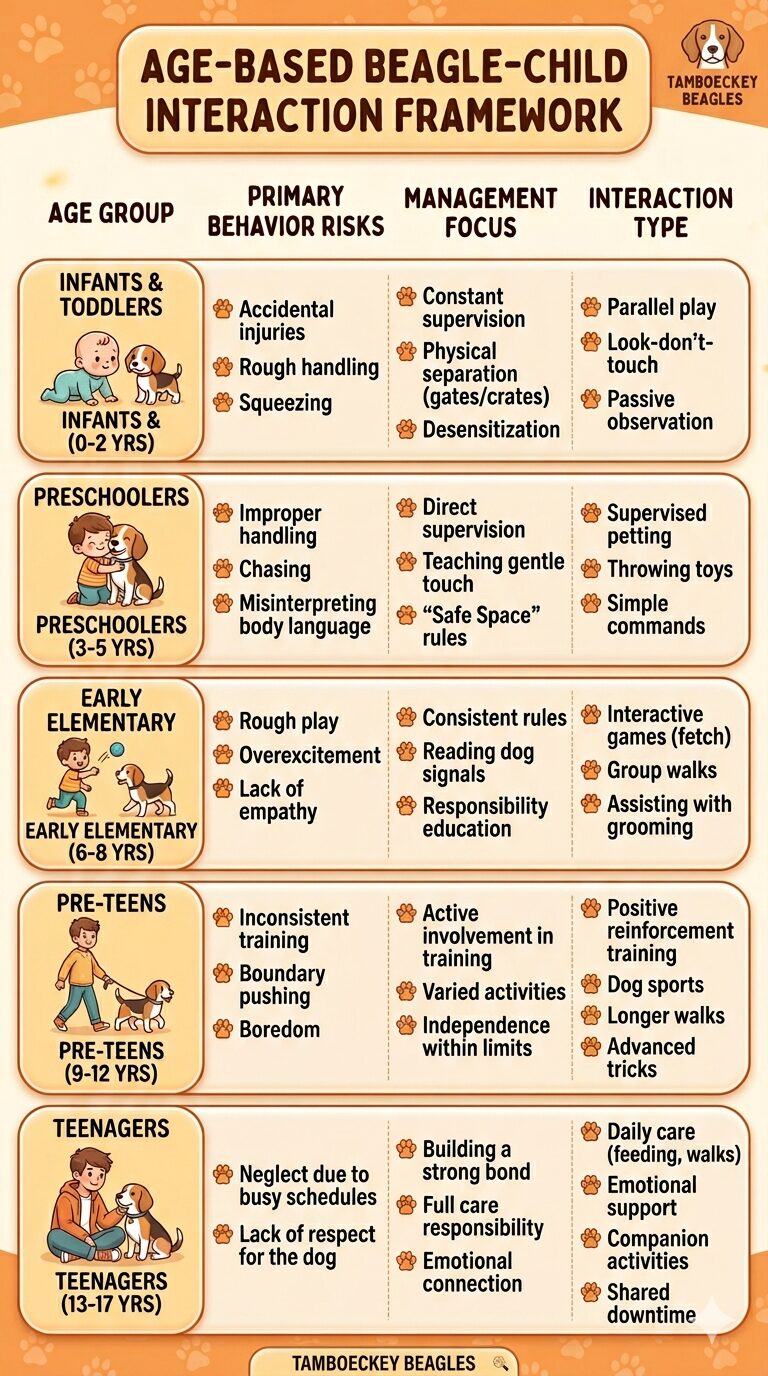
The toddler–Beagle risk profile:
The most significant physical risk in a toddler–Beagle household is not biting — it is accidental knockdown. Beagles are sturdy, enthusiastic dogs with a tendency to jump up on greeting and to barrel into family play with their full body weight. A 10–12 kg Beagle moving at speed toward a two-year-old standing at 80cm presents a real physical risk. Management during this stage focuses on managing the dog's greeting behaviour — four-paws-on-the-floor training — more than on the contact interaction itself.
Supervision Principles That Actually Work
Child safety around dogs is most effectively ensured through supervision that is specific, graduated, and built on observable criteria — not on age cutoffs or general rules of thumb. Effective supervision of Beagle–child interaction requires understanding what you are supervising for.
What to watch in Beagle–child interaction:
Arousal escalation: Beagles reach excitement quickly in group play. Watch for: increased vocalisation, faster movement, loss of response to known commands, fixed focus on food or toys in the vicinity of the child. These signals indicate the dog is approaching its arousal ceiling and the interaction should be wound down.
Resource-related tension: Beagles will guard food items, food-scented objects, and occasionally high-value toys. Any interaction between a child and a Beagle that involves food — including snacks the child is carrying — requires direct supervisory attention.
Recall gap during outdoor play: Children running in an open garden with a Beagle off-lead is a scenario where the Beagle's scent drive can pull its attention away entirely. Establish a reliable recall before allowing off-lead outdoor play, and only in a fully fenced area.
Graduated supervision model
Rather than a binary "supervised" or "unsupervised" framework, a graduated model based on demonstrated behaviour is more practical:
- Stage 1 (months 1–3) All interaction requires adult physical presence within arm's reach.
- Stage 2 (months 3–6) Adult must be in the same room with full attention; arm's reach not required if the dog's arousal is consistently managed.
- Stage 3 (months 6–12) Older children (8+) may interact in a familiar, low-stimulation setting with parental line-of-sight.
- Stage 4 (12+ months) Assessed on the basis of the specific child's age, the dog's training foundation, and the environment. No automatic unsupervised access for children under 8.
Child Safety Around Beagles: Teaching the Rules That Matter
Teaching children safe interaction with Beagles addresses a specific set of risks that differ in important ways from the herding-breed risks described elsewhere. Beagle-specific child safety focuses on food-handling, arousal management, and the breed's knock-over risk — not on nipping from herding instinct.
Beagle-specific child safety rules:
- No food near the Beagle outside of designated feeding times. Beagles are powerfully scent-motivated, and a child carrying a snack in the same space as a Beagle creates resource-guarding risk. Children should not eat in the dog's general living space, and the dog should not be present when children are eating unless the dog is settled and trained.
- Do not chase the Beagle. Chasing triggers the pack-chase instinct in reverse — the Beagle either becomes excited and ungovernable, or it becomes anxious and defensive. Neither outcome supports child safety. Teach children to call the dog using the trained recall word and a treat, not to pursue it.
- Do not disturb the Beagle when eating, sleeping, or in its crate. This is a universal dog safety rule, but it requires particular emphasis with Beagles because the breed's sociability can create a false sense that all interaction is welcome at all times. It is not.
- Move calmly around the dog. Unlike the Corgi's herding response to running children, the Beagle's risk with running children is primarily the excited chase/collision pattern — the dog joins in the running with full body enthusiasm. Teaching children to walk near the dog, not run, reduces the likelihood of accidental knockdown and excitement spiral.
Managing Beagle Scent Drive in a Family Home
The Beagle's scent drive is not a training problem — it is a breed characteristic. It will not be trained away. The goal of management is not to eliminate the drive but to channel it productively and to ensure that it does not create risk in a family context.
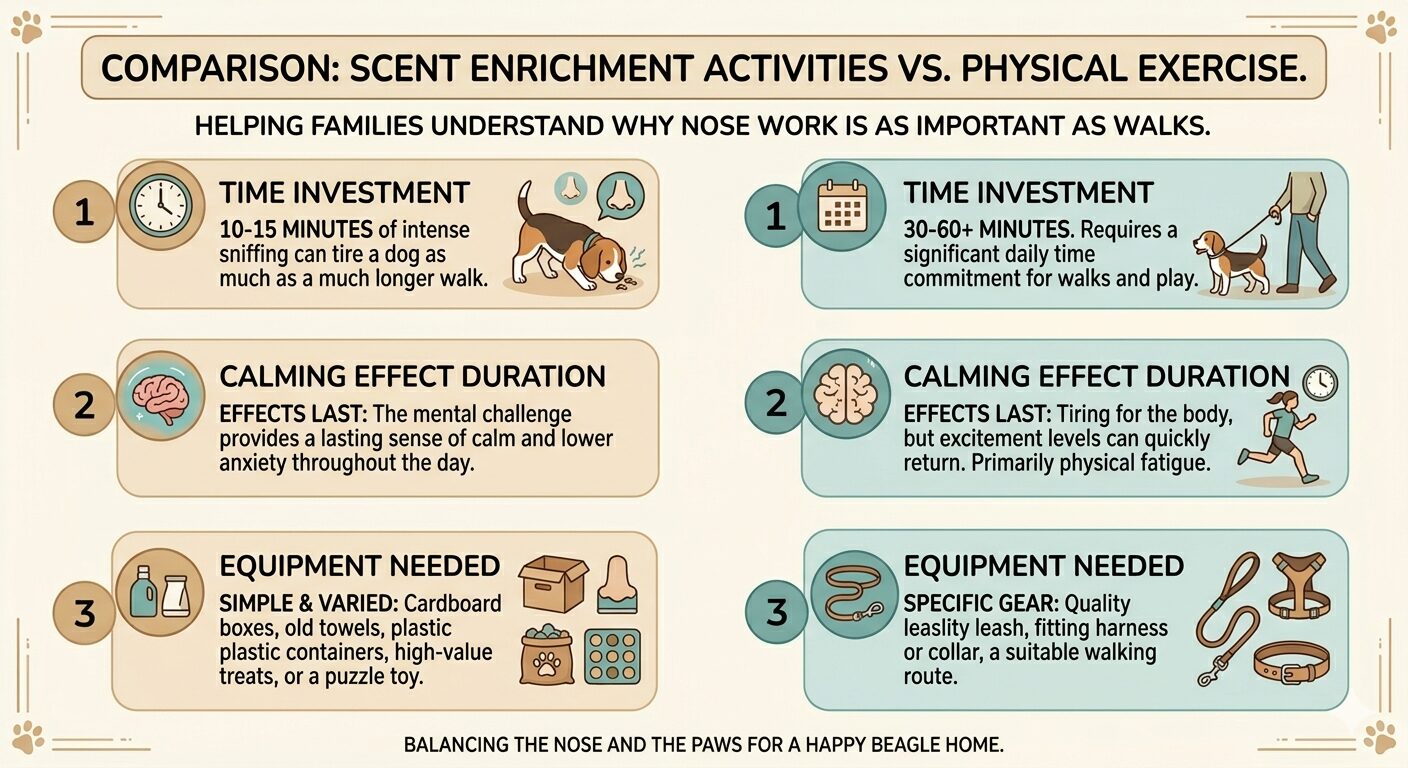
A Beagle's nose contains approximately 220 million scent receptors, compared to approximately 5 million in humans. This is not a slight difference — it is a completely different sensory experience of the world. A Beagle in a family kitchen during meal preparation is not misbehaving when it follows its nose toward the counter; it is doing exactly what 5,000 years of selective breeding prepared it to do.
Management strategies for family homes:
Counter-surfing prevention. Never leave food at Beagle nose-to-counter level unattended. This includes children's plates set on low tables, snacks left on coffee tables, and school bags containing food items. The Beagle will find them, and the family will be disappointed repeatedly until the environment is modified.
Garden management. Ensure garden fencing is secure to ground level — Beagles are persistent, low-to-ground diggers motivated by scent. A Beagle that can scent a neighbouring garden's activity will attempt to gain access to it. Standard garden fencing that works for most dogs does not always contain a motivated Beagle.
Scent enrichment as management. Directed scent activities — scatter feeding, nose work games, sniff walks on a long line — are among the most effective outlets for Beagle energy. A Beagle that has had 20–30 minutes of dedicated scent activity is significantly calmer in the family home for several hours afterward. This is more effective than the equivalent time of physical exercise alone.
Recall training as a priority. Recall training for a Beagle requires more investment than for most other breeds, precisely because the scent drive competes directly with the recall response during outdoor activity. A Beagle puppy should begin recall training from the first week in the home, and the recall should be maintained as a high-value reward behaviour throughout the dog's life.
For the broader developmental context of how scent drive and recall develop across Beagle developmental stages, the Beagle Puppy Socialisation Guide on this site covers the critical window management in detail.
Bonding Activities That Build a Genuine Connection
Beagle bonding activities in a family setting leverage the breed's two greatest social assets: its pack orientation and its nose. Activities that tap into either of these — and ideally both — create the deepest, most durable connections between Beagle and child.
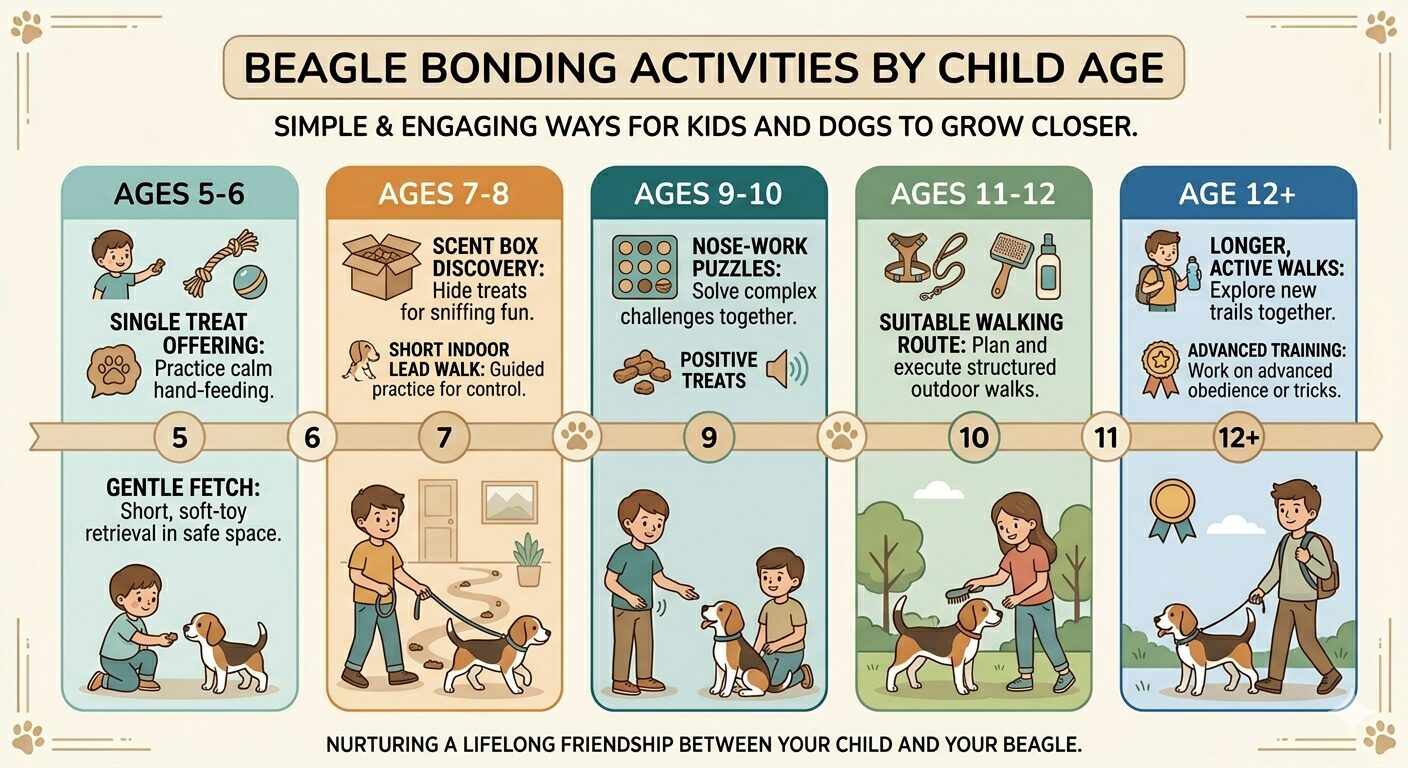
Bonding activities by age group
Ages 5–7
- Scent games: Hide a treat under one of three cups and let the child shuffle the cups while the Beagle watches, then release the dog to find it. Simple, short, highly engaging for both dog and child. Positions the child as the architect of the Beagle's fun.
- Scatter feeding: The child scatters the Beagle's meal kibble across the garden. Low risk, high engagement, uses the breed's natural foraging behaviour productively.
Ages 8–11
- Structured nose work. Set up a simple nose-work box search — several cardboard boxes, one containing a treat-scented item — and have the child "set the puzzle" while the dog waits. Release the dog and allow it to work independently to find the scented box. The child records which box it found in first; progressively increase difficulty.
- Lead walking. Children who have been taught proper lead technique can participate in regular walks. This is a strong bonding activity for Beagles because the walk satisfies both the physical and scent-exploration needs of the breed simultaneously.
Ages 12+:
- Participation in training. Teenagers can practise and reinforce known commands, introduce new tricks, and participate in more complex nose-work sequences. The Beagle's eagerness to work for food rewards makes it highly responsive training partner.
- Long-line sniff walks. An older child can manage a long-line (5–10 metres) walk in a safe outdoor environment, allowing the Beagle to follow scent trails within the lead's range. This gives the dog genuine olfactory enrichment while building the adolescent's skills in reading and responding to the dog's behaviour.
Families considering a Beagle alongside another family-oriented breed should note that Corgis and Beagles share many family-compatible traits, though their management priorities differ significantly — see Corgis and Family Dynamics on CorgiCrew for a detailed look at how the Corgi's herding-breed needs compare.
Integrating a Beagle Puppy into a Home with Children
The Beagle puppy integration process benefits from a structured, sequenced approach that accounts for the breed's specific sensory and social characteristics. Beagle puppies are intensely sensory — scent-curious, noise-responsive, and physically active — and a family environment provides enormous stimulus volume. Managing that stimulus volume is the central challenge of the first eight weeks.
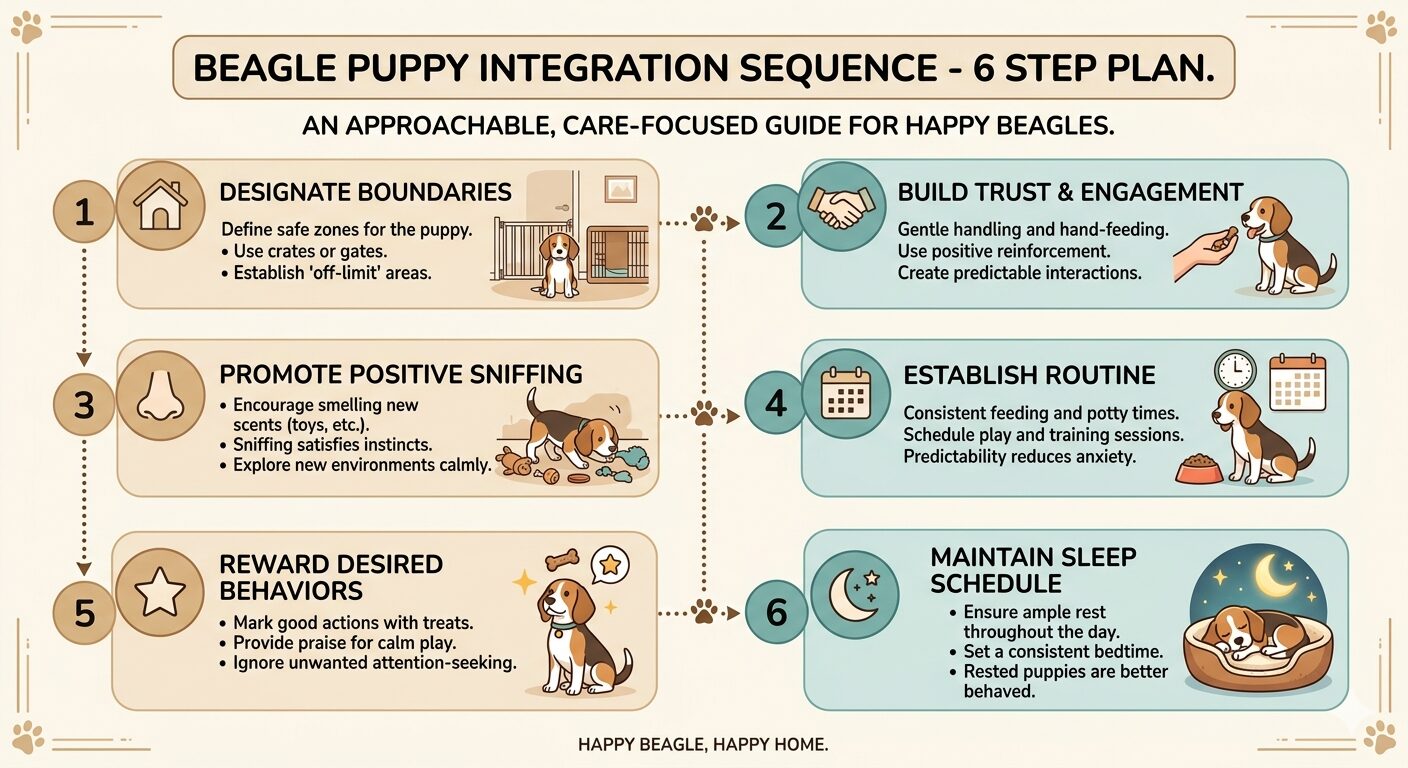
Integration sequence for a Beagle puppy in a family home
- Designate and enforce boundaries before arrival. The puppy's sleeping area, feeding area, and play zone should be established and explained to the children before the puppy arrives. Boundaries are much easier to enforce when they are set before the excitement of arrival rather than in the middle of it.
- Controlled first contact. The first meeting between the Beagle puppy and the children should occur in a calm, enclosed space — not the front door. Children should be seated on the floor, not standing over the puppy. Allow the puppy to approach and investigate at its own pace; this builds the puppy's confidence in the interaction rather than creating an anxiety response to being grabbed or handled from above.
- Manage the stimulus volume. A Beagle puppy entering a household with multiple children faces an enormous sensory load. Limit the number of children present for initial interactions to one at a time for the first three to five days. Once the puppy is comfortable with each child individually, group interactions can begin — briefly, calmly, with close supervision.
- Begin recall and name recognition immediately. The Beagle's recall challenge begins at the puppy stage. Use the puppy's name and a high-value treat to build an immediate association between the name and positive attention. This is the foundation on which reliable recall is built — and the earlier that foundation is laid, the more robust the eventual recall.
- Follow the developmental stage framework. The period between 8 and 16 weeks is a critical window for socialisation — the puppy's brain is actively mapping what is normal and safe. The Complete Guide to the Beagle on this site covers the full developmental stage framework for Beagle puppies, including the specific exposures that are most valuable during this window.
- Maintain sleep and feeding schedules. Beagle puppies need 16–18 hours of sleep per day in the first weeks. Children who wake the puppy to play, or who disrupt the feeding schedule, create an overtired and metabolically unstable animal. Explain to children in age-appropriate terms that the puppy's schedule is not negotiable — it is care, like their own bedtime.
- For foundational Beagle personality and breed-trait information that frames these integration decisions, the Complete Guide to the Beagle provides comprehensive background on what shapes a Beagle's character from breeding through to adult temperament. Families who source their Beagle puppy from a breeder who has followed structured health and temperament protocols — as outlined in Enhancing Your Bond Through Personality-Based Training on PemberDiamonds — will typically find the integration process more predictable and the temperament baseline more reliable.
Household Rules for Long-Term Family Play and Harmony
Sustainable family harmony with a Beagle is built on household rules that are consistently enforced across all family members and that account for the specific ways in which Beagle behaviour can create friction in a family context.
The Beagle family household rule set:
Physical environment rules:
- All food is stored at counter height or above — no exceptions.
- The Beagle's crate or designated sleeping area is inaccessible to children.
- The garden is fully fenced to ground level before the Beagle has outdoor access.
- Doors to the street are checked before the Beagle is off-lead indoors. Beagles will follow a scent through an open door without hesitation.
Behavioural rules for children:
- No roughhousing with the Beagle — no chase games that the Beagle initiates, no wrestling.
- No feeding the Beagle outside of its designated feeding times.
- Allow the Beagle to retreat to its crate or rest space without following it.
- Use the Beagle's name and a treat to call it, not chase and grab.
Consistency rules for adults:
- All adults in the household enforce the same rules, using the same commands. A Beagle in a household where Mum says "off" and Dad says "down" for jumping will learn neither command reliably.
- Positive reinforcement is the primary training approach. Beagles that are trained through positive reinforcement are measurably faster to learn, more stable emotionally, and form stronger bonds with their handlers than those trained through correction-based methods.
- Exercise is non-negotiable. A daily minimum of 60 minutes — not optional on busy days — is a household commitment, not an ideal.
Managing family play sessions:
- Family play with a Beagle should have structure: a start, a clear activity, and an end. The most effective play sessions for a Beagle in a family setting are scent-based or fetch-based rather than chase-based. Chase games — where the family chases the dog or the dog chases family members — reliably escalate into arousal states that are difficult to bring down and that increase the likelihood of jumping, nipping, or accidental knockdown. Redirect to structured fetch or scatter-feeding games instead.
 EXPERT INSIGHT
 EXPERT INSIGHT
Specialist Observation — The Arousal–Scent Feedback Loop
"The Beagle's scent drive and its general social arousal are not independent systems — they feed into each other in ways that families consistently underestimate. When a Beagle is in a high-arousal state — excited by children playing, doorbell ringing, multiple family members moving simultaneously — its scent sensitivity appears to increase. The dog becomes more reactive to food smells, more driven to investigate, and significantly harder to redirect. This is not the dog being disobedient; it is a neurological reality of how the olfactory and limbic systems interact under arousal.
The practical consequence for families is this: the worst time to have food in the Beagle's environment is when the household is at its most active. The after-school period, the dinner preparation window, and weekend mornings when everyone is home — these are the times when the Beagle's arousal is highest and its food-seeking behaviour is most intense. Families that schedule meal preparation to occur when the Beagle is in its crate with a Kong or similar food-dispensing toy avoid the feedback loop entirely.
A second specialist observation is relevant to families with multiple children: Beagles in households with three or more children typically show higher baseline vocalisation than those in smaller households. This is not a training failure — it is a stimulus-load response. The management answer is not more correction; it is structured decompression time built into the daily schedule, consistent with the Beagle's pack-animal need for regular, predictable rest periods even within an active social environment."
— From applied behaviour observation in family dog integration practice.
 1. Are beagles good family dogs for first-time owners?
 1. Are beagles good family dogs for first-time owners?
Beagles are family-friendly in temperament but are not the easiest choice for first-time owners. The breed's scent drive, vocal tendencies, and recall challenges require consistent training investment from day one. A first-time owner who is willing to invest in structured training from a qualified professional and to provide daily exercise will find the Beagle a rewarding family dog. An owner expecting a low-maintenance companion will find the breed demanding.
2. Do beagles get along with babies?
Beagles can live safely with babies when appropriate management is in place. The primary risks are jumping up and the dog's food-seeking behaviour near the baby's feeding area. Keep the Beagle and baby separated during feeding times; ensure the baby is never left unattended with the dog; train a reliable "four paws on floor" greeting behaviour before the baby is mobile. Most Beagles are naturally gentle with small family members when their own needs are consistently met.
3. How do I stop my Beagle from knocking over my toddler?
Train a "four paws on floor" command consistently — reward the dog with a high-value treat every time it greets without jumping. Manage the greeting context: if the Beagle jumps at the door, have the toddler in a safe area before the dog is released to greet. Ensure the dog has adequate exercise before high-contact family time, as a tired Beagle is significantly less likely to exhibit high-impact greeting behaviour.
4. How do I manage a Beagle's howling in a family home with small children?
Beagle howling in a family context is typically a stimulus response — to doorbells, outdoor noises, children's play, or isolation distress. Address each trigger separately: doorbell howling requires desensitisation; play-triggered howling requires arousal management; isolation howling requires crate training and gradual alone-time building. Note that howling driven by isolation distress will worsen if the dog is punished for it — the underlying anxiety must be addressed.
5. What age should I get a Beagle if I have young children?
There is no single right answer, but a Beagle puppy between 8 and 10 weeks allows the integration to occur during the critical socialisation window, when the puppy is most receptive to learning that children, household noise, and family activity are normal and safe. An older Beagle (12+ months) from a rescue or rehome situation can also integrate successfully, but the process will take longer and requires more careful assessment of the dog's prior history with children.
6. Can beagles live with very active children who run and play constantly?
Beagles can adapt to high-energy households, but specific management is required. Running children trigger the Beagle's pack chase response — the dog will join the running with full enthusiasm, which creates collision risk for younger children and can spiral into ungovernable excitement. Teach children to move calmly near the dog; limit high-energy group play to designated outdoor areas where the dog's arousal can be managed and redirected.
7. How do I teach my Beagle to have a reliable recall with children around?
Recall training for Beagles requires consistent high-value reward pairing — the recall command should always predict something excellent (premium treat, play, access to sniff activity). Begin training in a distraction-free environment and progress to outdoor training only once the indoor recall is 100% reliable. Children's movement and play are high-level distractions for a Beagle — the recall must be over-trained well beyond the level needed for an average dog before it will hold in this context.
8. Is a Beagle a good choice alongside other family pets?
Beagles are typically good with other dogs, owing to their pack-hunting background — they are not inherently dog-reactive. Introductions to cats require careful management, as the Beagle's prey drive will activate toward a fleeing cat. In households where the cat has been present from the Beagle's puppyhood and the cat does not flee, co-existence is generally achievable. Always introduce under controlled conditions and supervise until the relationship is well-established.
9. How long does it take for a Beagle to bond with children in the family?
Most Beagle puppies form a clear primary attachment within four to six weeks of arrival in a stable, predictable household. Bonds with specific children develop at varying speeds depending on who is involved in feeding, play, and daily care. Children who take an active role in the dog's care — filling the water bowl, preparing the scatter-feed, practising basic commands — typically develop the strongest individual bond with the Beagle.
10. What are the signs that a Beagle is stressed by the family environment?
Common stress indicators in Beagles in family settings include: increased or out-of-context vocalisation; destructive behaviour particularly when left alone; loss of house training in a previously house-trained dog; excessive licking or chewing of paws; avoidance of family members it normally seeks out; and reduced food motivation (notable in a breed that is typically highly food-driven). If multiple signs appear simultaneously, consult a veterinary professional to rule out health causes before addressing behavioural management.
CONCLUSION
Three principles make beagles with kids successful over the long term: understanding that the breed's traits — scent drive, pack orientation, vocal tendency — are features to be managed, not faults to be corrected; building the management structure before it is needed rather than in response to an incident; and investing in the bonding activities that make the Beagle an active participant in family life rather than a peripheral animal that happens to share the space.
Beagles are, at their best, deeply affectionate, endlessly curious, and genuinely joyful members of a family that understands them. The structure described in this guide does not restrict that joy — it creates the conditions in which it can safely exist alongside children of all ages.
The Training & Behavior category on BeaglePuppies is built on the conviction that confident owners raise confident dogs. Every framework in this guide — from scent management to the integration sequence — is a tool for building that confidence, one consistent decision at a time.
 CALL TO ACTION
 CALL TO ACTION
The foundations of a successful Beagle family experience are built early. If you are in the puppy stage — or preparing for it — explore the Beagle Puppy Socialisation Guide for the developmental framework that shapes how your Beagle learns to navigate the world, and the Complete Guide to the Beagle for the full picture of what the breed needs to thrive. Your puppy's wellbeing starts with your confidence as an owner — and both are built the same way, step by step, with the right information in hand.