
Why Your Beagle Puppy's "Naughty" Behavior Is Often About Our Signals, Not Their Nature
A Gentle, Care-Focused Guide to Understanding, Healing, and Raising a Happy Beagle
You brought home this soft, floppy-eared, nose-first little creature, and for a few glorious weeks everything felt right with the world. Then came the chewed shoe. Then the escape under the fence. Then the whining that started exactly three minutes after you left the room — and didn't stop.
It's so easy, in those moments, to wonder if something is wrong with your Beagle puppy. It usually isn't.
If you're a new or expecting Beagle puppy parent and your adorable puppy is showing signs of naughty chewing, escaping after scents, unruliness, or clingy anxiety, this gentle care-focused guide explains how our own daily signals and routines often shape these behaviors — and gives you practical, loving ways to guide your Beagle toward better habits and a stronger bond. Research from the University of Lincoln (2026), drawing on over 180 expert trainers and behavioural scientists, confirms that beagle puppy misbehavior owner signals — the things we do consistently or inconsistently every day — are the primary driver of problem behavior. Not breed. Not nature. Us. And that means the power to change it is already in our hands.
 QUICK ANSWER
Why Do Beagle Puppy Misbehavior Owner Signals Drive Problem Behavior?
Beagle puppy misbehavior owner signals — inconsistent responses, under-stimulation of scent-driven needs, inadvertent reinforcement of chaos, and irregular routines — are the primary cause of chewing, escaping, whining, and separation anxiety. The University of Lincoln's 2026 expert consensus confirms owner management, not breed, is the dominant behavioral factor.
It’s Not Your Beagle — It’s the Signals We’re Sending
Here's the most important thing this guide wants you to understand: when your Beagle puppy is doing something that feels like misbehavior, they are almost always responding rationally to the signals and environment you've been providing. They're not being bad. They're being a dog — and a very specific kind of dog, with a nose that processes the world at a level approximately 100,000 times more sensitive than ours and a brain wired for independent, persistent investigation of that world.
The 2026 University of Lincoln study, which gathered expert consensus from over 180 professional dog trainers and behavioural scientists, came to a clear conclusion: owner management — including daily routines, the consistency of our responses, how well we meet our dog's needs, and whether we can read our dog's communication signals — is the primary driver of behavioral problems. Breed factors came secondary. For a complete professional breakdown of what this research found and what it means for how dogs are raised, this authoritative breeder guide on the owner's dominant role in canine misbehavior development provides the full picture.
What does this mean practically for you and your Beagle puppy?
- When your Beagle whines and you respond, you're teaching them that whining works.
- When your Beagle pulls on the lead and occasionally reaches the interesting smell, you're teaching them that pulling sometimes works — and sometimes is enough to sustain the behavior indefinitely.
- When your Beagle chews the sofa leg and finds it satisfying, they're not defying you. They're filling a need that wasn't filled another way.
- When your Beagle dashes for the open door, they're following an instinct that has been rehearsed, possibly repeatedly, without consequence.
The reframe here is not about guilt. It's about power. If our signals are shaping these behaviors, our signals can reshape them.
The Beagle Sassy Teenager Phase
A Gentle Guide Through the Chaos
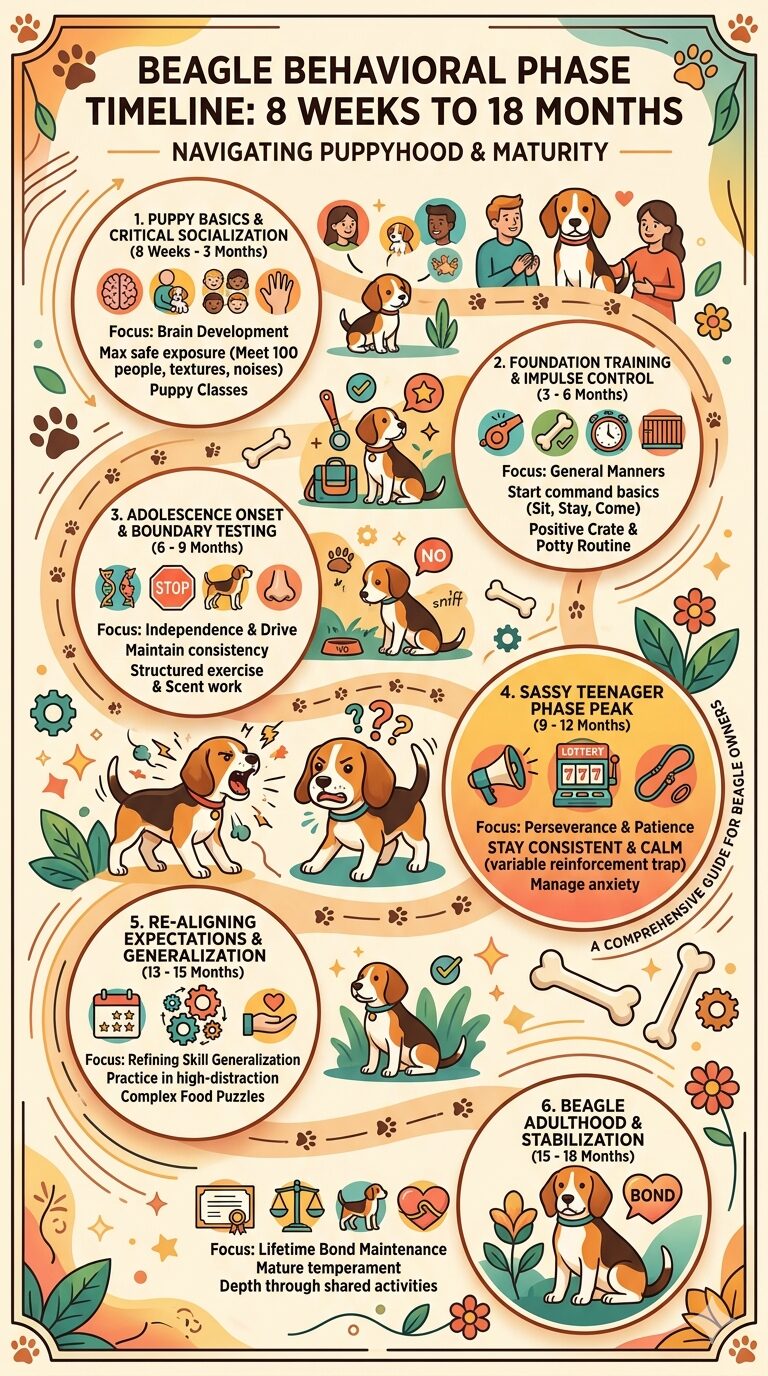 If you got your Beagle puppy at eight weeks and the first few months were relatively smooth — and then somewhere around five to seven months, they seemed to become a completely different dog — you've met the sassy teenager phase. It is real, it is documented, and it is temporary.
Research published in 2023 by Owczarczak-Garstecka and colleagues confirmed that adolescent dogs go through a genuine neurological and hormonal transition — typically between six and eighteen months — during which their responsiveness to previously learned cues reduces, their drive toward independent exploration increases, and their arousal baseline rises. This is not your Beagle being difficult. It is a developmental stage, as predictable as teething and as temporary as it.
Why the sassy phase hits Beagles particularly hard:
Beagles were bred for one thing. Following a scent to its source, independently, persistently, and joyfully. Their neurological wiring rewards independent nose-following more than almost any other behavioral pathway. In adolescence, when the inhibitory systems in the brain are simultaneously weakened by hormonal flux, you get a dog that is absolutely compelled by every interesting smell, has reduced bandwidth for deferring to your recall, and is experiencing it all as utterly wonderful.
The signals that make it worse:
- Repeating cues the dog isn't responding to, which teaches them that cues are optional.
- Punishing the independence-seeking, which adds stress to an already aroused nervous system.
- Giving up on training and walks because "they won't listen anyway" — precisely the structured activity that helps the adolescent brain regulate.
The signals that help:
- Acknowledging the phase internally and adjusting expectations temporarily.
- Keeping training sessions very short, very rewarding, and heavily food-based.
- Using the Beagle's nose as a training asset rather than a behavioral enemy — scent-based enrichment and nose work games channel the drive constructively.
- Staying consistent, even when it feels pointless. Consistency during the chaos is what produces the stable, responsive adult dog on the other side.
Beagle Attention-Seeking Fixes
When Our Responses Teach the Wrong Lesson
Beagle attention-seeking behavior — the whining, the pawing, the theatrical howling at closed doors — is usually completely trainable. But it requires understanding something counterintuitive: every time we respond to the demanding behavior, even to tell them to stop, we are reinforcing it.
Your Beagle's attention-seeking brain works on a simple equation: does this behavior produce attention? If yes, even occasionally, keep doing it. Intermittent attention is actually more reinforcing than consistent attention, because it teaches the dog that if they persist long enough, the reward eventually comes.
The daily signals that accidentally fuel attention-seeking in Beagle puppies:
- Looking at the whining puppy, even with a "shh."
- Picking them up when they paw at your legs.
- Giving a treat or toy to "distract" them from the demanding behavior — this is direct reinforcement of the demand.
- Any response — including frustration — to the howling at the door.
Beagle attention-seeking fixes that work:
- Structured ignore. When attention-seeking starts, turn your back, leave the room if possible, and do not return until there has been a pause of at least ten seconds of quiet. Return calmly, with minimal fuss.
- Pre-emptive connection. Give your Beagle ten minutes of focused, calm attention before you need to work or be unavailable. This fills their connection tank before the demand begins.
- Reward the settle. Keep a small handful of treats in your pocket during work-from-home periods. Every time your Beagle settles on their bed without requesting attention, mark it quietly and drop a treat near them without making eye contact. You're reinforcing independence.
- Teach a "place" cue. A reliable place or bed behavior gives your Beagle an alternative to attention-seeking as a strategy for getting good things. Shape this with patience — ten short sessions over a week — and it pays dividends for years.
For a broader picture of Beagle behavior and what drives it, Complete Guide to the Beagle provides the foundational breed understanding that makes all these fixes more intuitive.
Beagle Destructiveness Causes
What Under-Stimulation Looks Like in a Beagle Brain
A chewed chair leg, shredded newspaper, excavated garden. Destructive chewing in Beagle puppies is almost never about spite or misbehavior as we understand it. It is almost always about cognitive and sensory under-stimulation in a breed whose brain is built to be continuously, actively engaged with the environment.
How Beagle destructiveness develops — the owner signals chain:
- Beagle puppy is left for three or more hours without enrichment.
- Arousal builds. The need to investigate, chew, and engage with the environment increases.
- The sofa cushion, the chair leg, the rug — these become the enrichment.
- The chewing self-rewards (it's physically satisfying for a dog), which increases the probability of repetition.
- Owner returns and corrects the Beagle after the fact. The Beagle doesn't connect the correction to the behavior (the gap is too long).
- The chewing continues; the owner-correction adds stress without removing cause.
Practical daily signals that prevent beagle destructiveness:
- A frozen Kong or lick mat with part of the daily meal before any alone time. This provides twenty to forty minutes of active, satisfying, constructive chewing at the exact moment unsupervised access begins.
- Rotate chew options — bully sticks, raw bones (vet-approved), rubber toys — so novelty is maintained. Novelty is enrichment.
- Do not punish after the fact. The Beagle does not have the capacity to connect a correction to a behavior more than a few seconds old. All after-the-fact correction does is create a dog that is anxious around you when things have been chewed.
- Manage the environment before the behavior. Puppies chewing inappropriate items is, at its core, an environmental management failure, not a training failure.
The Beagle Behavior Guide includes further guidance on how enrichment intersects with Beagle feeding behavior — a natural pairing for scent-driven daily care.
Beagle Unruliness and Lead-Pulling
Daily Signals That Shape Walk Behavior
Beagle unruliness on walks — pulling, weaving, sudden stops, complete disregard for the "heel" concept — is one of the most common frustrations reported by first-time Beagle puppy parents. And it is one of the most directly owner-signal-driven problems in the breed.
Beagles were bred to put their nose down and follow it. They are not ignoring you on walks. They are doing exactly what their entire evolutionary history has trained them to do, in an environment that is absolutely saturated with olfactory information. The signal that creates the pulling problem is simple: every time pulling moves them closer to the interesting smell, pulling is reinforced.
Beagle unruliness disobedience tips that address the root signal:
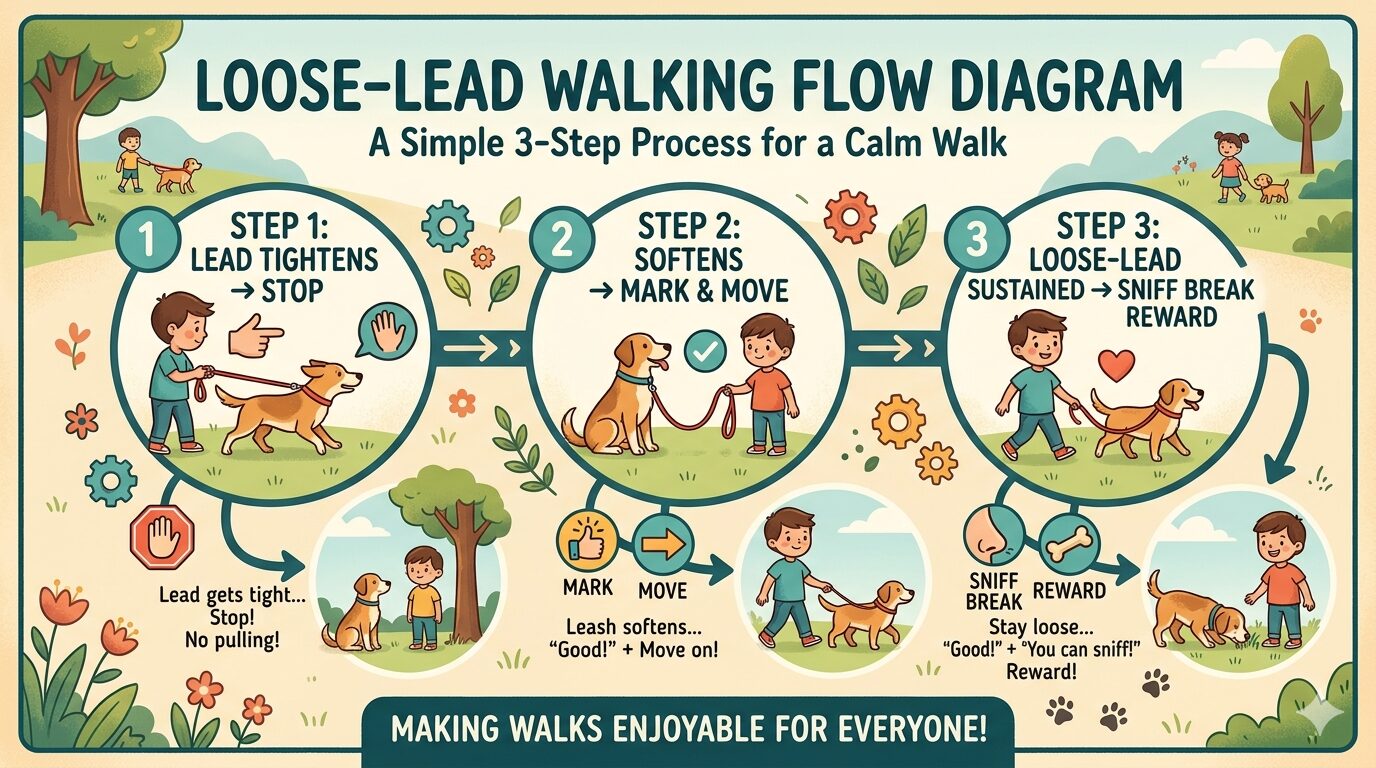
- Stop the moment the lead tightens. Every step you take on a tight lead is one more reinforcement of pulling. Stand still. Wait. The second the lead softens, move forward. The lesson. Lead tension stops progress; a loose lead earns it.
- Change direction unpredictably. Becoming less predictable on walks keeps your Beagle's attention on you rather than the environment. When they don't know where you're going, they watch you more.
- Use sniff breaks as rewards, not distractions. Cue "go sniff" when the lead is loose, and let them investigate freely for thirty seconds. This teaches the Beagle that loose-lead walking is the key that unlocks the sniffing — rather than pulling being the only strategy.
- Train recall separately, in high-distraction environments. Recall practiced only in the back garden will not transfer to the park. Beagle recall requires practice on real smells, at real distractions, with rewards that genuinely compete with the environment.
Beagle Escaping and Truancy
Understanding the Scent Drive and Our Role In It
A Beagle that has found a way out — under the fence, through the gate, over the wall — and followed a scent trail for twenty glorious minutes before being retrieved has experienced one of the most neurologically rewarding events available to their species. The probability of them trying again is very high.
Beagle escaping truancy and scent-driven prevention is one area where the owner-signal chain is unusually visible. Escapes don't happen in a vacuum. They happen because an opportunity existed, and because the Beagle had previously learned — through rehearsal — that the opportunity leads to reward.
The owner signals that enable truancy:
- Fence or gate conditions that haven't been checked since the puppy arrived and was small enough to squeeze through gaps that are now a habit.
- Recall that was trained in the garden but never practiced under genuine olfactory distraction.
- Allowing early self-directed roaming ("just in the front garden for a minute") that rehearsed the escape-and-explore pattern before it was a problem.
Prevention signals to build now:
- Audit every exit point in your garden monthly. Focus on: dig-unders at fence bases, gate latches, gaps at ground level. Beagles are more motivated escape artists than almost any breed, and they will invest sustained effort into a known weak point.
- Practice recall using high-value rewards — real meat, strong cheese — that can compete with the smell of whatever is on the other side of the fence. Practice this in increasingly distracting environments, not just at home.
- Never allow unsupervised garden access until recall is reliably established under distraction.
- If your Beagle has already established an escape habit, management is your primary tool while you rebuild recall: secure the environment first, then build the training.
Early Aggression Signs in Beagle Puppies
Catching It Before It Grows
Aggression in Beagle puppies is not a common presenting problem — Beagles are generally a friendly, sociable breed. But early signs of resource guarding, snapping when handled, or reactivity toward other dogs do occur, and they are almost always addressable when caught early and managed without the owner responses that escalate them.
The owner signals that inadvertently escalate early aggression:
- Punishing growling, which removes the warning signal without addressing the anxiety that produced it.
- Reaching into the food bowl or toy space without building a positive association first, which increases guarding anxiety over time.
- Pushing through early signs of discomfort during handling — ear checks, nail trims, vet examinations — without sufficient positive conditioning, which teaches the puppy that resisting is necessary.
Beagle aggression owner prevention — early signals to build instead:
- Handle your Beagle puppy's ears, paws, mouth, and body from day one, pairing every touch with a treat. This builds a positive association with handling that protects against fear-based defensiveness later.
- Approach the food bowl with additional treats, consistently, until your Beagle looks up at you approaching the bowl with anticipation rather than stiffening.
- If you see a growl, stop what you're doing, note the context, and seek guidance. A growl is information, not disobedience. Do not punish it.
- Socialisation during the critical developmental window — before sixteen weeks, with as many positive exposures to people, dogs, children, and environments as possible — is the single most protective factor against fear-based aggression development.
For detailed daily care routines that support confident, calm Beagle development, The Nose Knows — structured enrichment plan for Beagles provides a complete enrichment framework.
Abnormal Ingestive Behavior in Beagle Puppies
Scavenging, Fast Eating, and Food Anxiety
Beagles are legendarily food-motivated, legendarily nose-driven, and legendarily willing to consume things that are neither food nor intended for them. Abnormal ingestive behavior — rapid eating, scavenging, food guarding, eating non-food items — appears frequently in the breed but is substantially shaped by owner feeding habits and environment management.
The daily owner signals that amplify food-related misbehavior:
- Irregular feeding schedules that create uncertainty about when food will arrive, reinforcing anxiety-driven rapid eating and food-seeking.
- Leaving accessible bins, food on counters, or unmanaged table scraps that repeatedly reward scavenging — teaching the Beagle that the human environment is a reliable food source worth persistent investigation.
- Feeding in high-arousal states (after an exciting walk, during play) that pair eating with agitation rather than calm.
- Free-feeding (leaving food available all day), which for food-focused Beagles often increases food-fixation rather than resolving it.
Practical daily care signals that help:
- Two to three meals per day at consistent times. Predictability is the most effective anti-anxiety feeding tool available.
- Use a slow-feeder bowl or scatter feeding on a lick mat for Beagle puppies who eat rapidly — this extends the eating experience, improves digestion, and provides cognitive engagement simultaneously.
- Manage the environment ruthlessly: bins with locking lids, counters cleared, dining area closed off when unsupervised. Environmental management is more reliable than behavioral correction for scavenging.
- Use the Beagle's extraordinary food motivation as a training resource. Portion ten percent of every day's food ration for training and enrichment activities rather than serving it all in the bowl.
Beagle Separation Anxiety Remedies for New Owners
The Habits That Help or Harm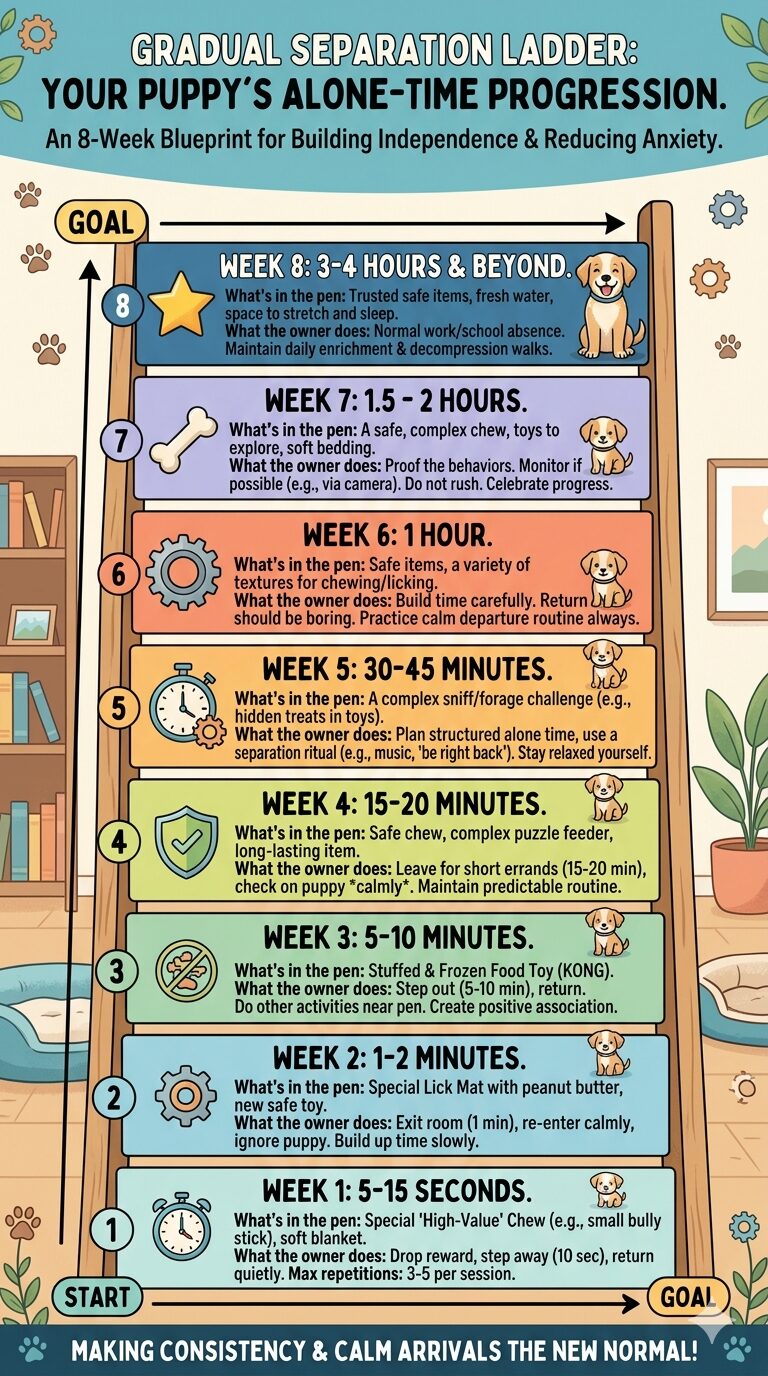
Of all the behavioral challenges Beagle owners face, separation anxiety and fear produce the most owner distress — because the sounds of a distressed Beagle are difficult to ignore and even harder to respond to correctly.
Separation anxiety in Beagle puppies is predominantly shaped by owner habits in the first few weeks of placement. The foundation of healthy independence is built — or not built — early.
The owner signals that unintentionally create separation anxiety:
- Constant physical contact in the first weeks: carrying the puppy everywhere, never allowing calm independent time, sleeping in direct contact every night. This teaches the Beagle that your presence is the baseline state of existence — and your absence becomes neurologically dysregulating.
- Emotional departures: long goodbyes, worried faces, baby-talk apologies before leaving. Every emotionally significant departure communicates that leaving is a distressing event.
- Returning to a crying puppy: every time you come back while the distress vocalisation is occurring, you are reinforcing vocalization as the effective strategy for producing your return.
Beagle separation anxiety remedies — the gentle, daily habits:
- Begin very short positive separations from day one: one minute with a frozen Kong in a pen or crate, calm return before anxiety builds. Extend duration incrementally — two minutes, then five, then ten — over days and weeks, never in large jumps.
- Calm, matter-of-fact departures and arrivals. No drama in either direction. Within two weeks of consistent practice, the emotional charge around your comings and goings begins to reduce measurably.
- Build independence as a daily practice: periods of quiet time on a bed or in a pen with enrichment, door closed or baby gate across, integrated into every single day — even days you're home.
- If your Beagle puppy is already showing significant distress at any alone time, early guidance from a qualified behaviourist produces much faster and more durable results than extended owner trial and error.
Building Bonds With Beagle Puppies Through Positive Reinforcement
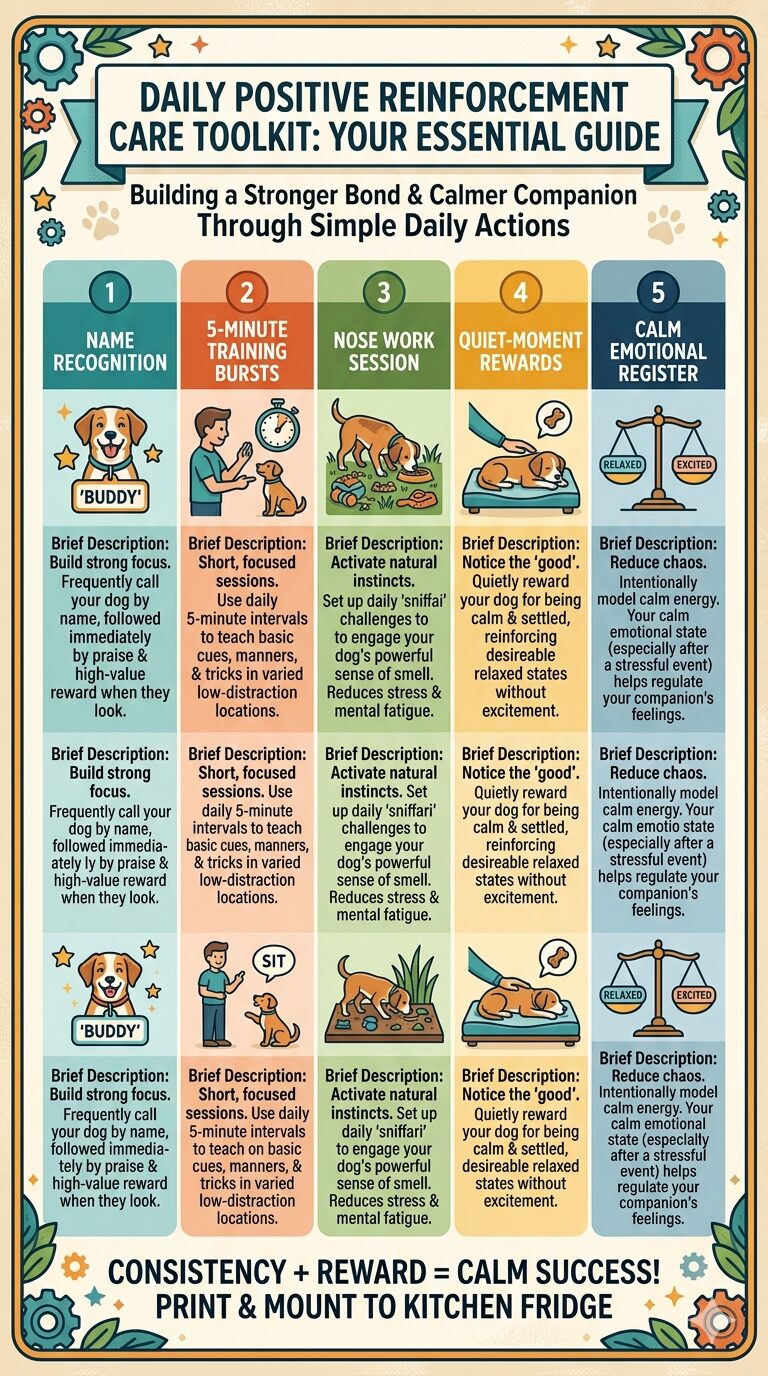
Your Daily Care Toolkit
Positive reinforcement is not just a training method for Beagles — it is the primary language through which you build your bond, earn their attention in a world full of competing smells, and create the mutual trust that makes everything else possible.
Beagles are motivated by food and by their nose. Both of these are extraordinary assets in positive reinforcement training. Here's how to use them every day:
Your daily positive reinforcement toolkit for building bonds with beagle puppies:
- Name recognition first. Say your Beagle's name once, in a warm tone, and the instant they look at you, reward immediately with a high-value treat. Ten repetitions daily, three times a day, for the first two weeks. Name recognition is the foundation of everything — recall, attention, relationship.
- Five-minute training bursts, multiple times daily. Beagle puppies have short attention spans and high food motivation. Five minutes of focused, rewarded training three or four times daily outperforms a thirty-minute session in both retention and enthusiasm. Keep sessions ending while they're still engaged.
- Nose work as bonding time. Hide a treat in a cardboard box, let your Beagle find it. Progress to hiding treats around a room, then outdoors. Nose work engages the Beagle brain so completely that ten minutes of it provides the cognitive equivalent of a much longer physical exercise session — and does it through play with you.
- Mark and reward the quiet moments. Throughout your day, notice your Beagle being settled, calm, not demanding attention — and quietly, warmly reinforce it. You are building the behavioral template for the adult dog you want.
- Keep the emotional register calm. Beagle puppies learn best in a calm, consistent, positive emotional environment. High excitement, frustration, or punitive responses all increase arousal, which reduces learning bandwidth. The calmer you are, the faster they learn.
As both the University of Lincoln's 2026 research and years of owner experience confirm: the relationship you build through daily positive reinforcement — consistent, patient, genuinely attuned to your Beagle's needs and communication — is the single most protective factor against behavioral problems. Not special equipment, not advanced techniques. Just you, showing up the same way, every day, with warmth and clarity.
 EXPERT INSIGHT
 EXPERT INSIGHT
From a Beagle Owner and Canine Enrichment Specialist
"The most underestimated tool in the new Beagle owner's kit is also the cheapest one: the daily sniff walk. Not an exercise walk. A sniff walk — ten to fifteen minutes where your Beagle leads, you follow at a loose lead, and they are allowed to investigate every smell at whatever pace they need. No agenda, no direction, no rushing.
I recommend this to every first-time Beagle parent because it does three things simultaneously that expensive enrichment toys and training classes often can't replicate. First, it depletes cognitive arousal — the mental energy of scent processing is so high that a fifteen-minute sniff walk produces more genuine tiredness than a thirty-minute brisk walk. Second, it reinforces loose-lead behavior naturally, because the Beagle learns over time that the loose lead is the key to the sniff experience. Third, and perhaps most importantly, it builds the bond through shared experience on the dog's terms. You are communicating, in the clearest behavioral language available, that you understand what your Beagle needs — and that you're willing to provide it.
In practice, Beagle owners who build sniff walks into their daily routine report measurably lower rates of destructive chewing, less attention-seeking behavior in the evenings, and significantly better recall development — because the dog has learned that following your direction leads to sniff opportunities rather than away from them. It sounds simple because it is. The best behavioral tools usually are."
 FAQ
FAQ
 FAQ
FAQ1. Why does my Beagle puppy seem to completely ignore me on walks?
Your Beagle isn't ignoring you — they're processing olfactory information at a level that genuinely competes with your presence as the most interesting thing in the environment. The solution is to become more rewarding than the smell: use high-value treats (real meat or cheese), change direction unpredictably to keep their attention on you, and reward loose-lead moments with "go sniff" cue access. Recall practiced only at home won't transfer — train it in increasingly distracting real-world environments.
2. My Beagle puppy whines and howls constantly when I leave the room. What am I doing wrong?
This is most commonly the result of constant-contact early care — if your puppy has never experienced calm alone-time with a positive association, your absence feels genuinely dysregulating. Begin very short, positive separations immediately: one minute with a high-value frozen Kong, calm return before distress begins. Extend duration incrementally. The sooner this training begins, the faster the results.
3. Is it normal for Beagle puppies to eat absolutely everything — including non-food items?
Scavenging and item-mouthing are normal puppy behaviors amplified in Beagles by their extraordinary scent drive. Environmental management is the primary tool: puppy-proof rigorously, use locking bins, and ensure your Beagle has appropriate chew outlets available. Eating non-food items (pica) can have medical causes — if it persists beyond environmental management, a veterinary check is warranted.
4. How do I stop my Beagle puppy from escaping the garden?
Audit every exit point and secure all of them before establishing any outdoor access. Beagles are persistent and motivated escape artists — a gap that was too small at three months is achievable at six. Simultaneously build recall using high-value rewards in increasingly distracting environments. Never allow unsupervised garden access until recall is reliable under genuine distraction.
5. At what age does the sassy teenager phase start in Beagles — and when does it end?
The adolescent phase typically begins between five and seven months in Beagles and resolves between fifteen and eighteen months, with individual variation. Owners who apply consistent positive management throughout the phase — maintaining training and exercise, not escalating to punishment, staying consistent with rules — typically find their Beagle emerges with stronger responsiveness and a more settled temperament than before the phase began.
6. My Beagle puppy growls over food. Should I correct this?
Do not punish the growl — it is a communication signal, not defiance. Punishing the growl removes the warning without addressing the anxiety that produced it, which frequently leads to biting without warning. Instead, approach the food bowl consistently with added high-value treats, building a positive association with your proximity during eating over days and weeks. If guarding is significant, a qualified behaviourist's guidance is the fastest and safest path to resolution.
7. How much exercise does a Beagle puppy need to prevent destructive behavior?
Physical exercise is important, but cognitive stimulation is equally — sometimes more — necessary for Beagles. A fifteen-minute sniff walk provides more genuine tiredness than a thirty-minute brisk walk for this scent-driven breed. For puppies under six months, exercise should be modest (five minutes per month of age, twice daily) to protect developing joints, with cognitive enrichment — frozen Kongs, scatter feeding, nose work — compensating for limited physical output.
8. Can I prevent Beagle separation anxiety before it develops?
Yes, and the earlier you start, the more effective the prevention. Brief, positive separations beginning in the first week of placement — one to two minutes with enrichment, calm return, gradual extension — build the independence tolerance that prevents full separation anxiety from developing. Calm, matter-of-fact arrivals and departures (no emotional goodbyes) and daily independent time as a routine — even when you're home — are the three most impactful preventive habits.
9. My Beagle puppy pulls relentlessly on the lead regardless of what treat I use. Why isn't it working?
The most common reason positive reinforcement lead training stalls is inconsistency: if pulling ever moves the dog forward, even occasionally, the behavior is maintained by that intermittent reward. Every single instance of lead tension must result in a complete stop, every time, by every person who walks the dog. Additionally, the treat value must genuinely compete with the environmental smells — most commercial treats are not high-value enough for Beagle lead work. Use real cooked chicken, cheese, or sausage.
10. Is it too late to change my Beagle's problem behaviors if they're already six months old?
No. Most behavioral problems in dogs respond to consistent positive management at any age, and six months is early in the developmental arc. The adolescent phase you're entering is actually an opportunity: the brain is more plastic during this period than at many other points. Consistent positive reinforcement, environmental management, and — where needed — qualified behavioural support can produce meaningful behavioral change at any age. The earlier you start, the faster the results; but starting later is always better than not starting.
CONCLUSION
Three things are worth remembering as you close this guide and go back to your wonderfully scent-obsessed, nose-first, occasionally chaotic Beagle puppy. First, the "naughty" behavior you're seeing is almost always a response to the signals and environment you've been providing — which is good news, because you can change both. Second, the sassy teenager phase is temporary, neurologically real, and survivable with consistent positive management and realistic expectations. Third, the daily care habits you build now — calm separations, consistent rules, scent-based enrichment, patient positive reinforcement — are the foundations of the confident, bonded, happy adult Beagle that your puppy is already becoming.
Within the Training and Behavior space, the most consistent finding for Beagle owners is this: empathy and consistency, applied every day, produce more behavioral transformation than any training technique applied sporadically. Your Beagle doesn't need you to be perfect. They need you to be predictable, warm, and present.
That you're here, reading this, already says everything about the kind of owner you're committed to being. Your puppy is very lucky.
 CALL TO ACTION
 CALL TO ACTION
Your next step is understanding your Beagle's nature at its fullest — because the more you understand them, the more intuitive these daily signals become. Complete Guide to the Beagle is the place to start. It provides the foundational breed knowledge that makes every behavior in this guide make more sense. When you're ready to go deeper on enrichment — the most powerful daily care tool for a scent-driven breed — The Nose Knows gives you a complete, structured plan tailored to your Beagle's needs. Your puppy's best life is built one small, consistent daily habit at a time. You've already started.