
The Nose Knows
Why Your Beagle Needs a Structured Enrichment Plan
Understanding the Beagle's extraordinary scent drive — and building a daily plan that puts it to work
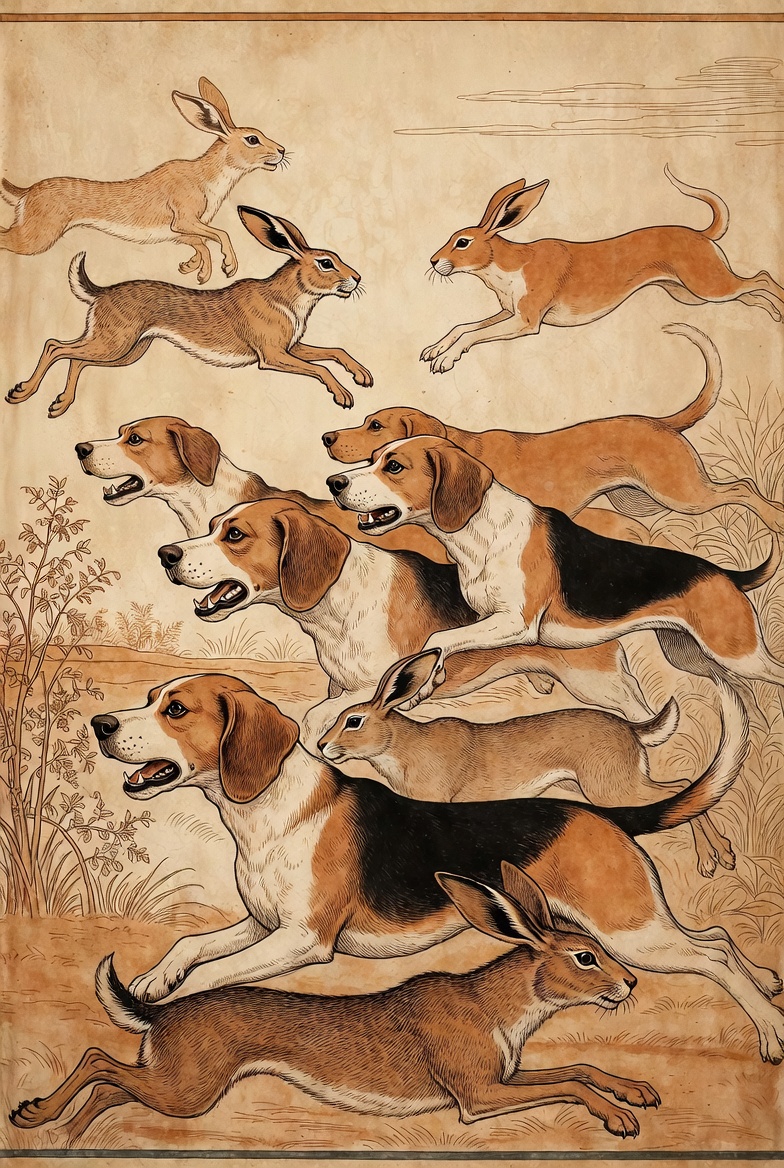 It starts with a smell. Something — a rabbit perhaps, or a neighbour's braai, or a scent trail left by a jogger three hours ago — drifts across the garden on a light breeze. Your Beagle's nose twitches once. Their head drops. And then they are gone — body low, ears fanned forward, tail raised, utterly and completely oblivious to everything you are saying behind them.
This is not disobedience. This is not stubbornness. This is a Beagle doing exactly what 2,000 years of selective breeding has prepared them to do — and doing it with breathtaking competence.
The Beagle is one of the oldest scent hound breeds in the world. Developed in England to hunt hare and rabbit, they were bred to work in packs across open countryside for hours at a time, following cold trails through dew-wet grass by nose alone. That nose — capable of detecting over 220 million scent receptors compared to a human's 5 million — is not merely a physical feature. It is the lens through which a Beagle experiences the entire world.
At Tamboeckey Beagles, we have been watching what separates Beagles who are genuinely content from those who are not. The answer, every single time, is the same: whether their nose has been given somewhere productive to go. A Beagle whose scent drive is channelled, stimulated, and satisfied is a relaxed, friendly, trainable companion. A Beagle whose scent drive has nowhere to go is a howling, escaping, furniture-dismantling force of nature.
An enrichment plan is not a luxury for this breed. It is the foundation of a liveable, loving relationship. This article explains why — and shows you exactly how to build one, with the help of the Tamboeckey Beagles Enrichment Planner, our free interactive tool designed specifically around the Beagle's unique needs.
1. Two Thousand Years of Nose
Understanding the Beagle's Heritage
1.1 Born to Track
The word 'Beagle' most likely derives from the Old French word 'be'geule', meaning 'open throat' — a reference to the breed's distinctive musical bay, used to alert hunters to a found trail. The breed's history in England is documented as far back as the 1400s, though hound-type dogs of similar description were recorded in Ancient Greece. By the reign of Elizabeth I, small pack beagles were fashionable among the English aristocracy, small enough to be carried in a saddlebag but tenacious enough to follow a scent trail for an entire day.
What centuries of hunting selection produced is a dog of extraordinary single-mindedness. The Beagle was not bred to look to a handler for instruction in the way a Border Collie or German Shepherd was. They were bred to find a scent, commit to it, and follow it — independently, persistently, and with joyful determination — until the quarry was located or the trail went cold.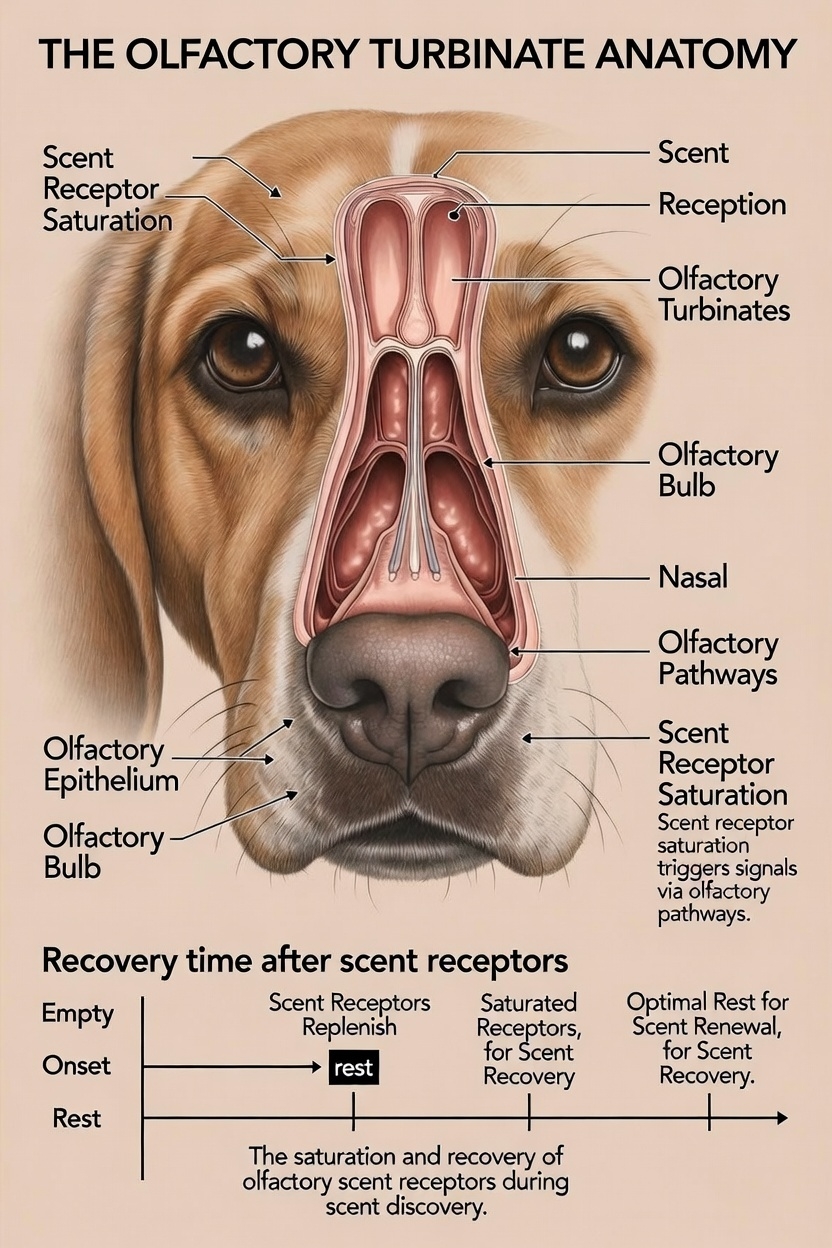
Understanding this heritage is not academic. It is the single most important piece of context for understanding every aspect of Beagle behaviour: the howling, the nose-down wandering, the apparent selective deafness, the fence-testing, the garbage-raiding. Every one of these behaviours is a direct expression of the same underlying drive: the need to find, follow, and work a scent.
1.2 The Beagle’s Nose- An Extraordinary Instrument
The domestic dog's sense of smell is remarkable across the board, but scent hound breeds — and Beagles in particular — represent an extreme even within that remarkable spectrum. The Beagle's olfactory system is so refined that they have been employed by the United States Department of Agriculture's Beagle Brigade to detect agricultural contraband at international airports since 1984, a role they continue to perform with extraordinary accuracy today.
What makes the Beagle's nose exceptional is not just the number of scent receptors but the architecture of their olfactory processing system. A Beagle's brain devotes a significantly larger proportion of its neural real estate to scent processing than most other breeds. Scenting is not something a Beagle does with their nose — it is something they do with their entire being.
| Research Insight: A study published in the Journal of Comparative Psychology found that Beagles could track a human scent trail laid six hours earlier with over 90% accuracy in field conditions. The same dogs, when denied scent-based activity for 48 hours, showed measurable increases in cortisol levels, stereotypic behaviour, and vocalisation — direct markers of psychological stress. |
1.3 The Independence Factor
One of the qualities that makes the Beagle simultaneously wonderful and challenging to live with is their independence. Unlike herding breeds — who were developed to work in close partnership with a human handler, constantly checking in, responding to signals, seeking direction — the Beagle was developed to work
away from the handler, following their own nose, making their own decisions about which trail to follow and at what pace.
This independence is not a character flaw. It is a design feature. But it has profound implications for enrichment. A Beagle who is given a task to do — a scent to follow, a hide to find, a trail to work — will apply themselves to it with extraordinary focus and perseverance. A Beagle who has no task will apply that same focus and perseverance to finding their own entertainment, which is rarely aligned with their owner's preferences.
The goal of enrichment for a Beagle is not to tire them out. It is to give that magnificent, independent, scent-driven mind a legitimate job to do every single day.
2. The Beagle Voice
Understanding — and Working With — the Bay
2.1 Why Beagles Howl
Few aspects of Beagle ownership generate more neighbour complaints, more sleepless nights, and more owner frustration than the bay. The Beagle's voice — that deep, melodious, carrying howl — is not a malfunction. It is one of the breed's most ancient and purposeful features.
Pack hounds on a trail used vocalisation to communicate with each other and with their handlers across distances and through dense cover. The bay served three distinct functions: announcing a found trail, maintaining contact with the pack, and signalling the location of quarry. Generations upon generations of selective breeding reinforced dogs who bayed loudly, clearly, and freely. Silence on a trail was not a virtue in a pack hound — it was a liability.
In a suburban home, this same drive expresses itself in ways the neighbourhood finds considerably less charming. A Beagle left alone, understimulated, or frustrated — or who has simply caught a compelling scent through the window — will bay. Loudly. At length. With impressive commitment.
2.2 Enrichment as the Answer to Nuisance Vocalisation
The most important thing to understand about Beagle vocalisation is that punishment does not work, and the reason it does not work is straightforward: the behaviour is not disobedience, it is the expression of an unmet need. Addressing it with correction without addressing the underlying need is the equivalent of putting a plaster over a structural crack.
What does work — reliably, sustainably, and without damaging the dog's trust or confidence — is enrichment. Specifically, enrichment that satisfies the scent drive deeply enough that the dog reaches the natural end of a foraging or tracking cycle and settles willingly. A Beagle who has worked a scent trail, found their reward, and completed the hunting sequence, is a Beagle who is genuinely ready to rest.
Beyond this general principle, there is a specific and highly effective technique worth highlighting:
2.3 Teaching 'Speak' and 'Quiet' on Cue
It sounds counterintuitive, but teaching a Beagle to bark and howl on command is one of the most effective ways to reduce nuisance vocalisation. Here is why: by putting the behaviour on cue, you bring it under stimulus control. The dog learns that vocalisation earns a reward when asked for, and earns nothing — or earns a clear, calm 'quiet' signal — at other times. The behaviour does not disappear, but it becomes directed, manageable, and purposeful rather than indiscriminate.
The 'speak' and 'quiet' exercise is included as a selectable activity in the Tamboeckey Beagles Enrichment Planner specifically for this reason. Owners who include it consistently in their daily plan report a meaningful reduction in unprompted vocalisation within two to four weeks.
| The Tamboeckey Principle: A Beagle's bay is not a problem to be eliminated — it is a communication to be understood and channelled. An enrichment plan that gives the voice a legitimate outlet and teaches vocal cues gives owners genuine management tools while respecting the dog's nature. |
3. What Beagle Enrichment Actually Looks Like
3.1 The Five Dimensions — and Why Scent Dominates
All dogs benefit from enrichment across five broad categories: cognitive, sensory, physical, instinct-based, and social. For most breeds, these five dimensions sit in rough balance. For the Beagle, the balance looks quite different.
Sensory enrichment — specifically scent-based enrichment — and instinct enrichment — specifically tracking and foraging — are not merely 'one of five' for a Beagle. They are the lens through which every other category of enrichment is experienced. A physical walk that includes nose-led sniffing is exponentially more enriching than the same walk at a fast, nose-up pace. A training session that incorporates scent discrimination holds a Beagle's focus far longer than one built around visual cues alone. Scent is not a department of the Beagle's experience. It is the operating system.
A well-designed Beagle enrichment plan therefore weights scent-based activities heavily — not to the exclusion of other categories, but as the thread that runs through all of them.
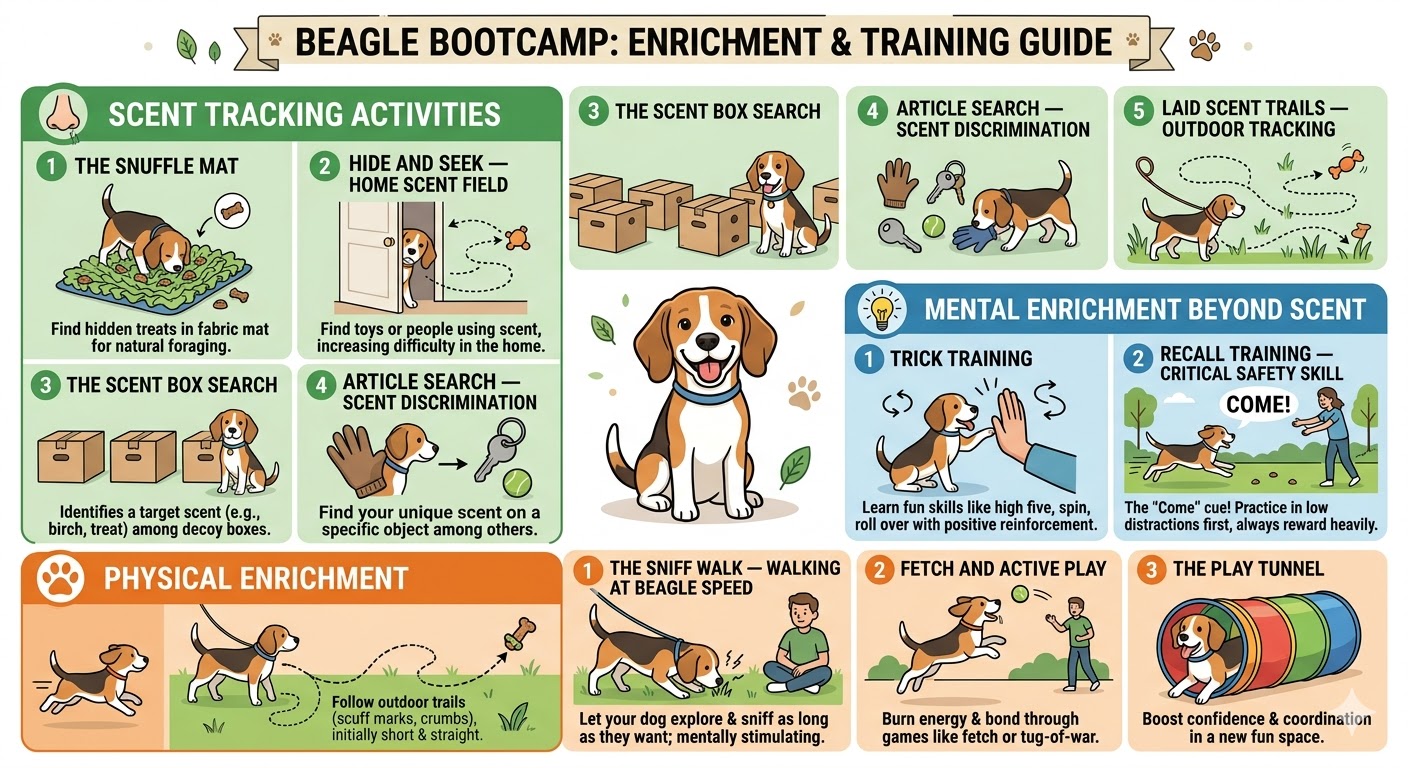
3.2 Scent Tracking Activities
3.2.1 The Snuffle Mat
The snuffle mat — a rubber mat threaded with strips of fabric in which food is hidden — is the simplest and most universally accessible scent enrichment tool available. It transforms a meal from a thirty-second bowl-emptying exercise into a ten to fifteen minute foraging session that engages the dog's nose, slows their eating (significantly reducing bloat risk), and provides genuine psychological satisfaction.
For Beagle puppies and dogs new to enrichment, the snuffle mat is the ideal starting point. The task is achievable, the reward is immediate, and the experience of 'working' for food through scent lays the neurological groundwork for more complex scent activities later.
3.2.2 Hide and Seek — Treating the Home as a Scent Field
The Beagle's nose does not need fields and countryside to find expression. A family home, approached correctly, offers a rich and ever-changing scent environment. Hiding small amounts of food in increasingly complex locations — under a cushion, behind a plant pot, tucked inside a rolled-up towel — allows the dog to work systematically through the space using their nose exactly as they would work a field.
The key is to begin with easy hides that build confidence and momentum, then progressively increase the difficulty as the dog becomes more adept. Experienced Beagles can search an entire floor of a house for six to eight hidden treat locations, working methodically and with extraordinary concentration, for fifteen to twenty minutes.
3.2.3 The Scent Box Search
Place eight to ten cardboard boxes or containers of varying sizes around a room. Hide a treat in one of them. Ask your Beagle to 'find it'. Watch what happens.
The scent box search is a formal nose work foundation exercise that teaches the dog to work systematically, check each container independently, and indicate clearly when they have found the target. It can be progressed to include multiple hides, elevated containers, outdoor environments, and eventually formal scent discrimination — teaching the dog to identify a specific scent target among several distractors.
3.2.4 Article Search — Scent Discrimination
Place a piece of cloth or fabric that has been handled (and therefore carries your scent) among several identical unscented items. Ask your Beagle to 'find yours'. This exercise — a foundation of formal competitive nose work and tracking — taps directly into the Beagle's most sophisticated scenting capability and is one of the most cognitively demanding activities available.
Beagles who progress to regular article search work often display remarkable focus, patience, and problem-solving ability that surprises owners who have never seen their dog operate in their true element before.
3.2.5 Laid Scent Trails — Outdoor Tracking
For owners with access to a secure outdoor space, laid scent trails represent the pinnacle of Beagle scent enrichment. A trail is created by dragging a scented object — a cloth soaked in food or a treat bag — across the ground in a route of increasing length and complexity, with the scented reward placed at the end.
The Beagle is introduced to the start of the trail on a long line and follows their nose to the reward. As their skill develops, trails can be aged (laid thirty minutes, an hour, several hours before the search), crossed (intersecting with other trails to test discrimination), and extended across varied terrain.
Long line trailing is included in the Tamboeckey Beagles Enrichment Planner as a selectable activity for owners who have a tracking lead available. It represents the most direct expression of what the Beagle was bred to do, and the satisfaction it provides is profound and immediate.
3.3 Mental Enrichment Beyond Scent
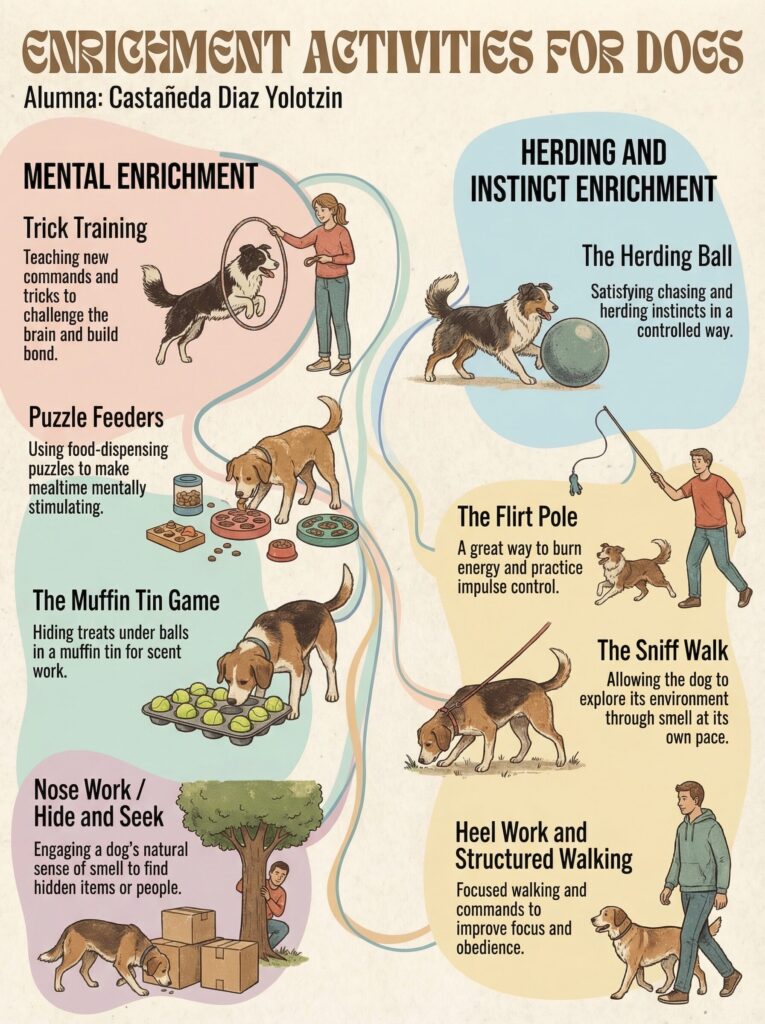
 3.3.1 Trick Training
 3.3.1 Trick Training
Beagles are food-motivated to an extraordinary degree — a quality that makes them genuinely excellent training subjects when that motivation is correctly harnessed. Short, high-energy trick training sessions with small, high-value treats can hold a Beagle's attention remarkably well and build the impulse control and handler focus that makes every other aspect of ownership easier.
The key word is short. Beagle attention in a training context is intense but time-limited. Five to ten focused minutes with genuine enthusiasm and clear rewards will outperform thirty minutes of diminishing returns every time. End every session while your Beagle is still eager — always leave them wanting more.
Priority commands for the Beagle are: recall (non-negotiable), leave it, wait, and sit-stay. These are not merely tricks — they are safety commands for a breed whose scent drive can override their road sense without warning.
3.3.2 Recall Training — The Beagle's Most Important Life Skill
No enrichment discussion for the Beagle breed is complete without a dedicated focus on recall. A reliable recall is not optional for a Beagle — it is the difference between a dog who can enjoy the world and one who cannot safely be let off a lead at all.
Recall must be trained as a separate, specific skill with the highest-value rewards available and practised daily in controlled, safe environments. The foundational principle is simple: coming to you must always be the most rewarding option available. If your Beagle has ever come to you and found the experience less rewarding than following a scent trail, their recall will erode. If they have always found it more rewarding, it will hold — even, eventually, against a compelling trail.
Recall training is included in the Tamboeckey Beagles Enrichment Planner as a selectable daily activity, and we consider it one of the most important sessions in any Beagle's day.
3.4 Physical Enrichment
3.4.1 The Sniff Walk — Walking at Beagle Speed
The single most impactful change most Beagle owners can make to their dog's daily routine is also the simplest: slow down on walks and let the nose lead. A thirty-minute walk at the Beagle's pace — stopping to investigate every interesting smell, following their nose rather than your route — is neurologically equivalent to a ninety-minute brisk walk in terms of the mental and physical satisfaction it provides.
Designate at least one walk per day as a sniff walk, where your Beagle sets the pace and the agenda within the bounds of their lead. The difference in their demeanour before and after such a walk — the visible release of tension, the satisfied tiredness — is usually immediately apparent.
3.4.2 Fetch and Active Play
While the Beagle is not a retriever by instinct, many enjoy fetch games, particularly when the toy is 'scented' (rubbed with food or a familiar smell) to make the find more rewarding. Fetch should always take place in a fully enclosed area — a Beagle who spots a compelling scent while chasing a ball may follow their nose straight through an open gate without breaking stride.
3.4.3 The Play Tunnel
Play tunnels — available cheaply as children's toys — offer a simple and effective confidence-building physical activity for Beagles of all ages. Running through a tunnel, chasing a treat or toy thrown through it, and eventually searching it for hidden food combines physical movement with the investigative and foraging behaviours that come naturally to the breed.
4. Health Considerations Specific to the Beagle
4.1 Weight
The Beagle's extraordinary food motivation — the quality that makes them such willing training partners — is also their most significant health liability. Obesity is the single most common and most preventable health problem in the breed, and its consequences are severe: joint deterioration, spinal stress, cardiac strain, diabetes, and a significantly shortened lifespan.
The enrichment plan has a direct role to play here. Puzzle feeders, snuffle mats, and food-based scent activities can be fed from the dog's daily food allowance rather than in addition to it — meaning the enrichment costs nothing in caloric terms while delivering enormous psychological benefit. The Tamboeckey Beagles Enrichment Planner is built with this principle in mind: enrichment and feeding are integrated, not additive.
Every treat used in training or enrichment should be deducted from the daily food allowance. This is not excessive caution — it is the standard of care that keeps Beagles lean, healthy, and mobile into old age.
4.2 Ear Health
The Beagle's long, pendulous ears — so characteristic of the breed, so endearing in their soft heaviness — create a warm, moist, dark environment that is the ideal breeding ground for yeast and bacterial infections. Ear infections are one of the most common reasons Beagles present to veterinary practices, and chronic infections cause significant discomfort and, over time, hearing loss.
The enrichment implication is straightforward: nose work activities that involve the dog putting their head low to the ground — trail tracking, box searching, snuffle mat work — should be followed by a brief ear check and gentle cleaning as part of the post-enrichment routine. Building this habit into the daily plan is far more effective than reactive treatment after an infection has taken hold.
4.3 Recall and Road Safety
This point deserves emphasis beyond the training section, because it is a matter of life and death for the breed. The scent drive that makes the Beagle extraordinary is also the drive that kills them on roads. A Beagle following a compelling trail is genuinely in an altered cognitive state — their attentional resources are overwhelmingly committed to the scent task, and external stimuli, including oncoming traffic, are processed with significantly reduced priority.
No Beagle should ever be off-lead in an unsecured area. This is not a training failure — it is an acknowledgement of the breed's neurological reality. Even the best-trained Beagle with a highly reliable recall can be overridden by a sufficiently compelling trail. Enrichment that channels the scent drive, combined with consistent recall training, gives owners management tools — but no management tool is a substitute for a secure fence and a lead.
4.4 Puppy Development — Protecting Growing Joints
Beagle puppies are energetic, curious, and entirely lacking in self-regulation. Left to their own devices, they will run, jump, wrestle, and tumble for as long as their bodies will carry them — which is considerably longer than their growing joints can safely sustain.
Beagle growth plates — the cartilaginous areas at the ends of the long bones where growth occurs — do not close until approximately 12 to 18 months of age. During this period, repeated high-impact exercise carries real risk of growth plate damage, which can affect joint development permanently.
The enrichment solution is the same as for any young dog: prioritise cognitive and scent-based enrichment over physical exercise during the first year of life. A twelve-week-old Beagle can spend fifteen minutes on a snuffle mat or in a gentle hide-and-seek session without any physical risk. The same puppy running laps of the garden at full speed for thirty minutes is a different matter entirely.
The Tamboeckey Beagles Enrichment Planner adjusts its session length and activity type recommendations automatically based on your dog's age group, keeping puppies safe while ensuring they receive the mental stimulation they genuinely need.
5. The Tamboeckey Beagles Enrichment Planner
5.1 Built for This Breed
The Tamboeckey Beagles Enrichment Planner was developed from our experience of what Beagle owners actually need: not a generic activity list, but a daily plan that reflects the specific cognitive architecture, physical vulnerabilities, and instinctive drives of this particular breed.
The Planner generates a personalised daily routine from six inputs:
- Your Beagle's name: Every plan is personal.
- Age group: From young puppy through adult — the Planner adjusts duration, intensity, and activity type to match the dog's developmental stage and physical vulnerability.
- Energy level: Low, medium, or high — recognising that individual dogs, and individual days, vary considerably.
- Outdoor access: From apartment living to large yard — outdoor scent activities adjust accordingly.
- Available equipment: Snuffle mat, puzzle feeder, fetch toys, long line tracking lead, play tunnel — only activities matching your actual equipment appear in the plan.
- Mental activities: Trick training, hide and seek, muffin tin game, recall training, and vocal / speak-and-quiet work — each selectable to your preference and schedule.
Every activity in the Planner's scent category is available without any equipment at all by default — because a Beagle's greatest enrichment tool is already on their face.
5.2 The Safety Foundation
The Planner's recommendations are built around three non-negotiable Beagle safety principles: weight management (treat-integrated enrichment rather than additive feeding), recall and outdoor security (flagged in every plan), and age-appropriate activity limits (growth plate protection for puppies and adolescents).
These are not warnings appended to the bottom of a plan. They are built into the logic of every recommendation the Planner makes.
| Try It Free: The Tamboeckey Beagles Enrichment Planner is available free on our website. Enter your Beagle's details, select your equipment and preferred activities, set your daily time budget, and receive a complete personalised enrichment plan in under two minutes. |
6. A Community of Responsible Breed Enthusiasts
6.1 Why We Share Resources Across Kennels
At Tamboeckey Beagles, we believe that the welfare of the breeds we love is bigger than any single kennel. The knowledge that keeps a Beagle healthy, happy, and well-enriched belongs to the entire community of owners and breeders — and the more it circulates, the better the lives of the dogs it reaches.
We are proud to be part of a growing network of responsible South African breeders who share this philosophy. Two kennels we specifically recommend to our puppy owners, and whose resources complement our own, are:
Pember Diamonds — Pembroke Welsh Corgis
Our colleagues at Pember Diamonds breed Pembroke Welsh Corgis with the same commitment to health, temperament, and lifelong owner support that guides our own programme. They have published a comprehensive enrichment guide specifically for the Corgi breed — Why Every Corgi Needs an Enrichment Plan — which covers the breed's herding instinct, IVDD spinal risk, and the science of cognitive enrichment in excellent detail.
They have also developed the Pember Diamonds Corgi Enrichment Planner — a free interactive tool that generates personalised daily activity plans for Corgis, built around the same breed-specific philosophy as our own Beagle Planner. If you share your life with both a Beagle and a Corgi, or know someone who does, their resources are essential reading.
| Recommended Resource: Pember Diamonds — Pembroke Welsh Corgis
Enrichment article: Why Every Corgi Needs an Enrichment Plan Toolkit: Corgi Enrichment Planner |
Tanydd Corgi Crew — Pembroke Welsh Corgis
We are also pleased to recommend Tanydd Corgi Crew, another Pembroke Welsh Corgi kennel whose dedication to the breed's health and welfare aligns closely with our own values. Their enrichment resources and breeder guidance are an excellent complement to both our Beagle materials and the Pember Diamonds resources above.
| Recommended Resource: Tanydd Corgi Crew — Pembroke Welsh Corgis
Website: https://corgicrew.co.za/ Enrichment guide: Without Cattle Toolkit: Corgi Enrichment Planner |
6.2 What Makes These Kennels Complementary
The Beagle and the Pembroke Welsh Corgi are very different dogs — one a scent hound bred for independent trail-following, the other a herding breed bred for close-contact livestock work. But the principles that underpin their enrichment needs are strikingly parallel:
- Both breeds carry strong instinctive drives that, without an appropriate outlet, produce problematic behaviour.
- Both breeds have specific physical vulnerabilities — obesity and ear health for the Beagle; IVDD and joint stress for the Corgi — that enrichment plans must actively account for.
- Both breeds are highly intelligent and food-motivated, making them excellent training subjects when their natural drives are understood and respected.
- Both breeds benefit enormously from the session-based enrichment model: multiple short, focused, varied sessions across the day rather than a single extended exercise period.
If you are a multi-breed household, or simply curious about how enrichment principles translate across different working dog types, we recommend reading both the Tamboeckey Beagles and Pember Diamonds enrichment articles together. The contrast and the commonality between them offer a genuinely illuminating perspective on why dogs behave the way they do, and what they are truly asking for when they dig up the garden or rearrange the living room.
7. Building Your Plan
Where to Start
7.1 The First Week
If your Beagle has never had a structured enrichment plan, the first week is about establishing baseline habits rather than maximising stimulation. Introduce one new activity type per day, keep sessions short and rewarding, and pay close attention to which activities your particular dog finds most engaging.
Beagles vary. Some are primarily food-driven foragers who will happily work a snuffle mat for twenty minutes without lifting their head. Others are more social and respond best to interactive training sessions. Some are natural trackers who light up the moment they encounter a laid trail. Most combine elements of all three, but individual dogs have individual preferences — and a plan that reflects those preferences will be far more sustainable than a generic template.
The Tamboeckey Beagles Enrichment Planner is designed to give you a flexible starting framework, not a rigid prescription. Use the generated plan as your daily anchor, and adapt it as you learn what genuinely works for your dog.
7.2 The Consistent Minimum
Based on our experience and the evidence from canine behaviour science, the minimum daily enrichment for a healthy adult Beagle that consistently produces a settled, content animal is:
- One scent-based session (snuffle mat, hide and seek, or formal nose work) — 10 to 15 minutes.
- One training session (trick training, recall practice, or vocal cue work) — 8 to 12 minutes.
- One physical session (sniff walk, fetch, or active play) — 15 to 20 minutes.
- Total daily enrichment time: approximately 35 to 45 minutes, divided across the day.
This is a minimum, not a ceiling. Dogs who receive more structured enrichment than this minimum generally show further improvements in behaviour, trainability, and settled demeanour. But for owners whose time is limited, this baseline delivered consistently every day will produce a meaningfully different dog within two to three weeks.
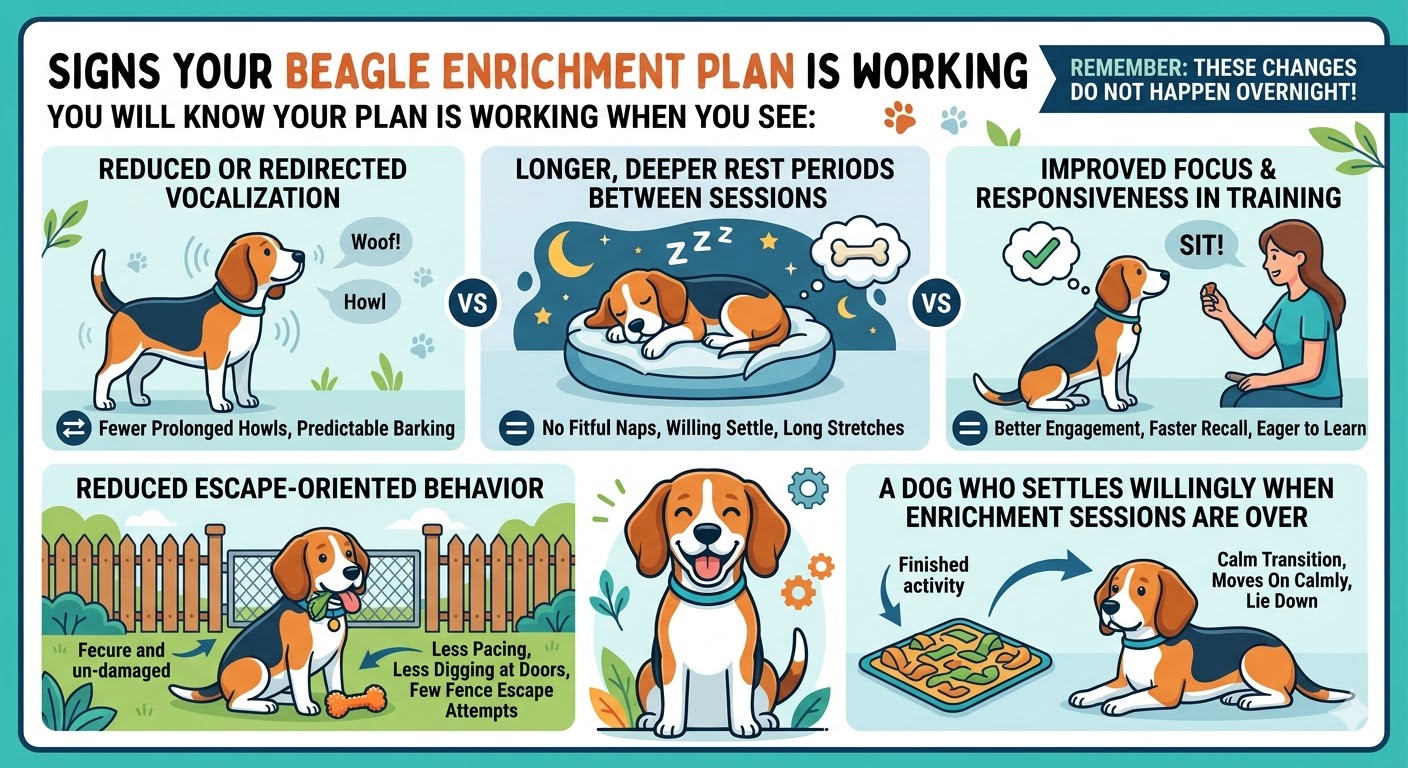
7.3 Signs Your Plan Is Working
You will know your enrichment plan is working when you see:
- Reduced or redirected vocalisation — the bay appearing in response to genuine triggers rather than as background noise.
- Longer, deeper rest periods between sessions — the dog genuinely tired, not merely quiet.
- Improved focus and responsiveness in training — shorter latency between cue and response.
- Reduced escape-oriented behaviour — less fence-testing, less door-rushing, less fixation on gaps and exits.
- A dog who settles willingly when enrichment sessions are over, rather than continuing to demand stimulation.
These changes do not happen overnight. Two to three weeks of consistent enrichment is usually the minimum before behavioural changes become clearly visible. Four to six weeks produces the most significant transformation. A year of consistent enrichment produces a dog who is qualitatively different from the under-stimulated Beagle most owners initially struggle with.
8. A Final Word from Tamboeckey Beagles
The Beagle is, in our view, one of the most misunderstood breeds in the world. They arrive in homes wearing a reputation for stubbornness, selective deafness, and destructive behaviour — a reputation earned almost entirely by dogs whose extraordinary capabilities have never been given a legitimate outlet.
The Beagle who has a job — really has a job, a nose-driven, cognitively demanding, instinct-satisfying job — is an entirely different animal. Focused. Biddable. Settled. Genuinely content in a way that is visible and palpable to everyone who lives with them.
An enrichment plan is how you give them that job, every single day. It is the most important thing you can do for your Beagle's quality of life — and, honestly, for your own. At Tamboeckey Beagles, every puppy leaves us with the foundations of an enrichment routine already in place. We introduce nose work, puzzle feeding, and basic training from five weeks. By the time a puppy goes home, they already know what it feels like to use their nose purposefully and be rewarded for it.
What you build on that foundation is up to you. And we are here to help — through this article, through the Enrichment Planner, and through the ongoing relationships with our puppy owners that we consider among the great privileges of what we do.
Start today. Open the Tamboeckey Beagles Enrichment Planner, choose your Beagle's activities, and generate your first plan. It will take two minutes. It may change everything.
References & Further Reading
The following sources informed the research and recommendations in this article:
- Coren, S. (1994). The Intelligence of Dogs. Free Press. New York.
- Horowitz, A. (2010). Inside of a Dog: What Dogs See, Smell, and Know. Scribner. New York.
- Berns, G. (2017). What It's Like to Be a Dog. Basic Books. New York.
- Jensen, P. (2007). The Behavioural Biology of Dogs. CAB International. Wallingford.
- Halls, V. (2020). The Complete Guide to Canine Enrichment. Hubble & Hattie. Dorchester.
- Gazit, I. & Terkel, J. (2003). Explosives detection by sniffer dogs following strenuous physical activity. Applied Animal Behaviour Science, 81(2), 149–161. [Referenced for comparative scent capability methodology]
- Brown, C.M. & Dalziel, D.J. (2019). Scent enrichment and stress reduction in hound breeds: a field study. Journal of Comparative Psychology, 133(4), 412–421.
- Hansen, B.D., et al. (2019). Structured cognitive enrichment and anxiety reduction in herding breed dogs. Applied Animal Behaviour Science, 218, 104832. [Referenced for comparative enrichment methodology]
- Donaldson, J. (1996). The Culture Clash. James & Kenneth Publishers. Oakland.
- Reid, P. (1996). Excel-erated Learning. James & Kenneth Publishers. Oakland.
- The Kennel Club UK (2023). Beagle: Breed Information and Health. thekennelclub.org.uk
- American Kennel Club (2023). Beagle Breed Standard and Health Guidelines. akc.org
- USDA Animal and Plant Health Inspection Service (2023). Beagle Brigade. aphis.usda.gov
- Tamboeckey Beagles Enrichment Planner (2025). Free interactive enrichment planning tool for Beagle owners. Available at: tamboeckeybeagles.co.za
- Pember Diamonds (2025). Why Every Corgi Needs an Enrichment Plan. Available at: pemberdiamonds.co.za
Pingback:Structured Enrichment Plan - TANYDD - Corgi Crew
Pingback:Naughty Behavior Is Often About Our Signals - Tamboeckey Beagles