
Beagle Behavior Guide
You have done the research, you have fallen for those ears, and now there is a Beagle puppy in your home — and almost immediately you have discovered that this dog has its own ideas about where it is going and how loudly it intends to announce its opinions. If beagle behavior has caught you slightly off-guard, you are in excellent company. The Beagle is one of the most popular breeds in the world, and also one of the most misunderstood — not because it is complicated, but because what seems like disobedience is almost always the dog following its deepest instincts, precisely as it was bred to do for centuries.
This guide exists to bridge that gap. By the time you finish reading, you will understand why your Beagle bays, why it disappears nose-first into the garden, why training can feel like negotiating with someone who has already decided what they want — and what you can actually do about all of it. Understanding beagle behavior is not about controlling your dog. It is about learning to work with a dog whose instincts are vivid, powerful, and deeply intact.
What Is Beagle Behavior, Really?
Beagle behavior is the expression of a scent hound bred over centuries to track game independently for hours, maintaining focus through distraction, fatigue, and complex terrain. That genetic heritage is present in every Beagle that lives in a modern home — and it explains nearly everything that surprises owners, from the obsessive sniffing to the selective hearing when a scent is involved.
The Scent-Driven Instinct
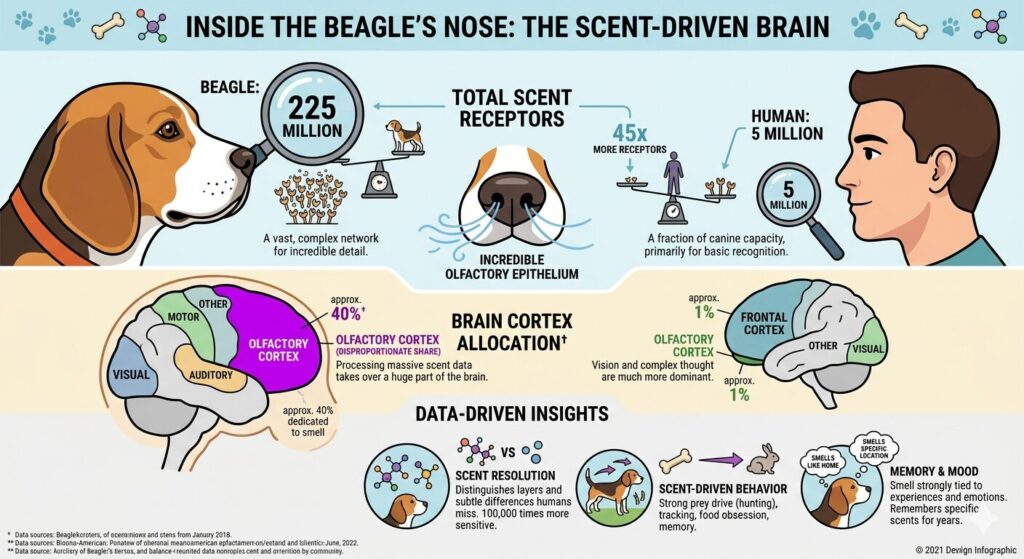 The Beagle has approximately 225 million scent receptors — compared to approximately 5 million in a human nose. This is not a peripheral feature of the breed. It is the central organising principle of the Beagle's entire experience of the world. When your Beagle puts its nose down, everything else — including your recall cue — becomes genuinely less important from a neurological perspective. The olfactory processing happening in that moment is simply more compelling than almost any other input the dog receives.
Understanding this reframes what looks like stubbornness or disrespect during walks and training. Your Beagle is not ignoring you. It is processing information through its primary sensory system with a level of focus that is, for that breed, completely natural and deeply rewarding in itself.
What scent-driven instincts look like in daily life:
- Nose-down tracking behaviour on walks, often to the complete exclusion of social interaction
- Sudden directional changes following scent trails, with significant pulling on lead
- Difficulty with recall when a scent trail is active — the dog is not defiant, it is captured
- Extended investigation of any new object, animal, or environment
- Counter-surfing and food-related exploration driven by scent detection, not opportunism
Working with scent instincts rather than against them:
- Structured sniff work (hide-and-seek with food, scent detection games) gives the olfactory system a legal outlet and produces a calm, satisfied dog
- Allow structured sniff time during walks on a long line — 10–15 minutes of nose-down time before asking for focused heel work dramatically improves responsiveness
- Scent hound instincts make Beagles excellent candidates for nose work / scent sports, which are increasingly available across South Africa and internationally
For a broader introduction to how socialisation shapes these instincts in the early puppy months, The First Few Weeks Make All the Difference covers the critical developmental windows and early exposure strategies essential for Beagles.
Why Beagles Vocalise and How to Manage It
Beagles do not simply bark — they bay. The bay is a sustained, resonant vocalisation that was specifically useful in the field: it told the hunter exactly where the dog was and kept the pack coordinated during a chase. In a suburban back garden, the bay is significantly less welcome — and considerably more audible to your neighbours.
Beagle vocalisation is one of the most common concerns raised by owners, and it is also one of the most frequently mismanaged. The most important thing to understand is that baying is self-reinforcing — the act of vocalising releases tension and satisfies the communicative drive, so the dog does not need an external reward to keep doing it.
A practical note on bark training. Do not attempt to train "quiet" by waiting for baying to stop naturally during a high-arousal event — that is too hard a starting criterion. Instead, teach "quiet" during mild, controllable vocalisation (like mild alert barking) and build the cue from there. Transfer the cue to higher-arousal contexts only once it is reliable in calm ones. This graduated approach works; trying to impose silence during peak arousal does not.
Management of the environment is often more effective than training interventions alone. Beagles that can see or hear triggers through a fence will bay at them indefinitely. Visual barriers and sound dampening in the garden environment reduce the frequency of triggered baying significantly.
Stubbornness, Selective Hearing, and How to Train Through It
Beagles are scent hounds — and scent hound "stubbornness" is fundamentally different from the challenge presented by herding breeds like the Corgi. Where a Corgi's apparent stubbornness is often the result of calculating cost-versus-benefit in real time, a Beagle's version is more frequently a case of genuine sensory capture. The dog's attention is locked onto olfactory input so intensely that competing inputs — including your voice — genuinely do not register as clearly.
This is important because the training solution differs significantly. You cannot out-compete a scent trail with a mediocre treat. But you can:
- Use higher-value rewards (real meat, cheese, the dog's absolute favourite food) when training around high-distraction environments.
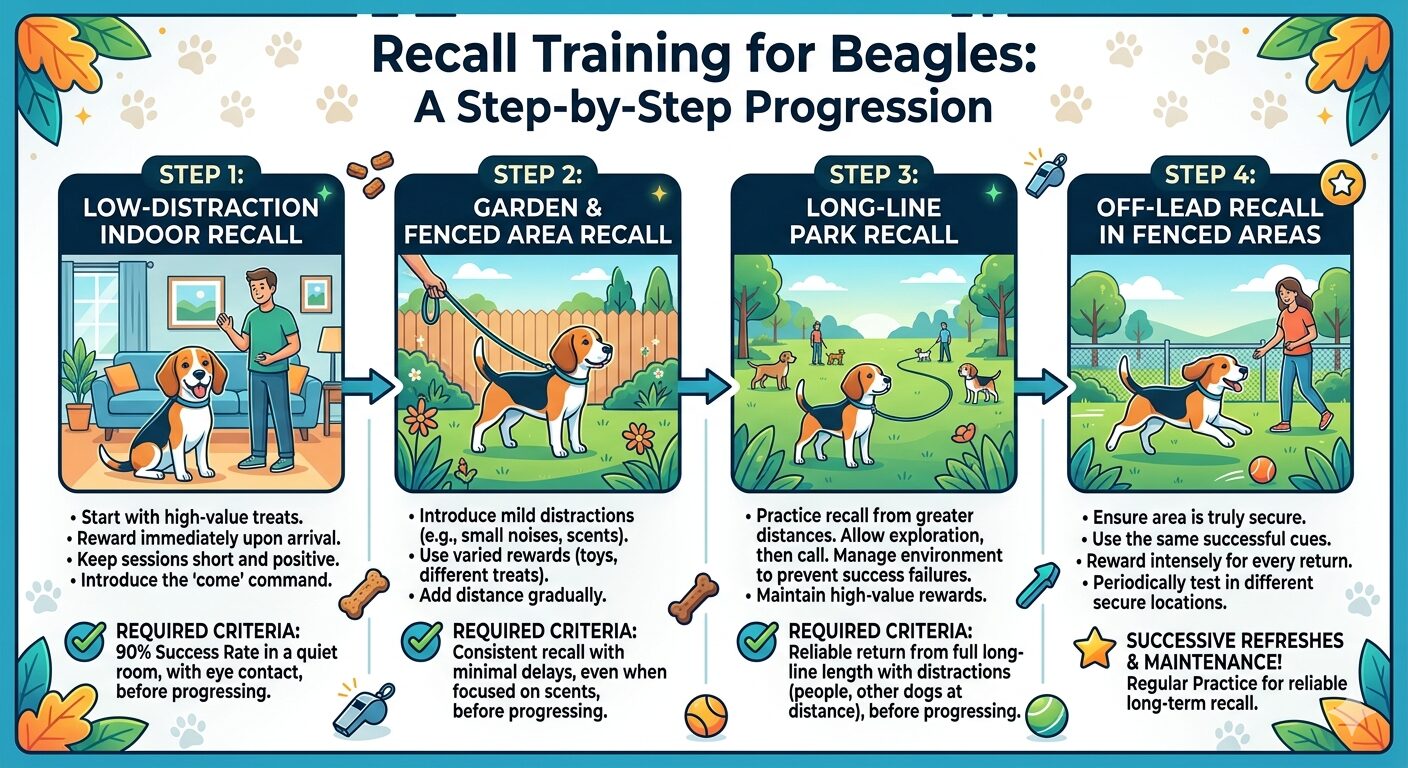
- Build your recall history in low-distraction environments first, with exceptional rewards every single time, creating a deep reinforcement history before asking for recall in challenging situations.
Practice recall on a long line to prevent self-rewarding "failures" — a Beagle that runs off and gets to investigate a fascinating scent has just practised successfully ignoring recall, and that practise matters.
Three training principles specifically effective with Beagles:
- Make training feel like hunting. Scatter food in the grass for the dog to sniff out, hide treats in cardboard tubes, use food-based motivation consistently. A Beagle working for its food through a training session is a Beagle using its most powerful instincts in service of learning.
- Work in shorter sessions with higher reward frequency. Beagles disengage from repetitive, low-reward training faster than many breeds. Sessions of 5–7 minutes with high reward rates and varied exercises retain engagement effectively.
- Train before meals, not after. A Beagle that has just eaten is significantly less food-motivated and therefore significantly harder to train. Morning and pre-meal sessions produce better results.
Separation Anxiety in Beagles
Beagles were bred to work in packs. The social structure of pack hunting — constant proximity to conspecifics, coordinated movement, shared purpose — is the ancestral context this breed comes from. When a Beagle is left alone in a house, it is experiencing something that is fundamentally at odds with its evolutionary experience. Most Beagles adapt to domestic alonetime; some do not adapt without deliberate support.
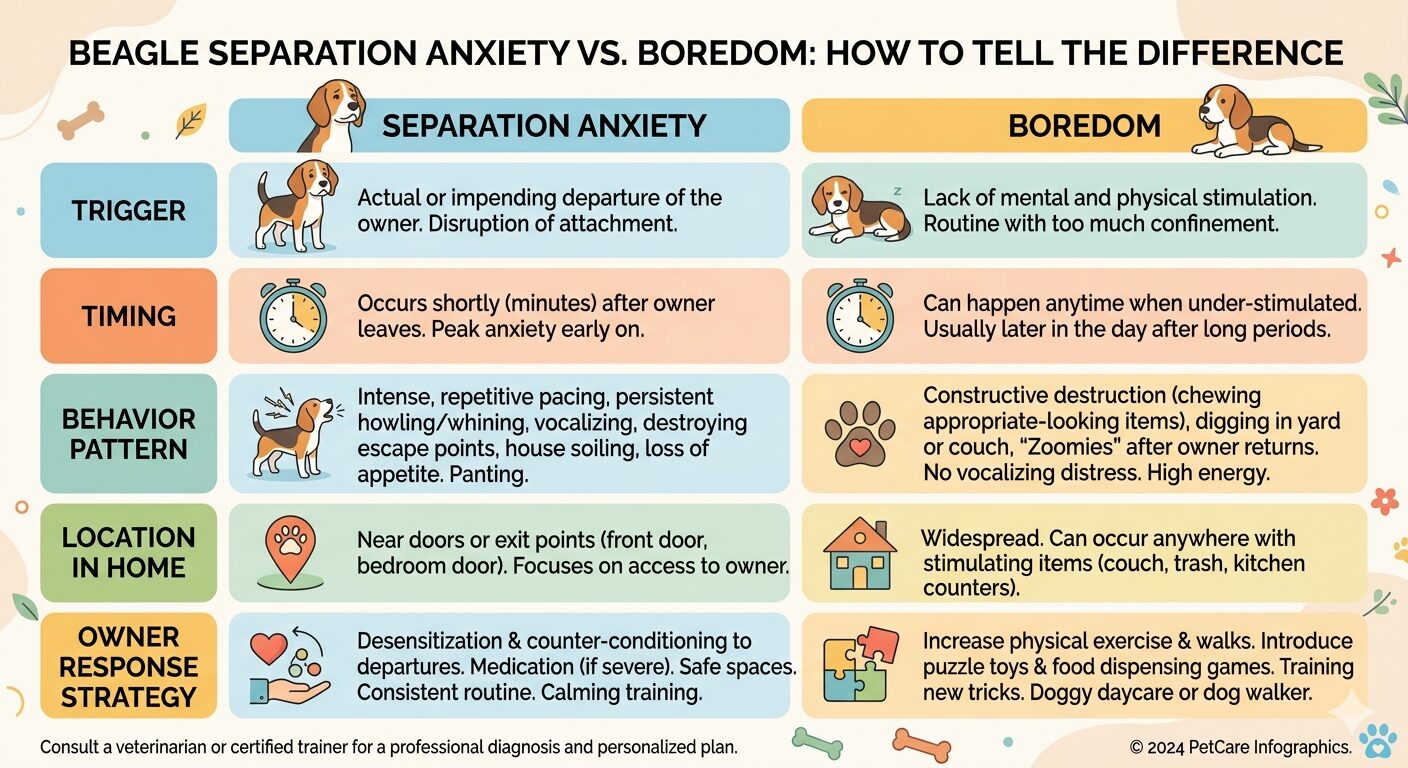 Separation anxiety in Beagles is distinct from boredom-related behaviour, though both can result in vocalisation and destructiveness.
Signs of genuine separation anxiety:
- Distress visible before you leave (panting, salivating, shadowing) when departure signals appear
- Vocalisation beginning within minutes of your departure and continuing throughout absence
- Destructiveness concentrated near doors and windows (escape-motivated, not boredom)
- Physical symptoms during absence (self-licking, salivation, elimination despite being housetrained)
- Rapid return to normal behaviour within minutes of your return
Building independence from the puppy developmental stage
The best time to build a Beagle's tolerance for alone time is during the first weeks in the home. Even if you are home, practice leaving the puppy in a safe space (crate or pen) for short periods during the day. A young puppy that learns that brief separations are safe and temporary builds resilience; one that is held or carried constantly often does not.
For dogs already displaying anxiety symptoms
- Begin with very brief, non-dramatic separations — 30 seconds out the front door — and build duration gradually over weeks
- Use a food-stuffed toy (frozen kongs are particularly effective) reserved exclusively for alone time
- Consult a force-free behaviour consultant if symptoms are severe — medication may be appropriate as a bridge while behaviour modification is underway, and a vet referral is the right first step
For a Beagle already showing attachment-related anxiety, addressing this alongside broader socialisation gaps is important. The Complete Guide to the Beagle provides a broader breed context that includes temperament profiling alongside this behavioral guidance.
The Often-Missed Essential
Beagles are frequently recommended to first-time owners because of their friendly temperament and moderate size. What is less often communicated is that a Beagle without adequate mental stimulation is one of the most persistently difficult dogs to live with — not because of aggression or fearfulness, but because an understimulated scent hound will find its own entertainment, and that entertainment will rarely align with your preferences.
A Beagle needs approximately 45–60 minutes of physical exercise per day as an adult. But its need for mental stimulation — primarily through scent-based activities — is at least as important, and possibly more so for dogs that are anxious, reactive, or behaviorally challenging.
Practical mental stimulation tools for Beagles:
- Sniffari walks. Rather than a structured walk, allow the dog to lead and sniff wherever it chooses (on a long line in safe areas). These walks are more tiring than equivalent distance at a steady pace.
- Scatter feeding. Feed a portion of the daily meal scattered in the garden rather than in a bowl. A Beagle sniffing for food for 15 minutes burns approximately the same mental energy as a brisk 20-minute walk.
- Nose work / scent detection. Structured scent games where the dog finds a hidden target odour. Beagles excel at this, and the sport is growing significantly in South Africa.
Puzzle feeders and lick mats: Food-based problem-solving that engages the nose, slows eating, and provides calm mental engagement.
The key insight is that mental stimulation for a Beagle should be primarily scent-based — this is where the breed's cognitive engagement is highest. Exercise alone (even vigorous exercise) leaves the olfactory system unsatisfied.
Beagles With People, Dogs, and Other Animals
The Beagle's pack heritage makes it one of the most naturally social breeds. Most well-socialised Beagles are friendly, curious, and adaptable across a wide range of social situations — with people of all ages, with other dogs, and often with other species. Their social confidence is one of the breed's great strengths as a companion dog.
With Children
Beagles are generally excellent companions for children. They are robust, playful, and patient in ways that smaller, more fragile breeds may not be. Their key challenge with children is arousal management — Beagles can become very excited during play and may jump, mouth, or vocalise persistently. Teaching the dog a "four on the floor" rule (no jumping reinforced, ever) and having children participate in calm training activities reduces these behaviours significantly.
With Other Dogs
Beagles are naturally inclined toward companionship with other dogs. Many Beagle owners find that having a second dog in the household dramatically reduces separation anxiety and boredom-related behaviours — this is consistent with the pack-oriented background of the breed. Introductions should be conducted in a neutral environment (not the resident dog's territory) with both dogs on-lead initially.
With Cats and Small Animals
Beagles have a prey drive that, while not as intense as sight hounds, can make cohabitation with cats or small animals challenging without proper introductions and management. The scent of small prey animals is highly activating. Gradual, managed introductions — where the Beagle remains on-lead and calm behaviour is consistently rewarded — give the best outcomes. A resident cat with places to escape to (high surfaces, dog-free rooms) is an important management tool during the integration period.
Obedience Training
Positive reinforcement is the most effective training framework for Beagles — and the most logically aligned with how the breed is motivated. A Beagle works for food with extraordinary focus when the training environment is appropriate and the reward is genuinely valuable. This makes shaping new behaviours relatively fast. The challenge is not initial learning but reliability under distraction.
Foundation behaviours for every Beagle puppy by 6 months:
- Sit, Down, Stand — practised in six or more distinct environments
- Recall — always rewarded with the highest-value treat available; never called to something unpleasant
- Leave it — essential for safety given the Beagle's scavenging instinct on walks
- Leash manners — a Beagle on a loose lead is a training achievement worth significant investment
- Place/Settle — gives the dog a behavioural anchor when calm is required
Managing food motivation
The Beagle's food drive is extraordinary — which is useful in training and problematic in other contexts. Counter-surfing, bin raiding, and persistent food-seeking behaviours all stem from the same intense scent-based food motivation. Management (secure bins, counters cleared, dog-proof cupboards) is not a failure of training — it is appropriate environmental management for a food-motivated scent hound.
The Essential Puppy Training Commands Every New Owner Should Know from PemberDiamonds provides a solid foundational framework for the obedience training that underpins everything covered in this section.
Developmental Stages
The developmental stages of Beagle puppies follow the same broad sequence as all domestic dogs, but the specific behaviors that emerge at each stage are particularly important to manage correctly in scent hounds.
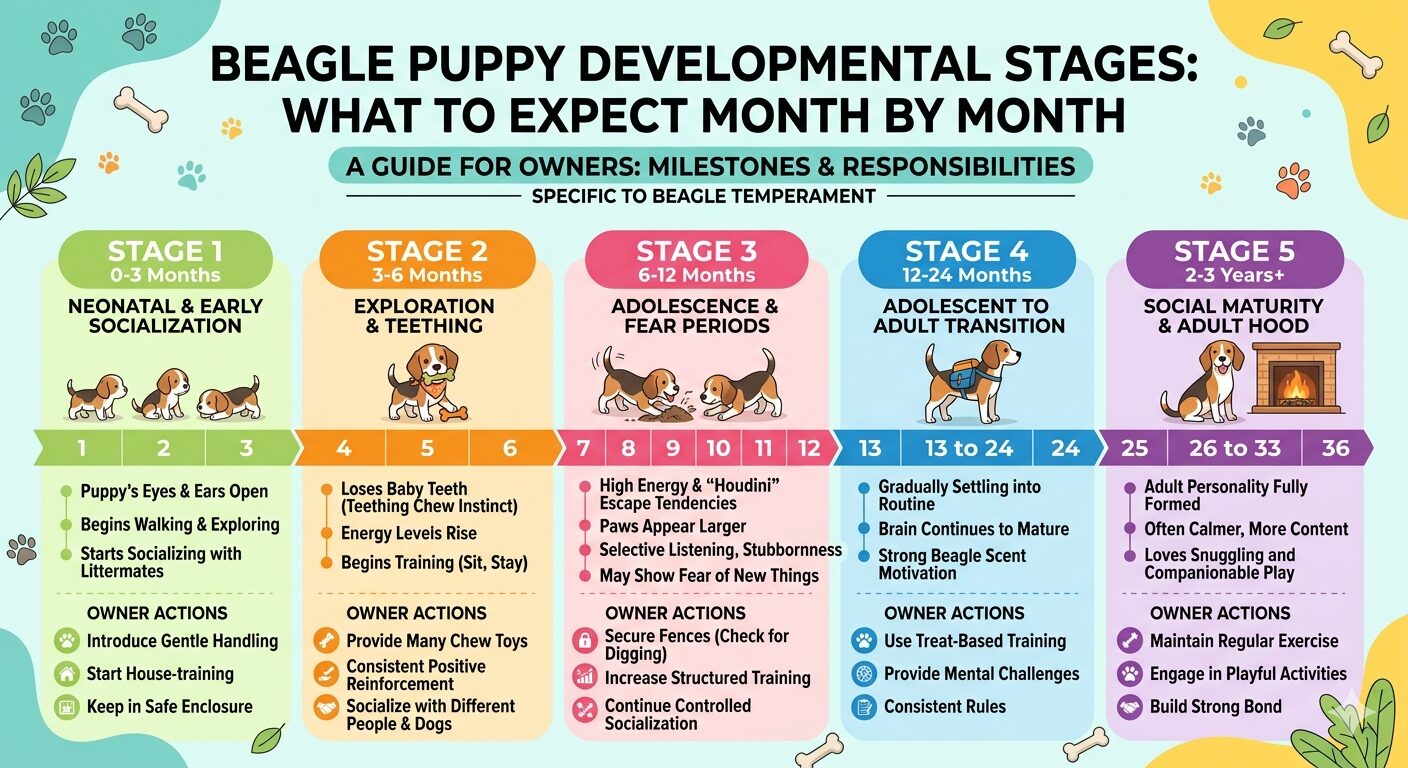
The socialisation window (3–12 weeks) is the most critical period for Beagle owners. The scent hound's sensitivity to novel stimuli means that inadequate exposure during this window creates lasting fearfulness or reactivity to specific environments, sounds, or social situations. Puppies that receive broad, positive exposure during this period develop the confident, friendly temperament the breed is known for. Those that do not may be anxious in unfamiliar environments throughout their lives, which compounds all other behavioral challenges.
The Clever Side of the Beagle
Beagles are consistently rated as having a moderate-to-high level of adaptive intelligence — the ability to problem-solve independently to achieve a goal. This intelligence is less academic than that of herding breeds (which are highly responsive to human direction) and more self-directed, which is exactly what a scent hound needed to work effectively without constant handler input.
In daily life, this manifests as:
- Escape artistry — Beagles are determined and creative when motivated to get to a scent or out of an enclosure
- Counter-surfing and bin investigation as systematic problem-solving, not impulsiveness
- Learning owner routines and manipulating them — many Beagles learn exactly when food will appear and time their attention-seeking accordingly
- Using vocalisation strategically to obtain attention, reinforcement, or access to resources
Managing attention-seeking behaviours
The most important principle is consistency. A Beagle that has been reinforced for attention-seeking behaviour (even inconsistently) will persist for a long time before extinguishing the behaviour. The rule is simple but demanding: any attention (including pushing the dog away, speaking, eye contact) reinforces the behaviour. Turn away completely, wait for silence, and reward the silence. This takes longer than most owners expect — 2–4 weeks of absolute consistency is the typical timeframe for significant reduction.
Using problem-solving as a training tool
The same problem-solving intelligence that makes Beagles challenging to manage can be channelled productively through trick training, puzzle feeders, and structured scent games. A Beagle that has spent 20 minutes working through a scent problem is a genuinely calm, settled companion. The energy goes somewhere — the owner's job is to direct where.
 Expert Insight
 Expert Insight
From a Beagle breeder and canine enrichment specialist with over 12 years working with scent hound breeds:
"The conversation I have most often with new Beagle owners is about what 'recall failure' actually means. They believe their dog knows the recall cue and is choosing to ignore it — which implies stubbornness or defiance. In nearly every case, what is actually happening is that the dog has not had sufficient reinforcement history for the recall cue in high-distraction environments for it to compete with the value of an active scent trail. You cannot expect a behaviour trained in your living room to transfer automatically to the park when the park contains 10,000 times more olfactory information than your living room. Recall in Beagles requires what I call 'deposit banking' — hundreds of successful, high-value recall repetitions across progressively challenging environments before you make withdrawals by asking for recall near a scent trail. The owners who struggle most are those who skip the deposits and go straight to the withdrawals."
A less commonly discussed insight. Beagles that receive adequate daily scent enrichment — not just physical exercise — show measurably lower anxiety scores on standardised behavioural assessments. Scent work is not a supplement to wellbeing for this breed. It is the primary mechanism through which the breed achieves psychological equilibrium. A Beagle that cannot sniff, track, or search is a Beagle that cannot fully regulate its own emotional state.
Frequently Asked Questions
 Frequently Asked Questions
1. Is beagle behavior suitable for first-time owners?
Beagles can be an excellent choice for first-time owners who understand the breed's scent-driven nature and invest in appropriate training from the start. They are friendly, social, and adaptable. The challenges — selective hearing near scent trails, baying, and separation anxiety — are manageable with the right approach and consistent positive reinforcement, but they do require commitment. First-time owners should research the breed thoroughly and have a training plan in place from day one.
2. Why does my Beagle ignore me on walks?
When your Beagle's nose is down on a scent trail, its olfactory processing is at full capacity — and competing inputs (including your voice) genuinely become less salient. This is not disobedience. It is neurological focus. The solution is to build a deep reinforcement history for recall in low-distraction environments first, use a long line for safety during the learning process, and understand that recall near an active scent trail is an advanced behaviour that requires significant training investment before it becomes reliable.
3. How do I stop my Beagle from baying so much?
First, identify which type of vocalisation is occurring — alert barking, separation-related baying, excitement vocalisation, or demand attention-seeking. Each requires a different approach. For alert barking, an acknowledgement-and-release cue works well. For demand vocalisation, consistent non-reinforcement over 2–4 weeks is required. Separation-related baying requires addressing the underlying anxiety. Environmental management (visual barriers, reducing auditory triggers) reduces overall frequency significantly.
4. How much exercise does a Beagle need each day?
Adult Beagles need approximately 45–60 minutes of physical exercise daily, but their mental stimulation needs — particularly scent-based enrichment — are equally important. A Beagle that is physically exercised but mentally understimulated will still display anxiety and problem-seeking behaviours. Sniff work, scatter feeding, and nose work games should be incorporated alongside physical walks. On lower-exercise days, increasing mental stimulation compensates effectively.
5. Do Beagles really escape from gardens?
Yes — Beagles are remarkably determined escape artists when a compelling scent motivates them. Standard fencing is often insufficient. Beagle-proofing a garden requires 1.8m minimum fence height, no gaps at ground level (Beagles will dig), and removal of any furniture or objects that could be used to step up to the fence line. Gates should be double-gated with a secure latch. Never leave a Beagle unattended in an unsecured garden.
6. Are Beagles prone to separation anxiety?
Yes — more so than many breeds, due to their pack-hunting heritage and social orientation. Beagles kept as single dogs with long periods of daily alone time are at significant risk of developing separation anxiety. Prevention through early independence training is far more effective than treatment after anxiety has established. If your Beagle is already showing anxiety symptoms, a gradual desensitisation programme — and veterinary consultation if symptoms are severe — is the appropriate response.
7. Can Beagles be trained reliably off-lead?
Off-lead reliability in Beagles is achievable, but it requires a much longer and more systematic training investment than most breeds. Many experienced Beagle owners choose to keep their dogs on a long line in unfenced areas rather than risk recall failure near an active scent trail. Dogs that have completed advanced recall training in multiple environments over an extended period can develop reliable off-lead manners, but this is the exception rather than the rule, and the risk of a scent-captured Beagle running into danger on a road is real.
8. Why does my Beagle counter-surf and raid bins?
Counter-surfing and bin raiding in Beagles is scent-driven food-seeking behaviour — not opportunism or "bad" behaviour. Your Beagle's nose detects food at distances and through barriers that would be invisible to most other breeds. Management is the most effective response: clear counters, secure bins, use dog-proof storage for food. Attempting to train this behaviour away without environmental management is consistently ineffective.
9. How do I handle my Beagle's attention-seeking behaviors?
Consistency is the essential ingredient. Any response to attention-seeking — including pushing the dog away or saying "no" — reinforces the behaviour. The only effective approach is complete non-response: turn away, look away, do not speak until there is a minimum 3-second pause in the behaviour, then quietly reward the calm. This requires 2–4 weeks of absolute consistency from all household members. The behaviour will temporarily increase before it decreases — this is normal.
10. Are Beagles good with children?
Beagles are generally excellent family dogs and are well-suited to households with children. They are sturdy, playful, and tolerant. The primary challenge is arousal management — excited Beagles may jump, mouth, or vocalise during play with children. Teaching the dog calm greetings (four paws on the floor, wait for attention to be offered rather than demanded) and having children participate in structured training activities produces the best long-term outcomes.
Conclusion
Understanding beagle behavior comes down to three foundational truths. First, the nose is everything — nearly every behavioral challenge that Beagle owners encounter is either directly caused by, or significantly influenced by, the scent-driven nature of the breed. Second, mental stimulation — particularly scent-based enrichment — is not optional. A Beagle that cannot engage its olfactory system adequately will find other, less desirable ways to fill that need. And third, positive reinforcement is not just the kindest approach to training a Beagle — it is the most effective one, because it leverages the food and reward motivation that the breed brings in abundance.
The promise of this guide was to help you understand your Beagle rather than just manage it. A dog whose behavior you understand is a dog you can train more effectively, advocate for more confidently, and enjoy more completely. The Beagle's irrepressible curiosity, warmth, and enthusiasm are not things that coexist with its challenging traits — they are the same traits, expressed differently depending on the context you provide.
In the Training & Behavior category, Beagles reward the owners who invest the time to understand how they are wired. Once you understand that, the path forward is clearer — and considerably more enjoyable — than you might have imagined.
Call to Action
 Call to Action
Your next step depends on where you are in your Beagle journey. If your puppy is still in the critical early weeks, The First Few Weeks Make All the Difference will help you build the socialisation foundation that everything else in this guide depends on. If you are looking for the bigger picture of Beagle ownership — temperament, health, breed history, and what to expect across the lifespan — the Complete Guide to the Beagle is exactly where to go next. Your Beagle's wellbeing starts with your confidence as an owner — keep building both.
Pingback:Beagle Separation Anxiety - Tamboeckey Beagles
Pingback:Corgi Behavior Guide - TANYDD - Corgi Crew