
Basic Beagle Training Techniques
 Beagles are among the most lovable dogs on the planet. They are also, by the honest assessment of most people who have raised one, genuinely challenging to train — and the reason for that challenge is almost always the same: their nose.
Beagle training basics are not complicated in principle. The techniques are the same techniques used across most breeds — positive reinforcement, consistent routines, clear communication, and patience. But a Beagle's olfactory system is built on a different scale to most other dogs: approximately 220 million scent receptors compared to a human's five million. When a Beagle catches a scent trail, everything else — including you, the treat in your hand, and the command you just gave — ceases to exist.
The good news is that this is a solvable problem. This guide gives you the practical, breed-specific techniques to work with your Beagle's instincts rather than against them — covering crate training, potty training, early commands, leash work, and the mental stimulation that keeps the nose engaged and the problem behaviours at bay.
 QUICK ANSWER
 QUICK ANSWER
What Are the Basics of Beagle Training?
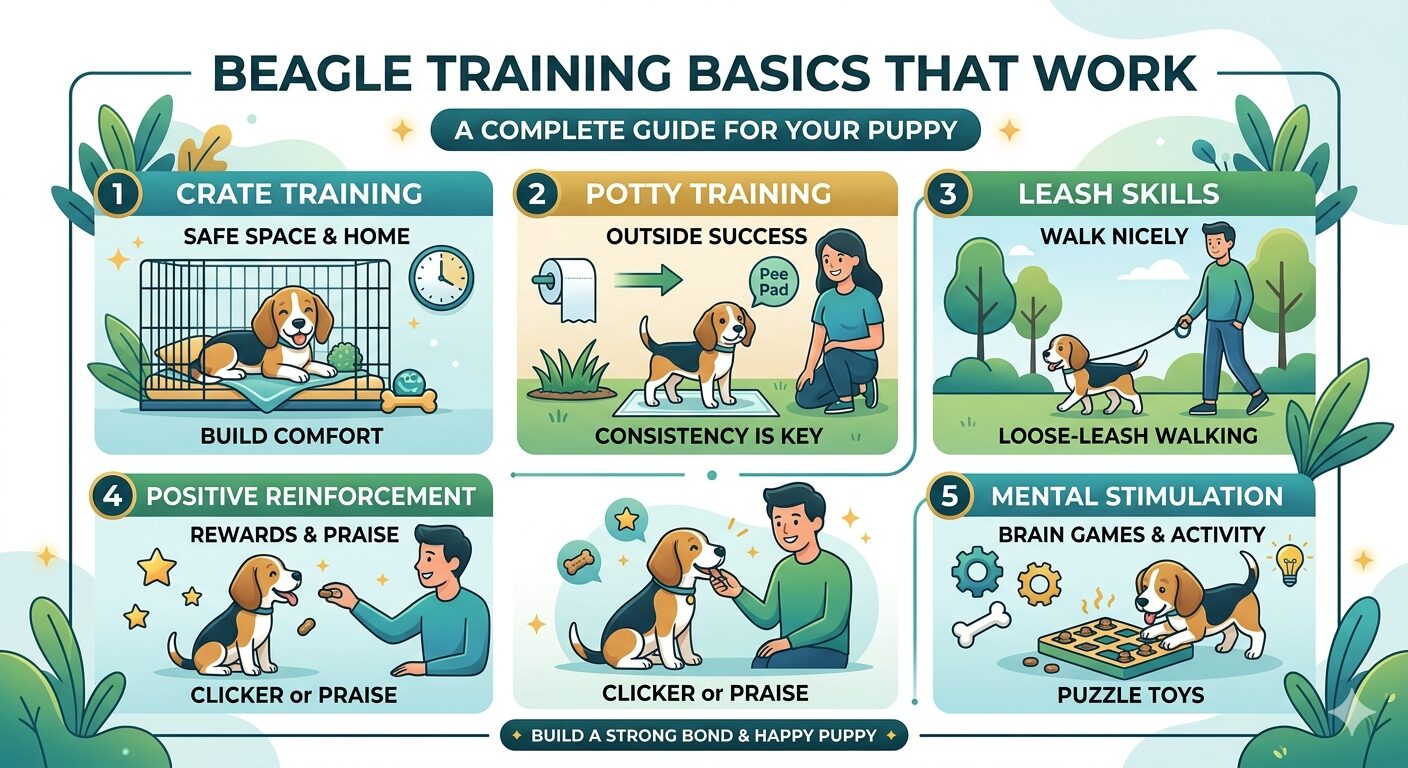
Beagle training basics involve positive reinforcement with high-value rewards, crate training for routine and security, consistent potty training schedules, early lead acceptance, and daily mental stimulation through scent work and problem-solving exercises. Training sessions should be short, frequent, and always conducted in low-distraction environments before gradually introducing outdoor or scent-rich contexts.
Understanding the Beagle Brain
Why Standard Training Advice Needs Adjusting
Most general puppy training guides were not written with a Beagle in mind. The core principles — mark, reward, repeat, be consistent — hold true for this breed. What changes is the application, particularly in environments where scent competes with your attention cue.
Beagles were developed as scent hounds, bred to work independently for hours at a stretch, following a trail without direction from a human handler. This history has direct training implications: independence is not disobedience; it is the breed's default operating mode. A Beagle that ignores recall in a park is not defiant — it is working precisely as it was designed to work over centuries of selective breeding.
Understanding this distinction is the beginning of beagle training basics that actually work:
Scent competition
Any training conducted in an environment with high olfactory interest (a garden, a park, a street) places your reward in direct competition with the dog's primary sensory drive. This is not a contest you can win with kibble. High-value rewards — soft, intensely aromatic treats — are non-negotiable outdoors.
Independence as a default: Recall reliability requires more repetitions and higher reinforcement than in most other breeds. This is not a training failure; it is a breed-specific baseline.
Short attention windows
Beagles disengage from formal training faster than breeds with a working-partnership profile (such as herding dogs). Three to five-minute sessions are effective; ten-minute sessions frequently produce diminishing returns from the midpoint.
Scent work as a training tool: The same drive that makes Beagles challenging in distraction-heavy environments makes them exceptional at scent-based tasks. Channelling the nose into structured exercises — scatter feeding, hide-and-seek games, rudimentary tracking — produces cognitive engagement and trainable focus that carries over into command work.
Crate Training a Beagle Puppy
Security Without Stress
For a breed with a pack-dog heritage, Beagles can be initially vocal in a crate — not because crate training does not work for them, but because isolation feels biologically wrong to a dog bred to work and live in a group. The solution is not to abandon the crate; it is to introduce it in a way that pairs the enclosed space with calm and positive experience before any extended confinement is required.
The correct crate size for a Beagle: Large enough to stand, turn, and lie down fully extended. No larger. A crate that is too large allows the puppy to eliminate at one end and sleep at the other — defeating the den instinct that makes crate training functional.
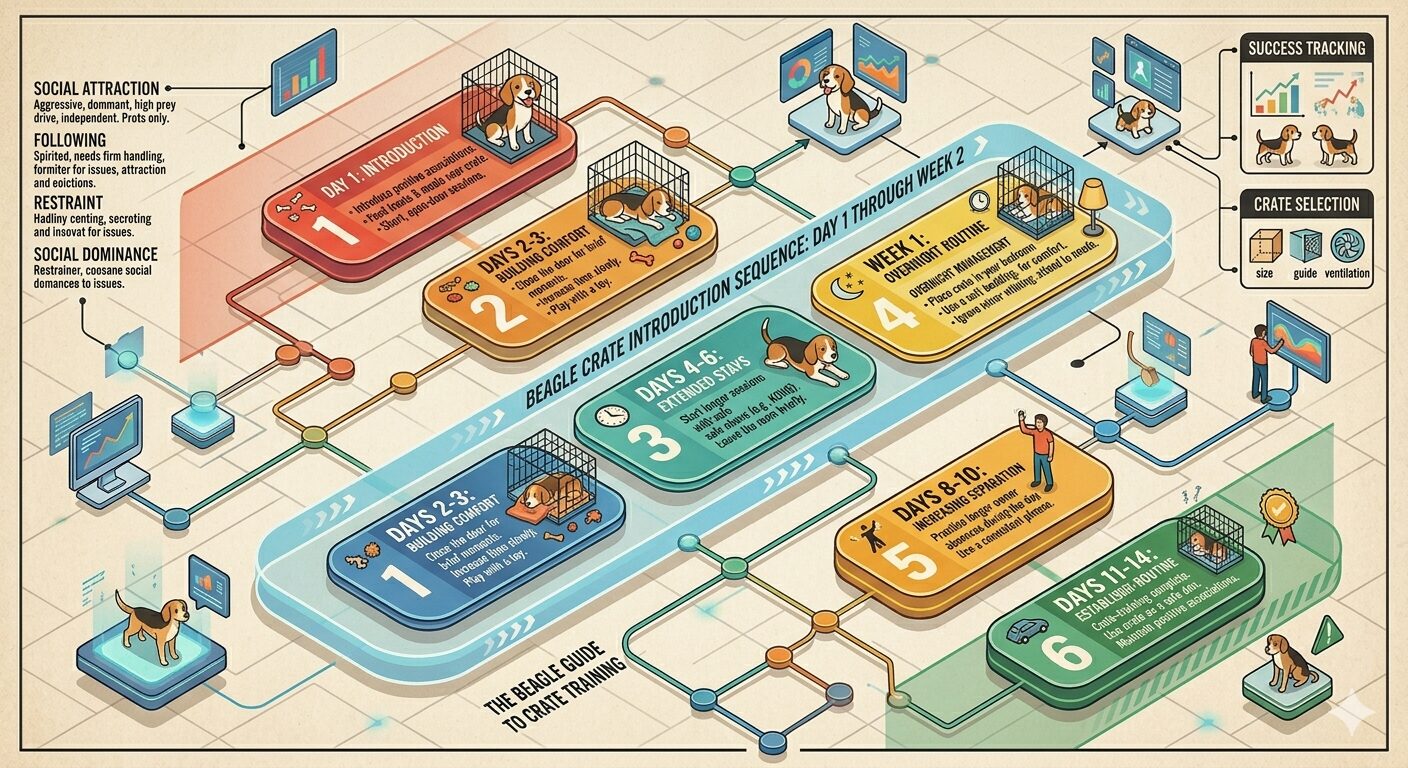
Introduction sequence (begin from day one at home):
- Place the crate in a room where the family spends time — the kitchen, the living room. Beagles are social animals and an isolated crate will increase vocalisation, not reduce it.
- Feed all meals inside the crate with the door open for the first three days. The crate should always be where good things happen.
- Introduce a specific verbal cue ("crate" or "in") paired with a treat dropped inside. Do not push or force entry.
- Begin closing the door for the duration of meals. Open the moment the meal is finished.
- Extend closed-door duration gradually. Five minutes with you in the room, then ten minutes, then the same with you briefly absent.
Managing vocalization
Beagles will vocalise when first confined, sometimes loudly. The rule is consistent: never open the crate in response to noise. Wait for a three-second pause in vocalisation — even a brief one — then open. Delivering release during barking teaches the puppy that barking is the exit code.
Overnight crating
Place the crate near your bed for the first two weeks. The proximity to human scent and sound significantly reduces overnight vocalisation in a breed with pack-dog instincts. Move gradually to the preferred location once the puppy is settled.
Potty Training Your Beagle
Beagle puppies are not harder to potty train than other breeds, but they are more likely to be distracted mid-task by a scent — particularly outdoors. A puppy taken outside to eliminate may spend three minutes investigating a smell trail left by a neighbourhood cat before it remembers why it was there, and then eliminate the moment it returns indoors.
Managing this requires two adjustments to standard potty training advice:
1. Outdoor potty time is not exploration time. Take the puppy to a designated elimination spot on lead. Keep movement restricted to that area until elimination is complete. The lead prevents the scent-distraction detour. Only after elimination should the lead be removed or the puppy allowed to explore.
2. Reward immediately and dramatically. The reinforcement window for potty training is even narrower than most owners realise — two to three seconds maximum between the behaviour and the reward. A puppy that finishes eliminating and walks four steps toward you before receiving the treat has received reinforcement for walking toward you, not for eliminating. Mark the moment it finishes, before any movement toward you.
Timing schedule for Beagle puppies
- Immediately on waking from any sleep — no exceptions
- Within ten minutes of any meal or water consumption
- After every play session
- Every sixty to ninety minutes during waking hours for puppies under twelve weeks
- Every two hours for puppies twelve to sixteen weeks
Overnight management
At eight weeks, most Beagle puppies cannot hold through the night. A single overnight toilet trip — taken calmly, with minimal stimulation, and returned directly to the crate — is more effective than expecting an accident-free night and waking to a soiled crate.
Timeline
Most Beagle puppies reach consistent daytime reliability between fourteen and eighteen weeks with a maintained routine. Night reliability follows at three to four months, sometimes later for small litters that were not crate trained from early on.
The First Commands to Teach Your Beagle
The approach to commands for Beagles mirrors the foundational sequence used across breeds — begin simple, build duration and distraction gradually, use positive reinforcement at every stage. The specific adjustment for this breed is to start all command training in the lowest-distraction environment available: indoors, away from windows, with no competing scent stimulus.
Commands to introduce first, in priority order:
1. Sit
Lure the nose upward and back with a small treat held above the puppy's eye line. The hindquarters naturally lower. Mark and reward the moment of contact. Introduce the verbal cue "sit" after the physical behaviour is reliable — approximately ten repetitions across two to three sessions.
2. Stay
Crucial for a breed with a strong roaming instinct. Build duration before distance: five seconds, then ten, then thirty. Only add distance — one step back — when the puppy is staying reliably for thirty seconds with you standing directly in front. Add distraction last.
3. Come (Recall)
This is the command that matters most for a Beagle's safety, and the one that requires the highest investment. Use the highest-value treat available. Call in an upbeat, happy tone. When the puppy arrives, reward immediately and extravagantly. Never call the puppy to you for anything it finds aversive (bath time, nail clipping) — this directly undermines recall reliability.
4. Leave it
Start with a closed fist holding a treat. The moment the puppy withdraws its nose, mark and reward from the other hand. This command has practical safety implications for a scent-driven breed that is strongly inclined to investigate and consume anything interesting on the ground.
5. Down
From sit, lure the treat toward the floor between the front paws and outward. Mark and reward when the elbows touch the ground. Useful as a calm-default behaviour in high-stimulation environments.
Leash Training
Managing the Nose on Walks
Leash training a Beagle presents a specific challenge that most other breeds do not share to the same degree: the puppy that is walking perfectly to heel will, without warning, throw its nose to the ground and lock onto a scent trail — pulling sideways, backwards, or into traffic. This is not a lead training failure. It is the breed in action.
Building lead acceptance before the walk begins
Introduce the lead indoors from seven to eight weeks. A lightweight flat collar or puppy slip lead, worn for five to ten minutes during meals or play, normalises the sensation before any expectation of behaviour is attached. The puppy that has worn a lead fifty times before its first outdoor walk is not distracted by the equipment on the walk.
The stop-and-wait technique for pulling
When the lead becomes taut, stop. No command, no correction — simply stop forward movement entirely. When the puppy returns to a slack lead position (even briefly), mark and move forward. This communicates a single, clear rule: the lead pulling forward stops progress. Most Beagle puppies understand this rule within two to three sessions; consistent application across walks cements it.
Managing the nose-to-ground detour
Build in structured sniff breaks as a reward, not as something the puppy takes for itself. Walk with a loose lead, then give a release cue ("go sniff") to allow a designated thirty to sixty-second exploration period. End the sniff break with a recall cue followed by the highest-value reward available. This teaches the puppy that returning from a sniff session is always worthwhile — which directly develops recall reliability in scent-rich environments.
Equipment note
A front-clip harness (not a back-clip harness, which facilitates pulling) is appropriate for Beagles that are still in the learning phase. Avoid retractable leads entirely during training — they teach the puppy that extending the lead produces more freedom, which is the opposite of the behaviour being established.
Positive Reinforcement and Clicker Basics for Beagle Owners
Positive reinforcement is the most effective training methodology for Beagles — not just philosophically, but practically. A scent hound trained with aversive methods does not become more compliant; it becomes more anxious and more likely to disengage from training entirely. The breed's independent streak becomes intractable under pressure.
Positive reinforcement, by contrast, turns training into a problem the dog is motivated to solve: "What behaviour produces the good thing?" For a food-driven breed like the Beagle, this is a highly effective motivational framework.
Using the clicker with a Beagle:
The clicker's primary advantage for this breed is precision. A Beagle's attention window is short, and the ability to mark a correct behaviour in the moment — rather than fumbling for a treat while the moment passes — significantly accelerates learning. Charge the clicker as described: click, treat, repeat ten times in rapid succession. The conditioned response (the puppy orientates toward you at the click) typically establishes within two sessions.
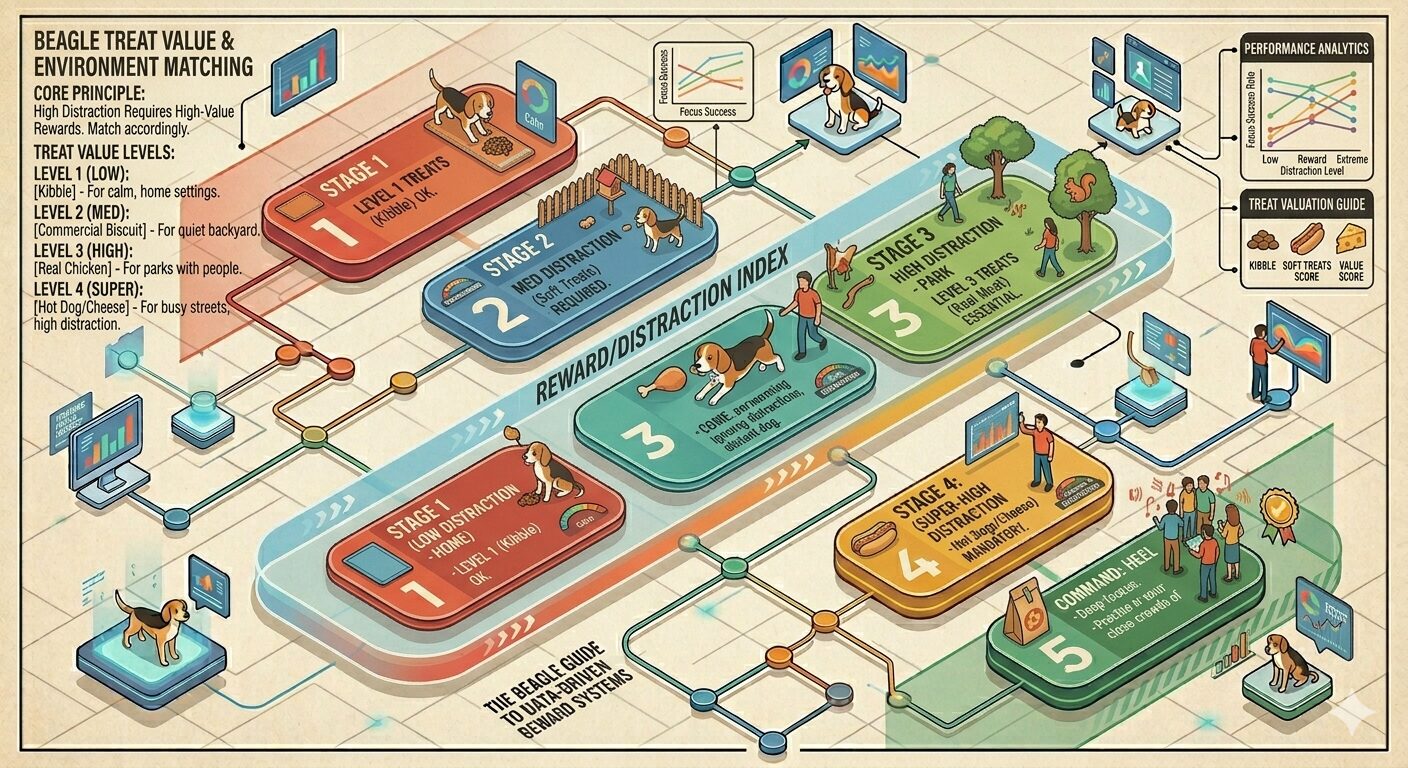
Treat selection for Beagles
Not all treats are equal for a scent-driven breed. High-aromatic, soft treats — cooked chicken, liver, cheese — compete more effectively with environmental scent than dry kibble. The higher the distraction level of the environment, the higher the value of the treat required.
Reinforcement schedules
Once a behaviour is established in a low-distraction environment, begin varying the reinforcement: reward every second or third correct response rather than every one. This intermittent schedule produces more durable behaviour — the puppy learns that the reward may come at any response, which sustains engagement and effort between rewards.
Key principle
Keep training sessions at three to five minutes for puppies under twelve weeks. End on success. A frustrated Beagle becomes a disengaged Beagle — and a disengaged Beagle will find its own entertainment, which is rarely what you had planned.
Consistency
Building a Training Schedule That Works
For a first-time owner managing a Beagle puppy, the concept of a training schedule can feel like an additional obligation in an already demanding period. In practice, the most effective training for Beagles is not structured as a separate activity — it is woven into existing routines.
Daily integration approach:
- Morning - Sit before breakfast is placed down; thirty-second recall practice in the hallway.
- Midday - Lead practice in the garden; a five-minute sniff work session (scatter-fed lunch in the garden).
- Evening - One formal training session of five minutes on a current command or a new behaviour; "go sniff" release practice before the evening walk.
- Ongoing - Potty trips every ninety minutes with outdoor marking and reward; crate routine with verbal cue at nap times.
The schedule that produces the most rapid, durable learning:
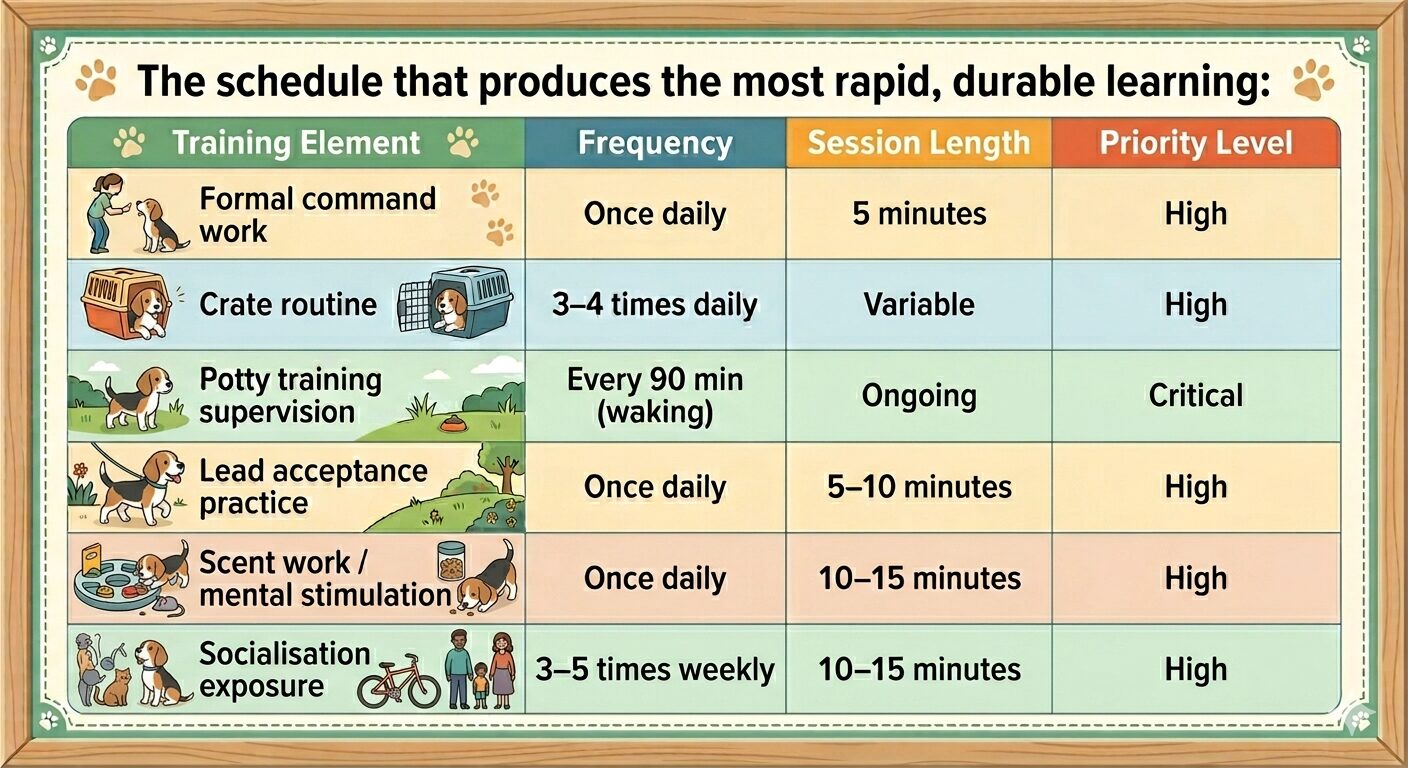
The critical element for Beagles is predictability. This breed responds well to routine — mealtimes, outdoor times, and training times that occur at consistent intervals produce calmer, more attentive dogs. A Beagle that cannot predict its day will manufacture stimulation, usually through vocalisation, destructive chewing, or attempts to escape.
For owners who want to understand how socialisation during the earliest weeks at the breeder shapes what training success looks like at home, the article Basic Corgi Training Techniques for Beginners on CorgiCrew offers a parallel framework — exploring how the same foundational principles apply to another intelligent, independent breed. The early socialisation concepts are directly transferable.
Mental Stimulation and Scent Work
The Beagle's Natural Superpower
A physically exercised Beagle is a tired Beagle. A mentally exercised Beagle is a calm, focused, and well-behaved Beagle. The distinction matters because physical exercise alone — even a long, satisfying walk — does not engage the olfactory processing capacity that defines this breed. A Beagle with a fully engaged nose for fifteen minutes will be more cognitively settled than a Beagle that has run for thirty.
Scent work activities for Beagle puppies:
Scatter feeding - Throw the puppy's entire meal portion across the garden lawn. The puppy spends ten to fifteen minutes finding every piece — a cognitively intense activity that taps directly into the breed's primary sensory drive.
Snuffle mat feeding - A dense rubber mat with treat pockets. Appropriate from eight weeks; encourages slow, methodical searching.
Hide and seek (treats) - Hide a strongly aromatic treat in one of three rooms and allow the puppy to locate it. Build to multiple hides; introduce a cue word ("find it") once the game is understood.
Rudimentary nose work
Introduce a specific aromatic target (clove, birch, or a specific food scent) in a small container; mark and reward when the puppy investigates the container. This is the foundation of formal AKC/KUSA nose work competitions, which Beagles excel at and which provide lifelong mental enrichment.
Problem-solving exercises
Treat dispensing toys, puzzle feeders, and sniff-based hide games all engage executive function — the cognitive processes associated with decision-making and planning — which are underdeveloped in a Beagle that is never mentally challenged.
Mental stimulation should be treated as a daily requirement, not an occasional bonus. A fifteen-minute nose work session before a formal training block produces a dog that is focused, engaged, and ready to work — not a dog that is buzzing with unreleased energy and incapable of sustained attention.
Solving Common Beagle Training Challenges
- The Beagle howl
Beagles bay. This is a breed characteristic — the howl that alerts the pack to a found trail — and it is deeply ingrained. The management approach is twofold: never reward baying with attention (which includes going to the dog, telling it to stop, or opening the back door in response), and provide sufficient scent and mental stimulation that the drive to vocalise is reduced. A Beagle that bays for more than fifteen minutes per day at home is usually under-stimulated, not badly behaved.
- Selective recall outdoors
If recall is working indoors but failing outdoors, the behaviour has been trained but not generalised. Begin proofing recall in the garden — the lowest-difficulty outdoor environment — with the highest-value treats available. Reward every single successful recall extravagantly. Only introduce more challenging environments (park, beach, scent-rich field) once garden recall is consistent across ten successive attempts. Long-line training (a ten to fifteen metre light lead) allows recall practice in open spaces without the risk of the puppy disappearing on a scent trail.
- Counter-surfing and scavenging
A Beagle's nose will direct it to food at any height or in any container it can reach. Prevention is the primary management tool — secure all food at a height the puppy cannot access, use childproof latches on low cupboards, and never leave food unattended on accessible surfaces. The "leave it" command (Section 4) provides a reliable interrupt for scavenging behaviour that can be caught in the act.
- Chewing
Destructive chewing in Beagles is almost always a symptom of insufficient mental stimulation, insufficient physical exercise, or insufficient crate/management routine. Before treating it as a behaviour problem, assess whether all three bases are covered. Provide appropriate chew outlets (raw meaty bones under supervision, durable rubber chew toys, antlers) and manage access to the environment until the puppy can be trusted.
For owners of show Corgi puppies dealing with the breeder-side of early behaviour preparation, the professional framework in the Breeder Puppy Prep Checklist for Show Prospects on PemberDiamonds provides a useful counterpoint — showing what structured early preparation looks like from the breeder's perspective.
EXPERT INSIGHT
 EXPERT INSIGHT
From a canine behaviourist specialising in scent hound breeds
"The most common training error I see with Beagle owners is trying to compete with the nose rather than redirect it. If your Beagle has caught a scent, the training session is effectively over — you cannot out-reward a live scent trail. What you can do is build a recall that is so deeply conditioned and so extravagantly rewarded that it interrupts the chain before the puppy's nose is fully committed to the trail.
The insight most owners miss: the ten seconds between your Beagle first lowering its nose and fully locking onto a scent trail is your intervention window. In that ten seconds, a well-conditioned recall cue can redirect the dog back to you. Once it is fully locked, you have lost the session. The practical implication is that recall training for Beagles must be proactive — call the dog before the scent locks, not after. This requires watching your dog closely enough to recognise the pre-sniff head-tilt and nose-drop behaviour. The owners who master this become excellent recall trainers almost by accident."
FAQ SECTION
 FAQ SECTION
1. Why is my Beagle so hard to train compared to other dogs?
The difficulty is not generalised — Beagles are highly trainable in environments that do not compete with their primary sensory drive. The challenge is scent distraction and the independent working instinct that the breed was developed to have. Training outdoors with low-value treats, in scent-rich environments, before the behaviour is established indoors, is the most common source of apparent "stubbornness." Begin all new behaviours indoors and proof them gradually in progressively complex environments.
2. At what age should I start beagle training basics?
From the day the puppy arrives home — typically eight weeks. Crate routine and potty training begin on day one. Formal command work begins in week one of ownership, with three to five minute sessions. The puppy's socialisation window (three to twelve weeks) means that every week of the first two months at home is a high-value developmental period. There is no advantage in waiting.
3. How do I stop my Beagle from howling in the crate?
Howling in the crate is almost always triggered by isolation from the pack. First-line management: move the crate close to where you sleep. Second: ensure the puppy has had sufficient exercise and stimulation before crating. Third: practise short, rewarded crate entries throughout the day so the crate is never associated exclusively with long confinement. Never release the puppy during howling — wait for a brief pause, then open.
4. Can Beagles be trained off-lead?
With significant investment and a strong recall foundation, yes — but the risk of a scent-locked Beagle in an unfenced area is real. Many experienced Beagle owners and trainers recommend that off-lead exercise for this breed occurs in fully enclosed areas until recall reliability is demonstrated across many months and many environments. A long-line (ten to fifteen metres) is the practical compromise — freedom of movement with a safety net.
5. What is the best way to use positive reinforcement with a food-obsessed Beagle?
A Beagle's food drive is a training asset, not a problem. Adjust the treat value to match the difficulty of the environment: low-value treats (kibble) for easy, familiar behaviours at home; high-value treats (chicken, liver) for new behaviours or distraction-heavy settings. Manage treat delivery so the puppy is working for the reward rather than simply waiting for it — vary the timing and the schedule to sustain engagement.
6. How long does potty training a Beagle typically take?
With a consistent schedule maintained seven days a week, most Beagle puppies reach daytime reliability between fourteen and eighteen weeks. Night reliability follows at three to four months. Puppies from large litters that were not crate trained before eight weeks may take longer. Inconsistency in the routine — particularly at weekends — is the most common reason potty training extends beyond four months.
7. Do Beagles respond well to clicker training?
Yes, particularly well. The clicker's precision suits a breed with a short attention window and a tendency to offer multiple behaviours rapidly in a training session. The click captures the correct behaviour in the moment that it occurs, which prevents the puppy from cycling through other behaviours and receiving a delayed reward. Charge the clicker properly before any formal training begins.
8. My Beagle is twelve weeks old and still pulling on the lead. Is this normal?
Completely normal at twelve weeks. Lead acceptance and loose-lead walking are different skills — lead acceptance (tolerating the collar and lead) is achievable from eight weeks; loose-lead walking with deliberate directional following takes several weeks of consistent practice beyond that. Apply the stop-and-wait technique consistently and practise in the lowest-distraction environment available. Most Beagle puppies begin showing meaningful loose-lead behaviour between twelve and sixteen weeks with daily practice.
9. What mental stimulation is best for a Beagle puppy under twelve weeks?
Scatter feeding is the safest and most cognitively appropriate option for very young puppies — no puzzle feeder components that can be ingested, no physical challenge that might strain developing joints. From ten weeks, a snuffle mat is appropriate. Formal nose work introduction can begin from twelve weeks. All mental stimulation sessions should be five to ten minutes maximum for puppies under twelve weeks — the cognitive load is real, and fatigue sets in faster than most owners expect.
10. How does what my Beagle's breeder did before eight weeks affect my training?
The breeder's socialisation and handling programme directly shapes the neural and behavioural baseline your puppy arrives with. A puppy that has been exposed to varied surfaces, brief stranger handling, and mild environmental complexity before eight weeks will generalise new training environments more easily and recover from novel stimuli faster. For a professional perspective on what a structured pre-placement programme includes, the Breeder Puppy Prep Checklist for Show Prospects on PemberDiamonds offers a detailed framework — the principles apply equally to Beagle breeding programmes.
CONCLUSION
Three things stand out across all of beagle training basics:
Firstly, the nose is not your enemy — it is your most powerful training tool. Scent work, scatter feeding, and nose-engagement activities settle a Beagle's brain more effectively than physical exercise alone, and they make formal training sessions dramatically more productive.
Secondly, recall is the most important investment you can make, and it requires more consistent effort with this breed than with most others. The return — a Beagle that reliably returns to you in a park, on a trail, in any environment — is worth every repetition. Start it in week one. Never stop practising it.
Thirdly, predictability is the foundation of a calm Beagle household. A consistent crate routine, a reliable potty schedule, and a daily structure that the puppy can anticipate produce a dog that is secure, settled, and genuinely easy to live with.
The Training & Behavior guidance on BeaglePuppies is built around the reality of what these dogs actually need — not generic puppy advice repackaged with a Beagle photo on it. Your puppy's wellbeing and your confidence as an owner grow together. Every consistent, positive training session is a step in both directions.
CALL TO ACTION
 CALL TO ACTION
If this guide has given you a clearer picture of what beagle training basics actually look like in practice, explore the wider Beagle Puppies resource library — starting with the Complete Guide to the Beagle for a deeper understanding of the breed, and The First Few Weeks Make All the Difference for the socialisation foundation that all training builds on. Every resource is written specifically for Beagle owners — because the breed deserves guidance that understands what it actually is.
Pingback:Training Techniques for Beginners - TANYDD - Corgi Crew