
Beagle Puppy Socialisation Guide
Building Confidence in Your Scent Hound From Day One
Beagles follow their noses. This is not a personality quirk — it is the defining feature of a breed developed over centuries to trail scent independently, often far ahead of their handler. That independence, combined with the Beagle's famously persistent vocalisation, means that an under-socialised Beagle doesn't just become nervous. It becomes an escape artist with a voice that carries three streets in every direction.
For owners who want a Beagle that is genuinely manageable in the real world — on walks, with visitors, around other animals — socialisation is not optional. It is the single most influential investment you can make in your puppy's adult behaviour.
This guide provides a practical, breed-specific socialisation roadmap for Beagle owners at every experience level. Whether you're raising your first puppy or adding a Beagle to an existing household, you'll find stage-by-stage guidance built on positive reinforcement — the approach that the evidence consistently shows produces the most durable, confident adult dogs.
QUICK ANSWER
What is the best way to socialise a Beagle puppy?
Beagle socialisation is most effective between 3 and 12 weeks of age. Use positive reinforcement to create positive associations with people, environments, sounds, and other animals. Keep exposures graduated and brief, and always end on success. Beagles' strong scent drive means nose-based games and food-reward training are especially effective engagement tools during this window.
Understanding the Beagle Before You Begin Socialising
Beagles are pack hounds. Their entire working history — trailing hare and rabbit in groups — shaped a dog who is fundamentally orientated toward cooperation: with other dogs, with handlers, and with the environment. This makes them naturally sociable animals who, given good experiences early, typically develop genuine warmth toward people and other dogs alike.
But the same instincts that make Beagles socially inclined also create their characteristic socialisation challenges. Scent is not simply a tool for a Beagle — it is the primary sense through which the world is experienced. When a Beagle catches an interesting scent, the rest of the world recedes. Recall, attention, and social cues from other dogs or humans all compete poorly against a compelling olfactory trail. For socialisation to be effective with a Beagle, this reality must be worked with — not against.
What makes Beagle socialisation distinct from other breeds:
- Nose-first orientation - Beagles process their environment primarily through scent; introducing scent-based reward and exploration into socialisation activities produces faster, more durable engagement
- Vocalisation as social communication - The Beagle bay is a functional working bark — a signal to the pack. Under-socialised Beagles often bay excessively in social situations, socialised Beagles learn to moderate this appropriately
- Pack instinct - Beagles are genuinely pack-oriented and typically thrive in multi-dog households; this makes inter-dog socialisation one of the most accessible aspects of the process
- Independent decision-making - Bred to work ahead of their handler, Beagles make autonomous decisions more readily than many breeds; recall training during socialisation is not optional — it is a safety requirement
- Food motivation - Beagles are consistently among the most food-motivated breeds, which is the good news for positive reinforcement training
The Socialisation Window
What It Is and Why It Closes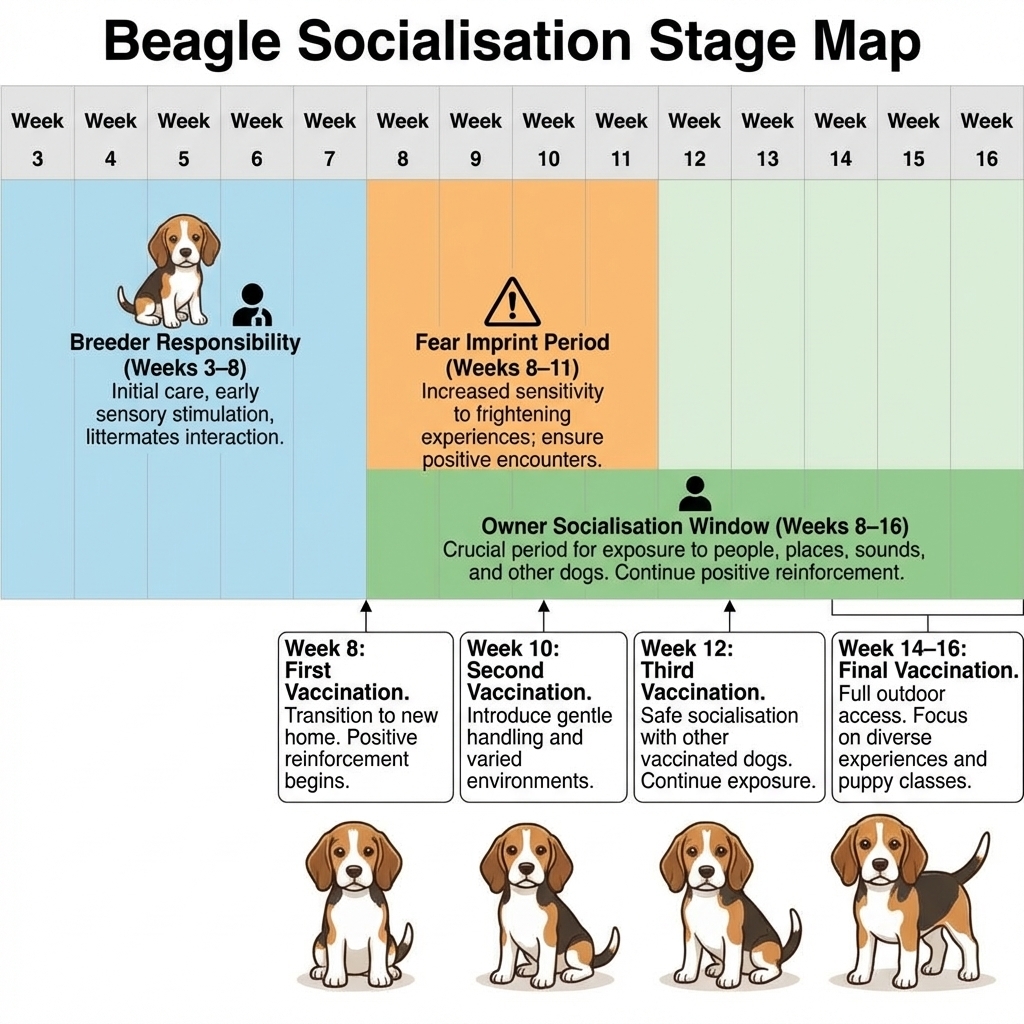
The socialisation window is a defined developmental period during which a puppy's brain is maximally receptive to forming associations — with people, animals, environments, sounds, and sensations. Associations formed during this window are more durable and more easily generalised than anything learned later in life. This is why early positive experiences produce confident adult dogs, and why early negative experiences — particularly during the fear imprint period — can require years of careful counter-conditioning to manage.
The window runs from approximately 3 weeks to 12 weeks of age. Its closure is not a hard boundary — learning continues throughout a dog's life — but the efficiency and permanence of socialisation learning decreases markedly after 12 to 14 weeks.
Critical periods within the window:
- Period Age Key Features Who Is Responsible
- Primary socialisation 3–8 weeks Social bonds, littermate learning, first human contact Breeder
- Fear imprint period 8–11 weeks Fear responses most sensitively formed; Owner — careful management essential single negative events can have lasting impact
- Secondary socialization 8–12 weeks Environmental confidence building; obedience learning begins Owner
The first half of the socialisation window — weeks 3 to 8 — occurs entirely in the breeder's care. What happens during that period shapes the puppy you receive at eight weeks. A breeder who managed their litter's socialisation rigorously (surface variety, sound exposure, multiple handlers, early neurological stimulation) hands you a puppy with a head start. A breeder who kept puppies isolated hands you a puppy with a deficit that you must work carefully to address.
For more on what ethical breeders do during this foundational period, the Corgi Ethical Breeding resource on PemberDiamonds covers the professional breeder socialisation standards applied from week 3 onward — standards that apply equally to well-managed Beagle litters.
Your First Days Home
Setting Up for Socialisation Success
The first 72 hours at home are not the time for socialisation outings. They are the time for settling. A puppy who feels safe in their immediate environment — who has a predictable feeding schedule, a comfortable den space, and calm, consistent handlers — has the emotional resources to approach novel experiences with curiosity rather than anxiety.
Think of it this way. Confidence in the unfamiliar is built from security in the familiar. Your home is the first chapter of your Beagle's social education, and it needs to be written carefully.
First-week setup priorities:
- Create a den space. A crate or defined sleeping area that belongs entirely to the puppy — never used for punishment, always accessible, and associated exclusively with rest and reward. A puppy who accepts their crate confidently has a portable security anchor for every future socialisation outing
- Establish feeding predictability. Beagles' food motivation is a major asset during training; feeding on a schedule (rather than free-feeding) keeps food reward value high and creates a natural daily rhythm that reduces ambient anxiety
- Introduce household sounds gradually. Washing machines, vacuum cleaners, television — begin at low exposure levels while the puppy is doing something enjoyable (eating, playing), and do not react to the sound yourself. Your calm response teaches the puppy that the sound is unremarkable
- Begin gentle handling practice. Touch ears, open the mouth briefly, handle paws, and press gently on the back — simulating veterinary examination. Pair each handling moment with a food reward. This is not obedience training; it is building the puppy's tolerance for human handling that will last a lifetime
- Limit visitors for the first 48–72 hours. Allow the puppy to orient to their core family before introducing additional humans
What to avoid in the first week:
- Car travel beyond the essential (vet check, collection journey)
- Uncontrolled access to the full house
- Sustained separation from all humans (Beagles are pack animals; isolation in the first days amplifies anxiety)
Handling Strangers
Building Confidence With New People
A Beagle who greets unfamiliar people warmly and without alarm is the product of deliberate, graduated stranger introduction across a wide variety of human presentations during the socialisation window. Beagles are generally predisposed toward human friendliness — but that predisposition requires positive early experience to express itself reliably.
The most consistent error in stranger socialisation is allowing well-meaning people to crowd, reach over, or pursue a puppy. The puppy learns — very quickly — that strangers are unpredictable. This is the foundation of the adult dog who barks at visitors, backs away from anyone outside the immediate family, or nips when approached without warning.
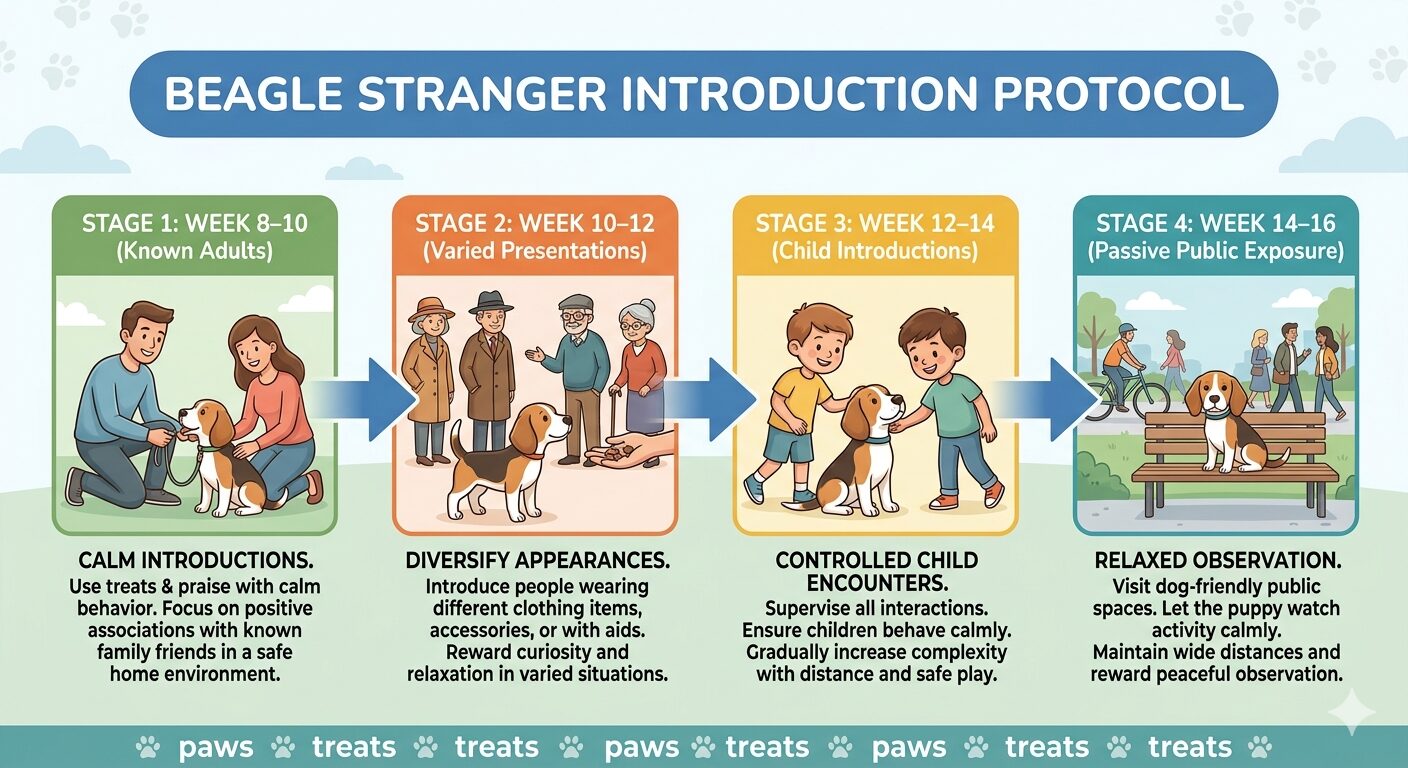
A practical stranger introduction programme:
Weeks 8–10 — Known adults in controlled settings
Brief family friends who can follow specific instructions: sit or crouch, avoid direct eye contact initially, extend a closed fist at nose level and wait for the puppy to sniff before attempting to pet
Three to five introductions per week, kept to 10 minutes maximum per session
Food reward delivered by the stranger at the moment of calm approach — this begins building the association between new humans and good outcomes
Weeks 10–12 — Varied adult presentations
People wearing hats, hoods, glasses, uniforms, carrying bags or equipment
Each visually distinct adult presentation adds a new "type" to the puppy's mental template of safe human
Beagles are particularly responsive to scent from unfamiliar people; allowing brief scent investigation before any petting is consistently effective for this breed
Weeks 12–14 — Child introductions
Children move quickly, approach directly, and speak loudly — all triggers for an under-socialised puppy's alarm response
Brief the child before the introduction: slow approach, no direct eye contact, let the puppy sniff first
The child should offer the treat, not the handler — this makes the child the source of the positive outcome
Weeks 14–16 — Passive public exposure
Café outdoor seating, quiet shopping car parks, pet-friendly retail environments
The goal is observation and habituation, not interaction. Your puppy watching the world from a safe position beside you — while eating treats — is effective socialisation
Introducing Your Beagle to Other Dogs
Inter-dog socialisation is one of the most natural aspects of Beagle development, given the breed's pack-hound heritage. Beagles typically show genuine enthusiasm for other dogs. The challenge is not usually reluctance — it is management of that enthusiasm to ensure introductions are safe and controlled rather than overwhelming for both parties.
Before full vaccination — safe options
- Household dogs (vaccinated, known health status)
- Privately arranged meetings with friends' or family members' vaccinated dogs in controlled settings
- Puppy socialisation classes held indoors with vaccination-verified attendees
Introduction protocol
- Choose neutral, open ground — not the home of either dog and not a small enclosed area
- Begin with parallel walking at a comfortable distance — both dogs walking alongside their handlers, gradually converging. This reduces the frontal approach that triggers defence responses
- Allow brief nose-to-nose contact (3–5 seconds) followed by recall and reward for both handlers. Build duration gradually across multiple repetitions
- Allow off-lead interaction only in a securely enclosed space, once both dogs have demonstrated relaxed body language through the leashed introduction
Beagle-specific considerations
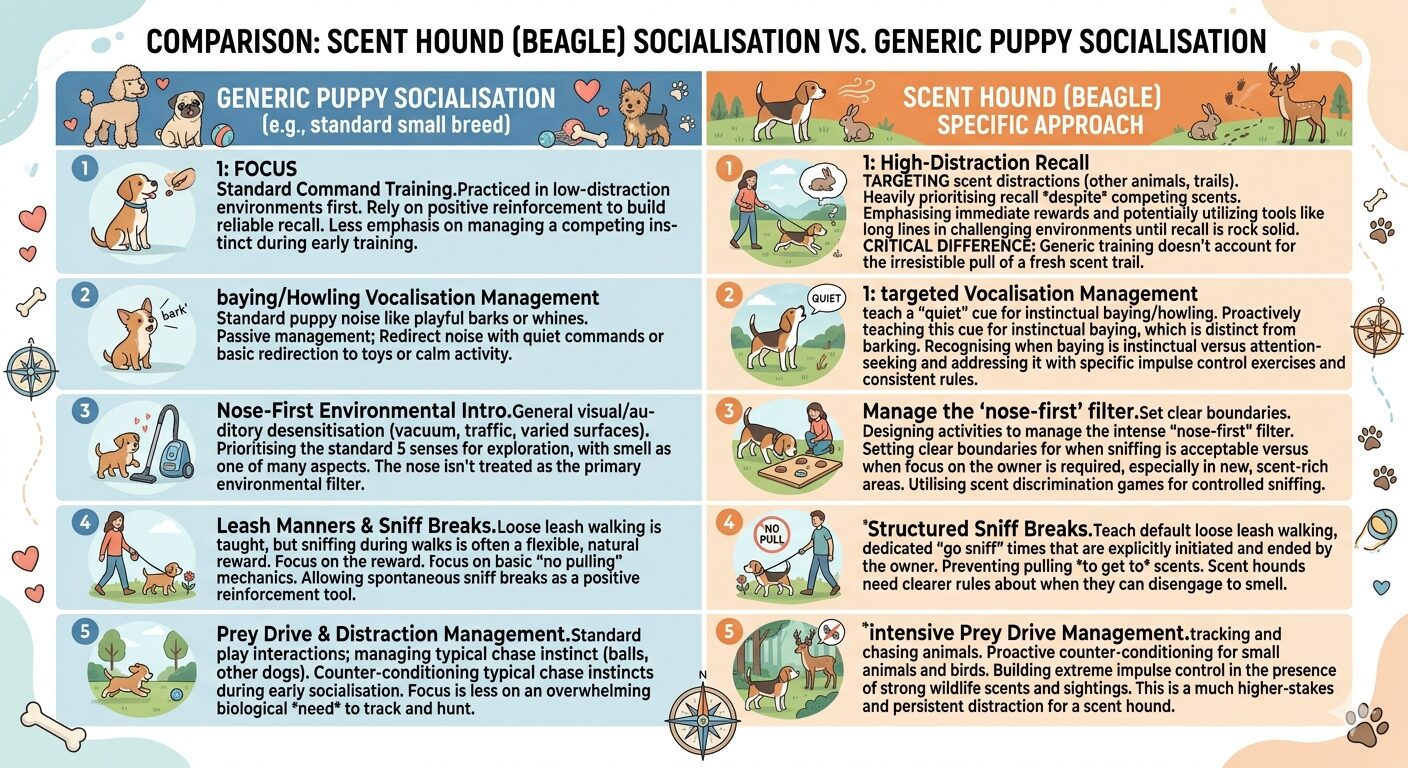
Beagles who catch a scent during a dog introduction will often disengage entirely from the social interaction to follow the trail. This is not anti-social behaviour — it is scent hound priority. Bring them back with a high-value food reward, allow the sniff, then re-engage
Monitor for over-arousal: Beagles who become very excited around other dogs can escalate into rough play that the other dog finds threatening. Brief managed sessions with regular breaks are more productive than sustained off-lead free play
Tracking inter-dog socialisation progress
Note the body language quality at each session — loose, wavy, relaxed (positive) versus stiff, fixated, or hackle-raised (needs intervention). Progress should show increasing relaxation over successive introductions with the same dog, and gradual positive generalisation to new dogs.
Group Classes and Structured Socialisation Environments
Group puppy classes are one of the most efficient socialisation investments available to a Beagle owner. They combine obedience training, environmental exposure, inter-dog interaction, and handler skill development into a single, trainer-supervised session.
Beagles are sometimes underestimated in training contexts because their scent-driven distraction can look like lack of attention or intelligence. The opposite is true. A Beagle who is engaged with a food reward in a group class is highly trainable — they are simply a dog for whom food motivation must be used skillfully to compete with the olfactory environment.
What to look for in a Beagle-appropriate puppy class:
- Positive reinforcement methodology — non-negotiable for scent hound confidence building
- Qualified trainer with demonstrable experience managing scent hound distraction patterns
- Group size of 6–8 puppies maximum
- Structured rest periods within the session — over-stimulated Beagles become increasingly scent-focused and lose training engagement
- Indoor or enclosed outdoor venue to reduce uncontrolled scent trails that pull Beagles off task
What to expect from your Beagle in class
- Your Beagle will likely be the dog with their nose on the ground between exercises — this is normal
- They will respond faster and more reliably to food rewards than to praise alone in the early classes — use this
- Recall practice in a class setting is challenging for scent hounds; position yourself with a high-value treat at nose level rather than calling from a distance and hoping
The CorgiCrew community has developed excellent practical guidance on evaluating puppy class quality and what to expect from group socialisation environments — content that translates directly to Beagle owners navigating the same choices. You can find their Corgi Puppy Socialisation Tips as a complementary reference, particularly the section on identifying quality group training environments. https://corgicrew.co.za/ ??? socialization??
Positive Reinforcement
The Core Tool for Scent Hound Training
Positive reinforcement is not simply a training methodology preference. For a scent hound, it is the approach most functionally aligned with how the breed is wired. Beagles follow rewards — specifically, food rewards — with the same commitment they follow scent. This makes positive reinforcement not merely effective but extraordinarily efficient when applied correctly.
The mechanics of positive reinforcement for Beagles:
Marker-reward timing
Use a clicker or consistent verbal marker ("yes") to mark the desired behaviour the instant it occurs, followed by a food reward within one to two seconds. The marker bridges the gap between the behaviour and the reward, allowing precise communication
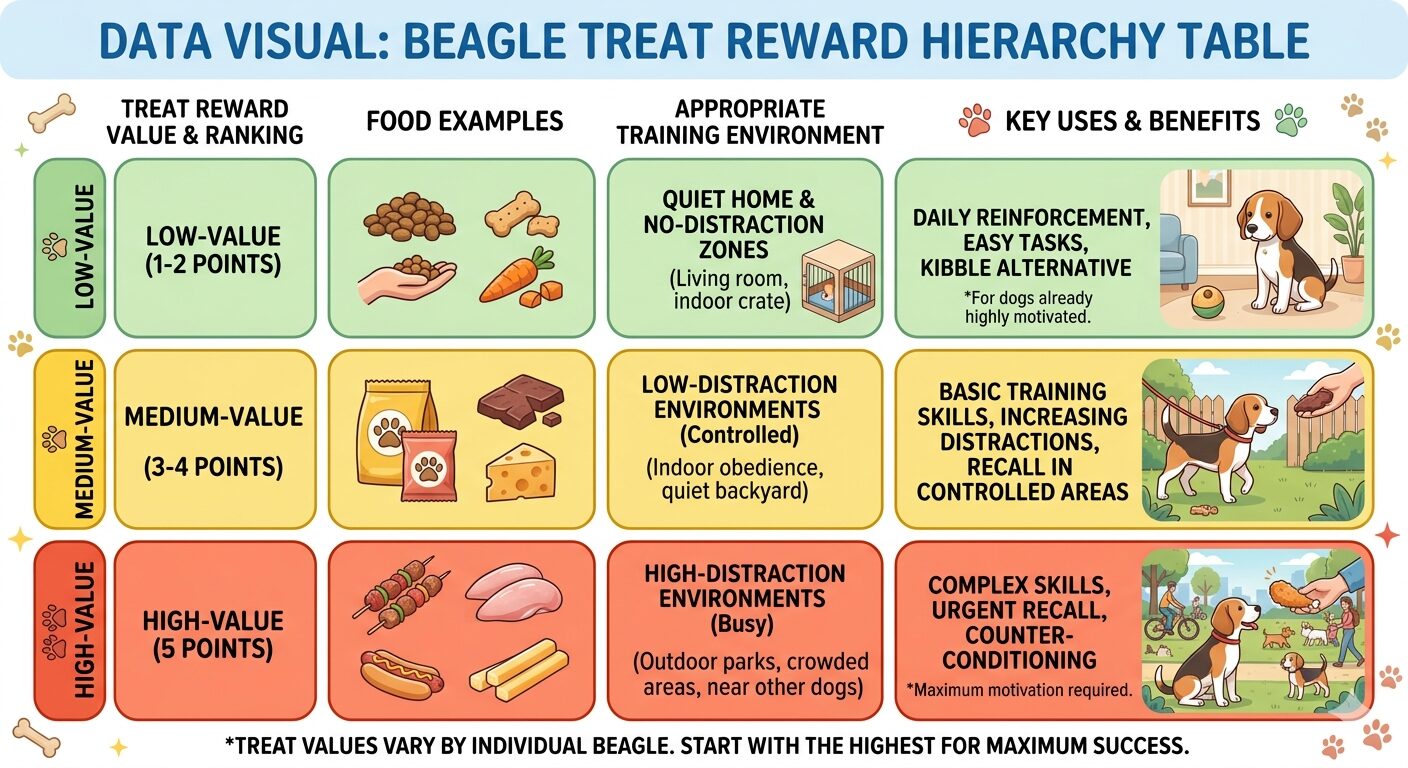
Reward hierarchy
Not all treats are equal in a Beagle's assessment. Establish a hierarchy: kibble (low value, low distraction environments), small cheese cubes or dried meat (medium value, moderate distraction), real meat or fish (high value, maximum distraction or new skill introduction)
Variable reward schedule: Once a behaviour is reliably established, shift to variable reinforcement — rewarding every second or third correct response rather than every one. This produces behaviour that is more persistent and more resistant to extinction when the reward is absent
Session length
Beagle puppies under 12 weeks: maximum 3–5 minutes per formal session. Three short sessions throughout the day outperform one long session dramatically. Beyond 12 weeks, extend gradually to 5–10 minutes
Positive reinforcement in socialisation contexts
When your Beagle puppy investigates an unfamiliar object calmly, interacts warmly with a new person, or maintains loose body posture around another dog, that moment is the one to reinforce. You are not rewarding compliance — you are rewarding confidence. This distinction matters enormously: you want a dog who is genuinely comfortable, not merely suppressing discomfort to avoid correction.
Behaviour Shaping for a Beagle’s Specific Social Challenges
Beagles present three socialisation challenges that are specific to the breed and require targeted behaviour shaping rather than generic puppy training:
Challenge 1
Scent-triggered disengagement
The situation. Mid-social interaction, your Beagle catches a scent and checks out entirely — nose to ground, ears closed to your cues.
The shaping approach. Teach a "check in" behaviour from week one. Every time your puppy voluntarily makes eye contact with you, mark and reward immediately. Over repetitions, this becomes a default behaviour — the puppy who periodically scans back to you during exploration, even when following a scent trail. This check-in behaviour becomes the foundation of reliable recall and social attention management.
Challenge 2
Vocalisation in social situations
The situation. Your Beagle bays at unfamiliar dogs, strangers, or sounds during social outings.
The shaping approach: Do not correct the vocalisation directly — this suppresses communication without addressing the underlying emotional state. Instead, mark and reward the moment of silence after the bay: "yes" + treat the instant the sound stops. Gradually, shape for longer and longer silences. Pair this with distance management — ensuring that exposures happen at a distance where your Beagle notices the stimulus without crossing their threshold into full vocalisation.
Challenge 3
Selective recall in off-lead environments
The situation. Your Beagle is reliable on recall in the garden, non-existent on recall when a scent trail is active.
The shaping approach: Never practise recall in environments where you cannot enforce it — a Beagle who is called and doesn't come gets a repetition of "it's fine to ignore the recall" rather than a training event. Build recall in controlled environments first, adding distraction and scent-trail presence incrementally over weeks. Use the highest-value food reward available at exactly the moment of return. For reference, The First Few Weeks Make All the Difference provides foundational context on how early breeders can set up recall basics before the puppy arrives home.
Obedience Basics That Make Socialisation Safer
A Beagle with a reliable obedience foundation is a dog you can manage safely in social environments. Without basic obedience, socialisation outings become unpredictable — your dog is a scent-following, vocalising, independent decision-maker with no reliable communication channel between you and them.
The core five for Beagle socialisation safety:
- Name response - Reliable, consistent response to name regardless of ambient distraction. This is the foundation of every other management tool. Practice in low-distraction settings first; introduce distraction incrementally
- Sit - The most useful interruption cue. A sitting Beagle is not baying, pulling, or nosing along the ground in pursuit of a trail
- Wait/stay - Critical for doorways, gate exits, and any transition point where an unsecured Beagle would bolt after a scent
- Leave it - Interrupts scent investigation of hazardous objects or inappropriate social interactions (another dog showing clear warning signals, a child behaving erratically)
- Come (recall) - Must be trained progressively with consistent positive reinforcement. Never use recall for an unpleasant consequence (grooming, bath, end of play) — this poisons the cue
Training schedule for the socialisation period
- Week 8–10 Name, sit, first recall attempts in the home
- Week 10–12 Down, wait introduced; recall practised in enclosed garden
- Week 12–16 All five cues in increasingly distracting environments; begin first group class if available
- Ongoing Continue across adolescence — skills acquired in puppyhood require maintenance through the hormonal changes of 4–12 months
Managing the Scent Hound Mind During Socialisation
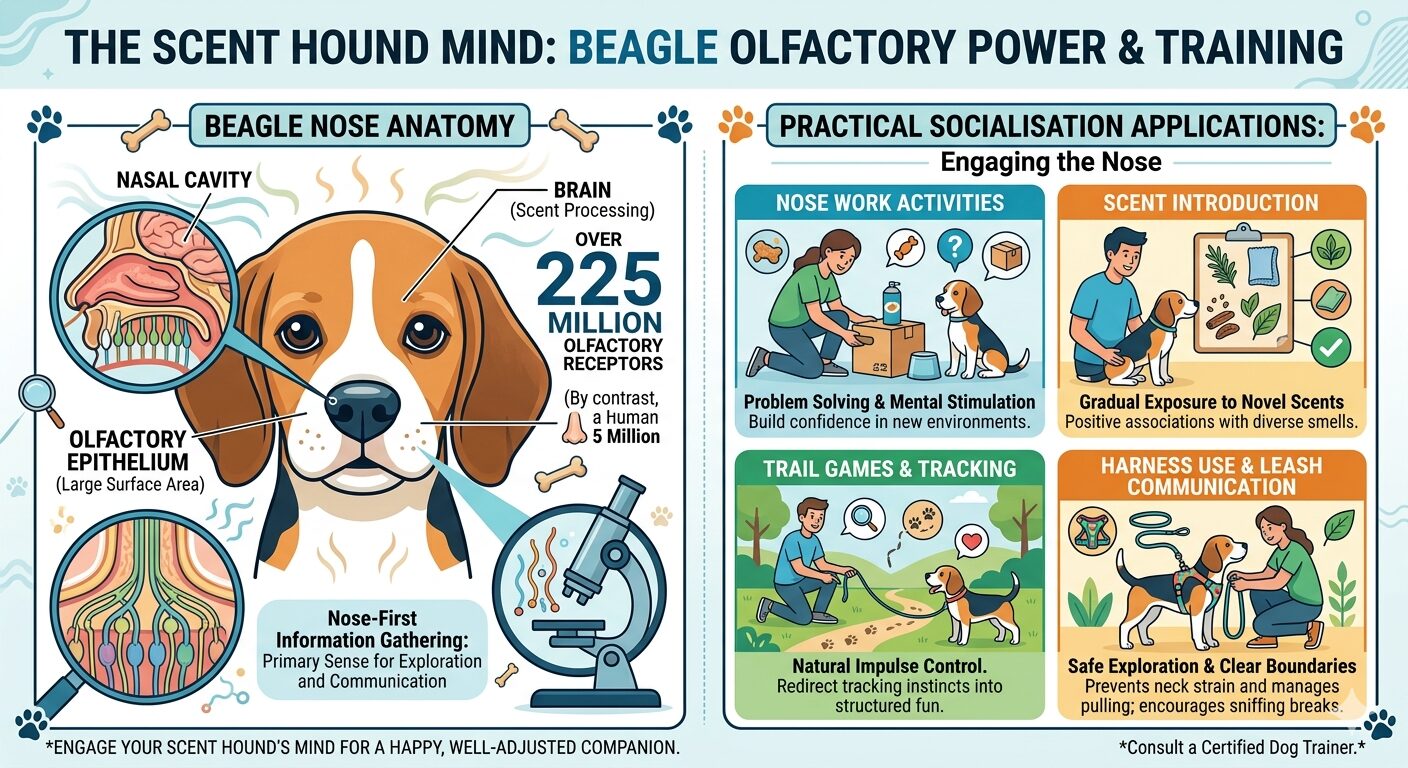 The Beagle nose is, by any physiological measure, extraordinary. With approximately 225 million olfactory receptors compared to approximately 5 million in the human nose, a Beagle processes scent information at a resolution that is genuinely incomparable to human sensory experience.
Socialisation that ignores this reality is socialisation that is working against the breed.
Working with the scent hound mind during socialisation is not complicated — it simply requires that you understand scent as a motivator rather than treating it as a distraction to be suppressed.
Practical applications of scent-aware socialisation
Nose work as confidence building
Simple scatter feeding or snuffle mat activities in new environments allow your Beagle to approach the space through their primary sense — scent — before being asked to engage socially. A Beagle who has thoroughly scented a new environment is demonstrably calmer and more socially responsive than one dropped into the middle of a novel space
Scent introduction of unfamiliar people
Allowing your Beagle to sniff a stranger's hand or clothing before any petting mimics the natural Beagle greeting protocol and produces faster relaxation than direct physical contact
Trail games in safe social environments
A simple treat trail laid across a new environment turns the exploration itself into a positive reinforcement experience — building positive associations with the environment through scent engagement
Harness vs collar for scent hound outings
Beagles following a scent trail pull against a collar in ways that can cause physical discomfort and create negative associations with outings. A well-fitted harness removes this physical conflict and keeps socialisation outings physiologically comfortable
For further guidance on how these early weeks shape your Beagle's long-term behaviour, Complete Guide to the Beagle provides comprehensive breed-specific context across health, training, and care.
EXPERT INSIGHT
"The most consistent mistake I see Beagle owners make during the socialisation period is using the same treat value for every context. In the garden with no distractions, a piece of kibble is adequate. In a puppy class with six other dogs and a trainer demonstrating equipment in the middle of the room, that same kibble is completely invisible to the Beagle brain — which is deep in scent-processing mode and requires a compelling food signal to compete. I always ask owners to build a treat hierarchy before their first socialisation outing and to bring their highest-value treat — real meat, cheese, dried fish — to every new environment for the first four to six weeks. Once the environment itself has become familiar and therefore lower-stimulation, you can drop down the reward value. But trying to compete with a Beagle's nose using kibble in a novel environment is a losing strategy from the start. The other thing: don't under-estimate how much your Beagle is learning from watching. A puppy who sits beside you at a café and watches the world, eating treats while the world goes by, is building positive associations with every person, car, and sound that passes. That passive observation time is not wasted — it may be some of the most valuable socialisation your dog ever receives." — COAPE-accredited Animal Behaviourist specialising in scent hound breeds
FAQ SECTION
1. When should I start socialising my Beagle puppy?
Socialisation begins at the breeder's premises from approximately week 3. As an owner, your responsibility begins at collection — typically eight weeks of age. The secondary socialisation window (weeks 8 to 12) is highly effective, but the fear imprint period (weeks 8 to 11) requires careful management. Start immediately and progressively, rather than waiting until full vaccination.
2. How do I socialise a Beagle puppy before they are fully vaccinated?
Before full vaccination, avoid uncontrolled public dog-traffic environments. Safe options include: meetings with vaccinated household dogs, controlled introductions with friends' vaccinated dogs in private settings, and puppy classes held in sanitised indoor venues with vaccination-verified attendees. Carrying your puppy in public spaces — allowing observation without ground contact — is a practical early option for sound and human exposure.
3. Why does my Beagle completely ignore me when they pick up a scent?
This is breed-typical behaviour rooted in the Beagle's working heritage as an independent scent-trailer. In socialisation terms, it means recall and attention training must be prioritised and practised with high-value food rewards in progressively more distracting environments over weeks — not assumed to transfer automatically from low-distraction to high-distraction settings. A "check-in" behaviour (voluntary eye contact rewarded) built from week one dramatically improves scent-hound attention over time.
4. My Beagle bays constantly during socialisation outings — is this normal?
A degree of vocalisation is breed-typical. However, excessive baying during socialisation outings usually indicates that the exposure intensity
exceeds the puppy's current confidence level. Increase your distance from the trigger (person, dog, sound) until the puppy is noticing without reacting, reinforce calm observation with high-value treats, and work progressively closer over multiple sessions. Do not correct the vocalisation directly — address the underlying emotional state through positive reinforcement.
5. Can Beagles socialise well with cats and small animals?
eagles have prey drive — originally directed toward rabbit and hare — and this can extend to cats, small dogs, and other small animals in the home. Early, carefully managed cross-species socialisation (scent introduction first, visual contact second, physical proximity third) produces Beagles who live comfortably with cats and small animals in the same household. The critical variable is management during the introduction phase and never allowing unsupervised access until reliable calm cohabitation is established.
6. What is the fear imprint period, and how does it affect my Beagle?
The fear imprint period runs from approximately 8 to 11 weeks of age — overlapping exactly with the time most Beagle puppies arrive in their new home. During this period, negative experiences are more rapidly and durably learned than at any other point. A single frightening event (a dog attacking, a loud unexpected noise, being dropped or handled roughly) can create lasting fear associations that require significant counter-conditioning to address. This is not a reason to avoid socialisation — it is a reason to manage exposure intensity carefully during this window.
7. How do I know if my Beagle's socialisation is going well?
Progress indicators include: the puppy's arousal level decreasing over repeated exposures to the same stimulus (habituation), the puppy voluntarily
approaching previously unfamiliar people or animals, recovery time after mild startles getting shorter, and food reward acceptance remaining consistent in novel environments (a puppy who won't take treats is too aroused or anxious to be learning). Any consistent failure to habituate — fear that intensifies rather than resolves over exposures — warrants assessment by a qualified behaviourist.
8. Are Beagles easy to socialise compared to other breeds?
Beagles' natural pack orientation and food motivation make inter-dog socialisation and food-reward-based training generally accessible. Their breed-specific challenges — scent-triggered disengagement, vocalisation, and independent recall — require targeted management rather than generic approaches. Overall, a Beagle with a good early socialisation foundation from the breeder and consistent positive reinforcement from the owner is one of the more socially resilient dog breeds in everyday life.
9. How does early socialisation affect a Beagle's long-term behaviour?
Early socialisation is the strongest predictor of adult behavioural health in dogs, including Beagles. Dogs with broad, positive early socialisation show significantly lower rates of fear, anxiety, aggression, and separation-related behaviour in adulthood. Conversely, under-socialisation in the primary and secondary windows is one of the most common underlying causes of behaviour problems that present in adult dogs — problems that are often manageable but rarely fully resolved through training alone.
10. Should I use a harness or collar for socialisation outings with my Beagle?
A well-fitted, escape-proof harness is strongly recommended for Beagles during socialisation outings. Beagles following a scent trail pull against restraint; a collar concentrates that pressure on the throat and creates physical discomfort that builds negative associations with outings. An H-harness or Y-harness with a chest clip allows full freedom of movement, distributes any restraint pressure across the chest and back, and makes socialisation outings physiologically comfortable — which is a prerequisite for effective learning.
CONCLUSION
Beagle socialisation comes down to three things done consistently: starting early, using positive reinforcement across every new experience, and understanding your scent hound well enough to work with their instincts rather than around them.
The socialisation window is the most valuable developmental resource available to any Beagle owner. What your puppy experiences between weeks 8 and 16 — the people they meet, the environments they explore, the animals they learn to read — creates the behavioural template for the adult dog you will spend years living with. Invest in it deliberately, and the returns are a dog who is genuinely confident, socially appropriate, and a pleasure in every environment you share together.
This is core Training & Behavior territory, and there is nothing passive about it. Socialisation is active, daily, and deeply connected to everything else you do with your Beagle. Begin now, stay consistent, and trust the process.
Your Beagle wants to engage with the world. Give them the tools to do it well.
CALL TO ACTION
Continue your Beagle's development with the resources specifically built for you at beaglepuppies.co.za. Start with The First Few Weeks Make All the Difference — a companion guide covering the foundational period before socialisation proper begins — and explore the Complete Guide to the Beagle for breed-specific context across health, care, and training. Your confidence as an owner grows alongside your Beagle's — and every article in the Tamboeckey Beagles' library is written to support exactly that.
Beagle Puppy Socialisation Guide
Pingback:Beagle Feeding and Nutrition - Tamboeckey Beagles
Pingback:Socialising Your Beagle Puppy - Tamboeckey Beagles