
Why Your Beagle Won't Stop Howling
And How to Actually Fix It — A Complete Guide for South African Beagle Owners
Practical training advice for Pretoria, Johannesburg, Cape Town & beyond
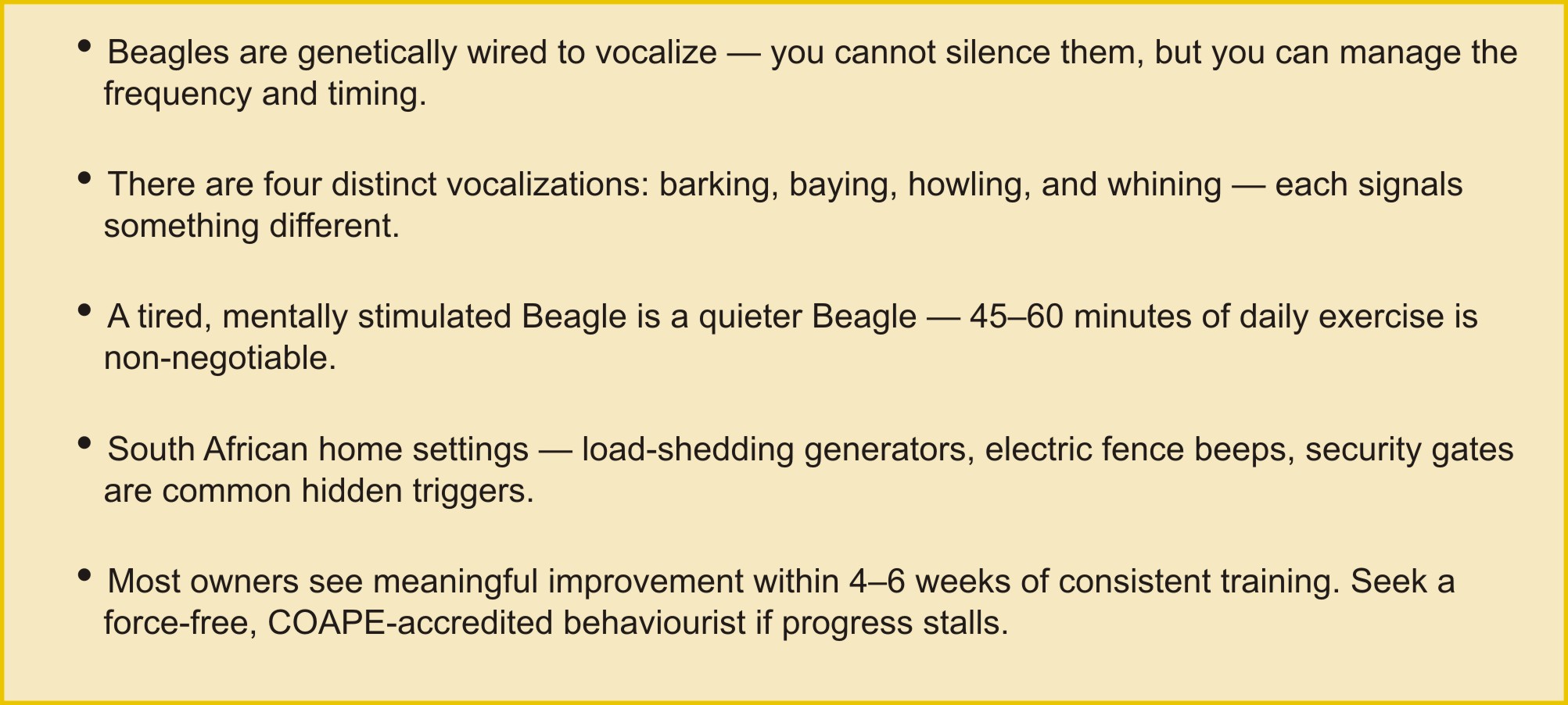
Quick Takeaways
It's 11pm. Your Phone Just Lit Up.

It's a WhatsApp from your body corporate. Your Beagle has been baying for the last twenty minutes straight. The neighbours in the townhouse complex are not impressed. If this sounds familiar, you are not alone — and you are not a bad dog owner. You just have a Beagle.
Beagles are one of South Africa's most popular family breeds: affectionate, curious, and sturdy enough to handle our climate. But their legendary vocal nature — that deep, resonant bay that carries three streets over — is the number one complaint from owners in Pretoria suburbs, Johannesburg townhouse complexes, and Cape Town estates.
Here's the good news, you can fix this. Not by silencing your dog's personality, but by understanding why they're doing it and meeting those needs more cleverly. This guide gives you the complete picture — the science, the practical training steps, realistic timelines, and South African-specific advice you won't find in generic overseas dog blogs.
Why Beagles Vocalize So Much
The Honest Explanation
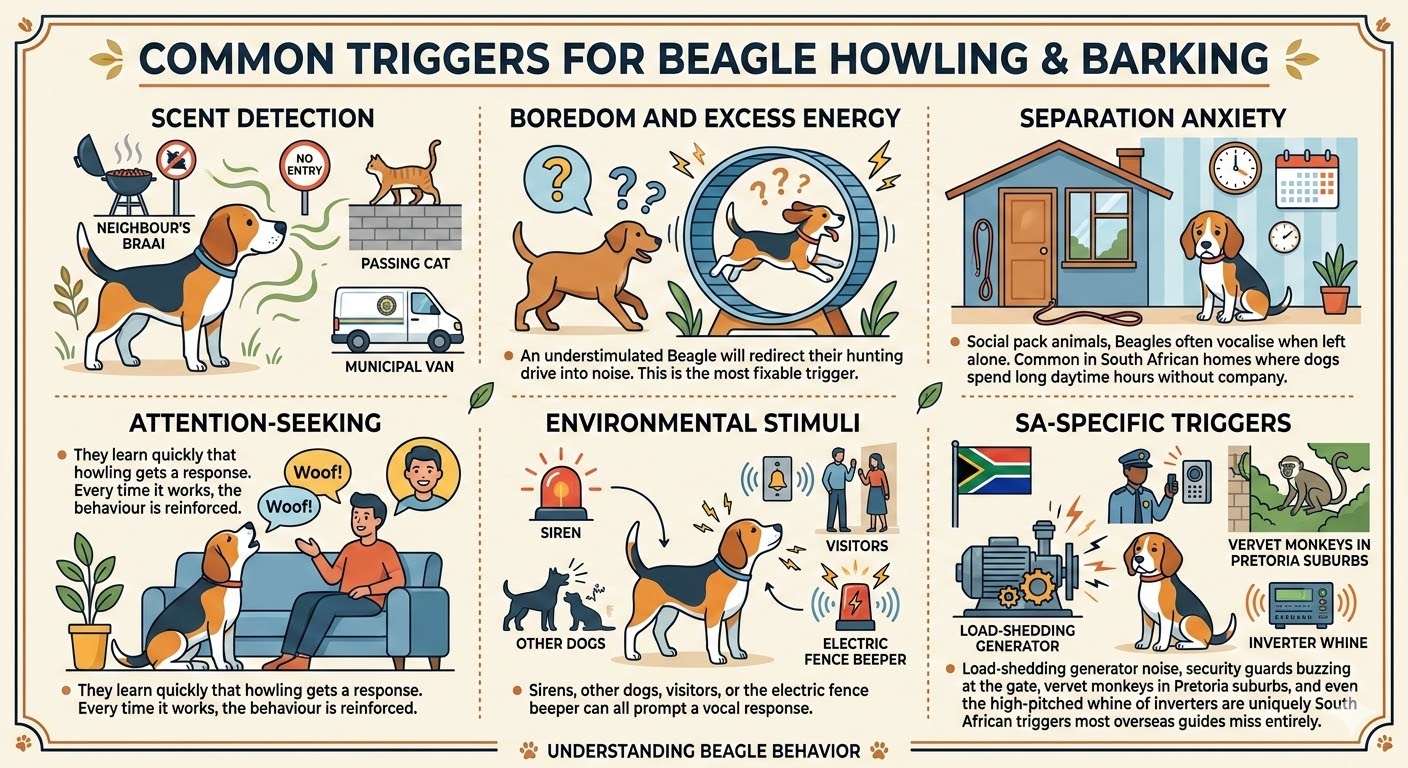
Beagles were bred in England as scent hounds, used in packs to hunt rabbits and hare across open countryside. Their vocalization wasn't a quirk — it was the job. Baying and howling communicated the dog's position to hunters and to other dogs in the pack across long distances. Centuries of selective breeding have hard-wired this behaviour so deeply that even a Beagle who has never hunted a day in its life will still bay at a scent trail, a passing cat, or nothing you can see at all.
The Four Beagle Vocalizations
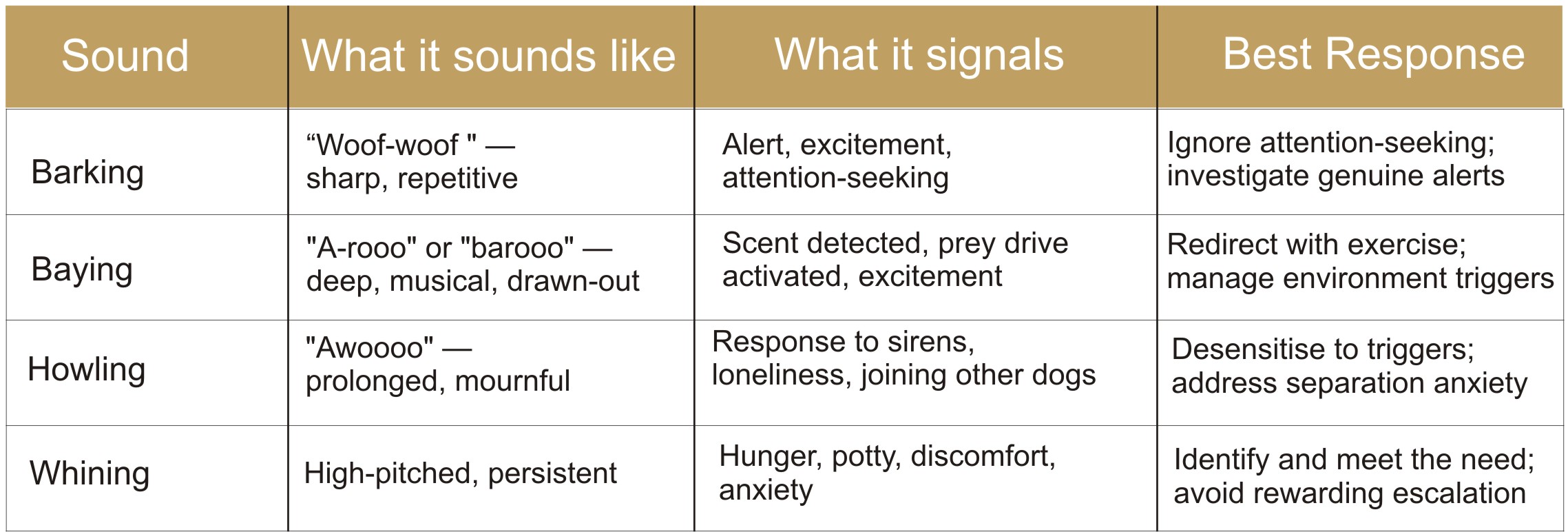
What They Mean and What to Do
Beagles have a unique vocal repertoire. Understanding which sound you're hearing is the first step to addressing it correctly.
Training Strategies That Actually Work (And Realistic Timelines)
A word of honesty before we start: there is no quick fix. Beagle vocalisation is deeply instinctual, and any approach that promises to 'stop' it in days is misleading you. What you can realistically achieve is a significant reduction in frequency and volume — enough for peaceful suburban living — within 4 to 6 weeks of consistent daily effort. Here is what that looks like in practice.
Step 1: Exercise and Mental Stimulation First (Non-Negotiable)
Everything else in this guide fails if this step is skipped. A bored Beagle is a loud Beagle, full stop. Provide 45–60 minutes of intentional exercise daily — not a wander around the garden, but a leashed walk that engages their nose. Allow them to sniff freely for portions of the walk. This is mentally exhausting in the best way.
For South African summers, shift walks to early morning or after sunset to avoid heat exhaustion. In smaller Gauteng garden flats or security estate homes with limited outdoor space, supplement with:
- Snuffle mats and scatter-feeding (hide kibble in grass or on a mat)
- Kong toys stuffed and frozen the night before
- Scent-tracking games: hide treats around the house and let them 'hunt'
- 10-minute obedience or trick training sessions — cognitively tiring and relationship-building
Step 2: Teach the "Quiet" Command — The Right Way
This takes 3–6 weeks practiced consistently. Here is the exact process:
- Week 1–2: Let your Beagle vocalize briefly, then wait for even a 2-second pause. The instant they stop, say "quiet" calmly and reward with a high-value treat (biltong pieces work brilliantly). Repeat 5–10 times per session, twice daily.
- Week 3–4: Begin saying "quiet" just before the natural pause, so the word starts to predict the silence. Extend the required silence to 5 seconds before rewarding.
- Week 5–6: Introduce mild distractions — a knock on the wall, another dog in view on a walk — and practice the quiet command in those contexts. Gradually build up to real-world triggers.
Critical – Never shout at a vocalizing Beagle. To them, you are joining the howl. Stay calm, wait for silence, reward generously.
Step 3: Desensitisation for Reactive Baying on Walks
For Beagles who bay explosively at other dogs, cyclists, or pedestrians on walks — common in busy Pretoria suburbs and along Johannesburg greenways — use the "Look at That" (LAT) technique developed by behaviourist Leslie McDevitt. Start at a distance where your dog notices the trigger but hasn't yet reacted. The moment they look at the trigger, mark with "yes" and treat. Over several sessions, the trigger becomes a predictor of treats rather than a reason to bay. Gradually reduce the distance as calm responses become reliable.
Step 4: Addressing Separation Anxiety Howling
This is the most common complaint in South African households where owners leave for work at 7am and return at 6pm. Separation-related vocalising is different from boredom or reactive baying — it is driven by genuine emotional distress and requires a specific approach:
- Practice departure cues without leaving — pick up keys, put on shoes, then sit back down. Repeat until the cues stop triggering anxiety.
- Start with absences of just 30 seconds, building very gradually to longer durations.
- Consider a dog-sitter, doggy daycare, or asking your domestic worker to spend time with your dog during the day — a practical and often cost-effective SA solution.
- In severe cases, consult your vet. SA vets can prescribe short-term anti-anxiety medication to assist training — not as a permanent fix, but as a tool to get below the anxiety threshold where learning becomes possible.
Environmental Adjustments for South African Homes
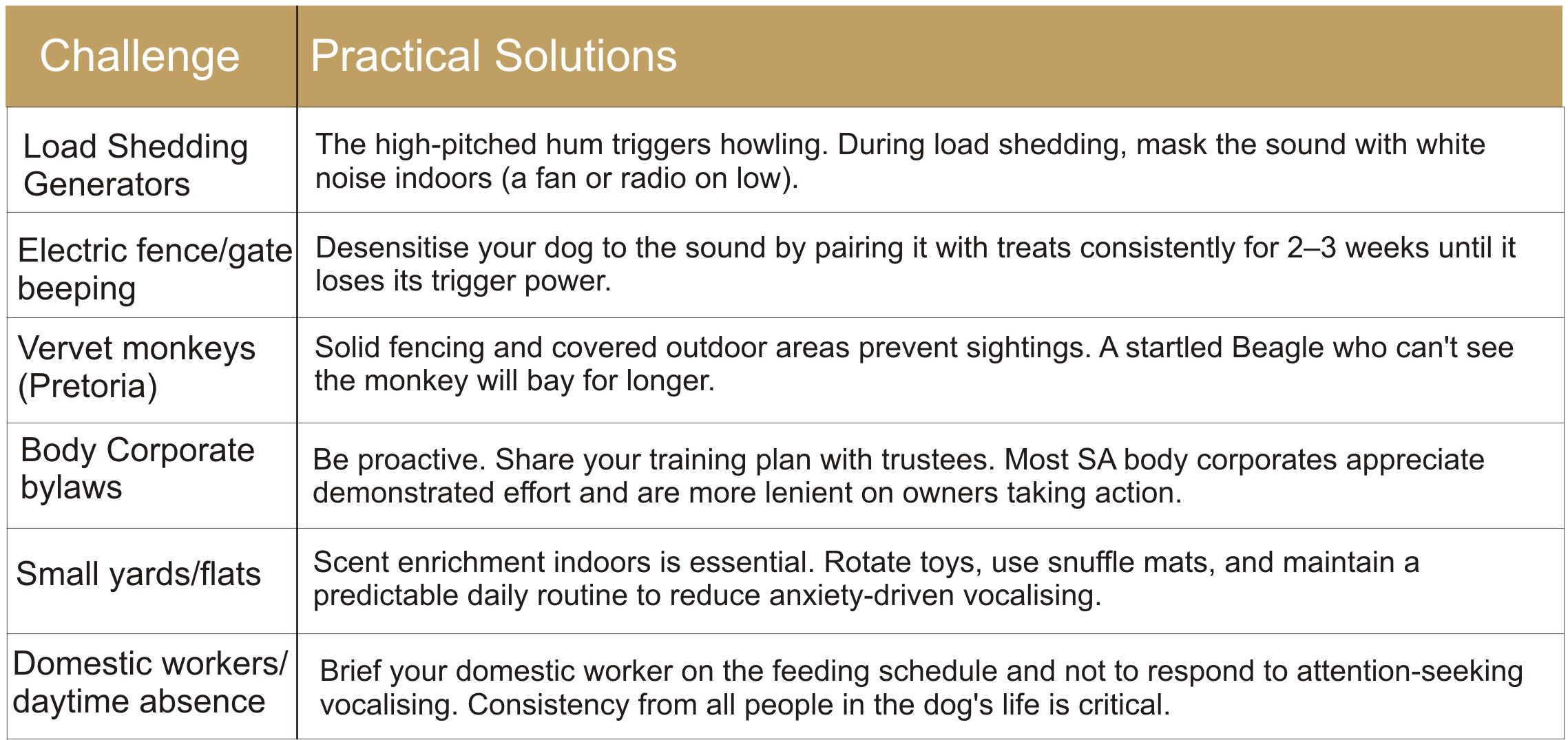
South African homes present unique challenges — from large-erf Pretoria estates to sectional-title Joburg complexes with strict body corporate noise bylaws (typically framed under the Gauteng Noise Control Regulations). Here is how to adapt your home environment:
Frequently Asked Questions
Will my Beagle ever stop howling completely?
No, and that would not be healthy for them. The goal is management: reducing frequency and volume to a level where you and your neighbours can live comfortably. Most owners achieve this within 4–8 weeks of consistent training.
Is it cruel to ignore a howling Beagle?
It depends on the cause. Ignoring attention-seeking howling is the right approach — responding rewards the behaviour. But ignoring genuine separation anxiety distress without addressing its root cause is not fair to your dog. Identify the type of vocalisation before deciding how to respond.
Can I use a bark collar or citronella collar?
These are strongly discouraged by professional behaviourists and animal welfare organisations, including the NSPCA. Punishment-based tools suppress the symptom without addressing the cause, often increasing anxiety and sometimes causing new, worse behaviour problems.
My Beagle only howls when I leave. What do I do?
This is separation anxiety — see Step 4 in the training section above. If the vocalising continues for more than 20–30 minutes after departure and is accompanied by destructive behaviour or elimination indoors, consult a vet or COAPE-accredited behaviourist.
Are there SA-specific resources for Beagle owners?
Yes. The NSPCA (nspca.co.za) provides welfare guidance and referrals. For training, look for force-free trainers certified through COAPE International or the Association of Pet Dog Trainers (APDT SA). Facebook groups like 'Beagle Owners South Africa' are also a good community resource.
When to Seek Professional Help
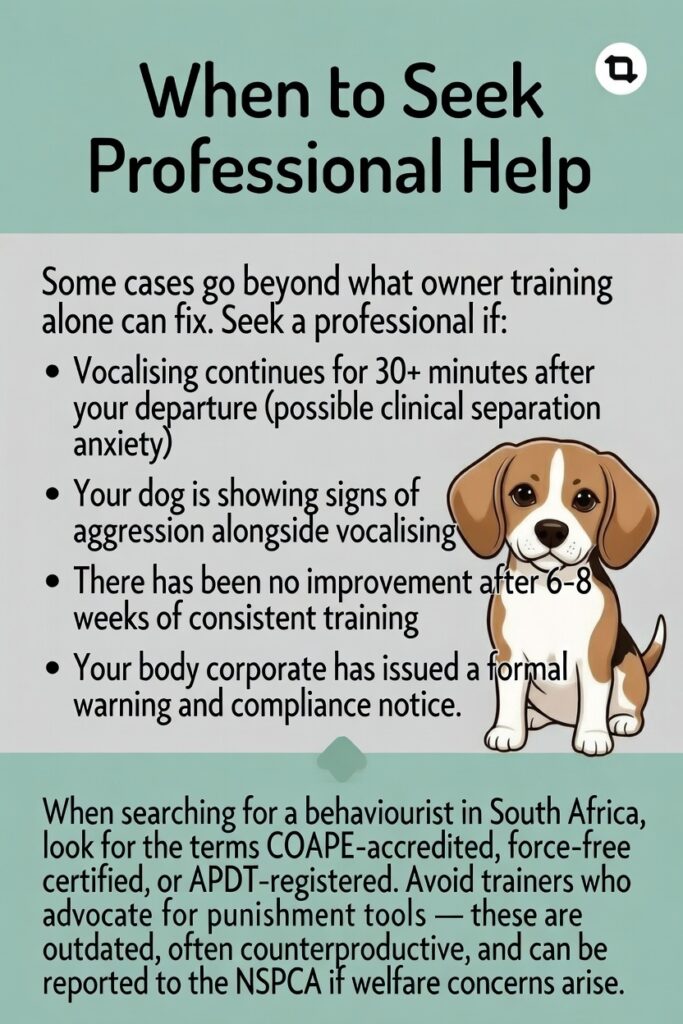
Some cases go beyond what owner training alone can fix. Seek a professional if:
- Vocalising continues for 30+ minutes after your departure (possible clinical separation anxiety)
- Your dog is showing signs of aggression alongside vocalising
- There has been no improvement after 6–8 weeks of consistent training
- Your body corporate has issued a formal warning or compliance notice
When searching for a behaviourist in South Africa, look for the terms COAPE-accredited, force-free certified, or APDT-registered. Avoid trainers who advocate punishment tools — these are outdated, often counterproductive, and can be reported to the NSPCA if welfare concerns arise.
The Bottom Line
Your Beagle's voice is part of who they are. Centuries of breeding made them this way, and no amount of frustration or wishful thinking will produce a quiet Beagle. What will produce a manageable Beagle is understanding their needs, meeting them consistently, and adapting your home environment to reduce unnecessary triggers.
Owners who commit to this process — really commit, daily, for 6–8 weeks — almost universally report dramatic improvement. The neighbours stop complaining. The body corporate warnings stop coming. And you get to keep your wonderful, ridiculous, endlessly entertaining hound.
Pingback:Beagle Puppies for Sale - Tamboeckey Beagles