
Are Beagles Good Family Dogs?
Most families researching Beagles already half-want one. The breed is friendly-looking, medium-sized, famous for being gentle with children, and seems, on paper, like an obvious family dog. The question is rarely "are they nice dogs?" The real question — the one worth answering honestly — is whether a Beagle will actually suit your family's specific life, not just the idea of family life in general.
This article is written for South African families in the research phase of getting a dog — curious about Beagles but cautious enough to want an honest answer, not a sales pitch — so they can make a confident, well-informed decision they won't regret. The are Beagles good family dogs question deserves more than a reassuring yes. It deserves a real answer: yes, genuinely, for the right family — and here is what "the right family" actually looks like.
Beagles have been one of the most consistently popular breeds in South Africa for decades, and the reason is not mysterious. But the families that love them most are the ones who went in knowing what they were getting. This guide is for them.

Are Beagles Good Family Dogs?
Yes — Beagles make excellent family dogs for households that understand their nature. They are affectionate, pack-oriented, sturdy, and typically wonderful with children and other pets. The honest caveats are equally important: Beagles are scent-driven, vocal, and moderately stubborn. Families who prepare for these traits in advance consistently report a deeply rewarding relationship. Those who don't are frequently surprised by them.
The Beagle Personality
What the Breed Is Actually Like
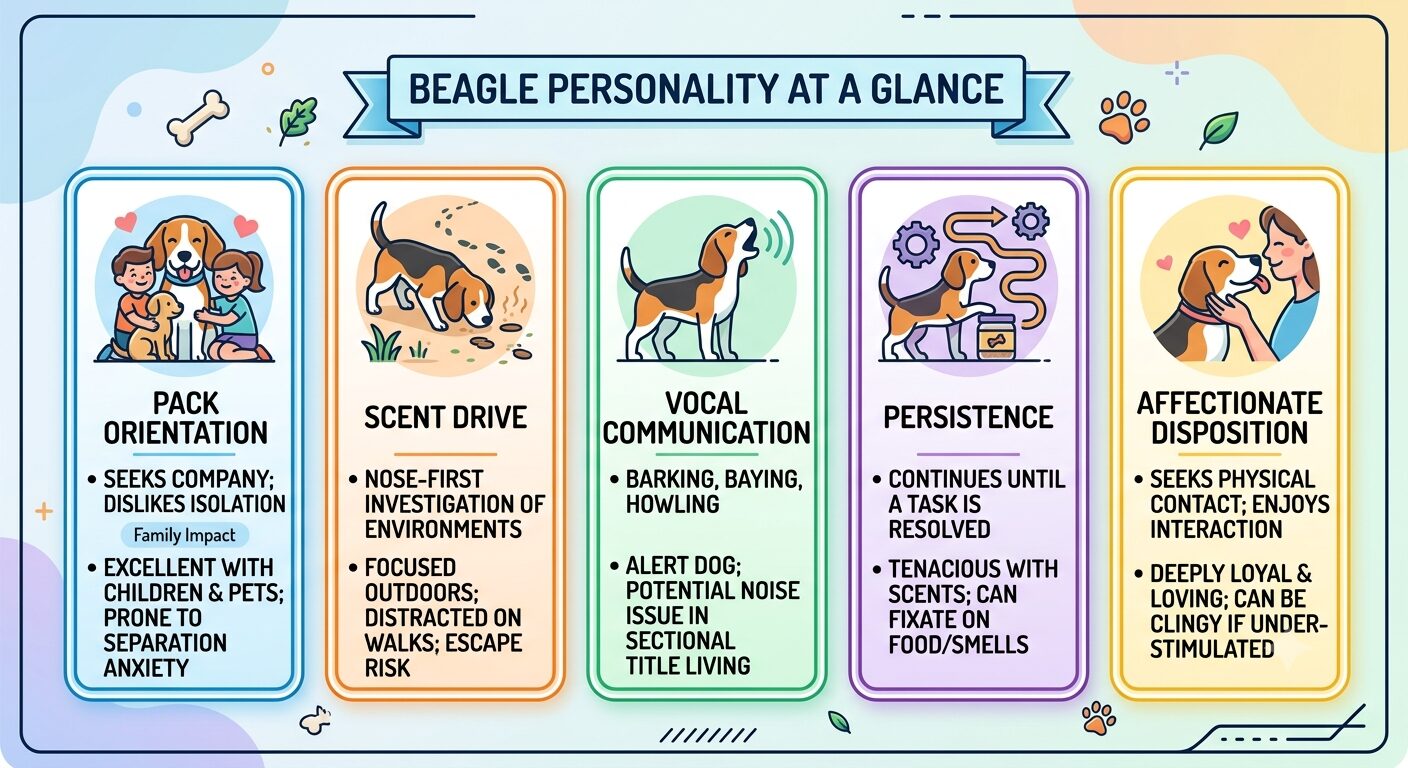
The Beagle is a scenthound — one of the oldest breed classifications, developed specifically to track game by scent across long distances. In Britain, Beagles were used to hunt hare in packs, and that working origin shapes every aspect of the breed's personality: they are sociable because pack hunting requires cooperative temperament; they are vocal because the bay (the distinctive Beagle howl) communicated the dog's location and direction to the hunting party; they are persistent because a hound that abandoned a scent trail was useless; and they are independent because field decisions had to be made without waiting for instruction.
These are not character flaws. They are the breed's design features — and they are fully present in the modern family Beagle, regardless of whether that dog has ever tracked anything. Understanding beagle breed personality traits at this level makes the rest of this article coherent, because everything that makes Beagles wonderful as family dogs and everything that catches families off-guard can be traced back to this working origin.
Beagle Temperament With Children
What the Evidence Shows
The Beagle's beagle temperament with children is one of its most consistently praised qualities, and the evidence — both anecdotal and from structured breed assessment — supports the reputation. Beagles are sturdy, tolerant, playful, and gentle by breed temperament. The American Temperament Test Society's data places the Beagle at a pass rate above 80%, indicating a breed with a reliably stable, non-aggressive disposition under stress conditions.
Several specific characteristics make Beagles particularly well-suited to family life with children:
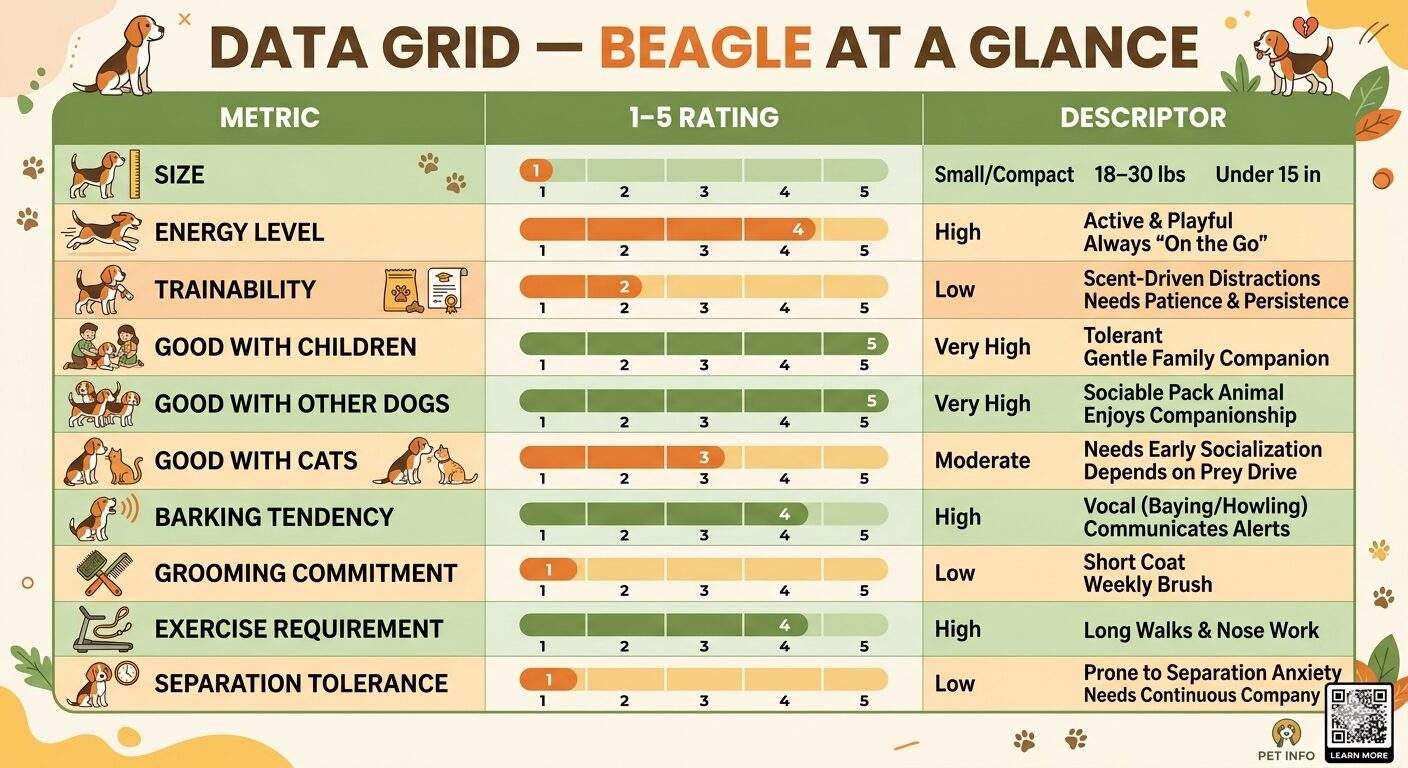
1. Physical robustness. At 8–14 kg for a standard Beagle, the breed is large enough not to be accidentally injured by toddler interaction, but small enough to be unthreatening to young children. The compact, muscular build is genuinely resilient.
2. Play drive without intensity. Beagles love to play but do not have the intense prey drive or herding instinct that can cause other breeds to become rough or overwhelming in active play with children. Play is typically joyful rather than driven.
3. Gentle mouth. The breed does not have a strong biting tendency, and bite incidents in well-socialised Beagles are rare compared to breeds with stronger guarding or herding instincts.
4. Tolerance of noise and chaos. Most Beagles are not startled or stressed by the unpredictable noise, movement, and activity levels of family life. This is a breed that was bred to work in stimulating environments and generally does not over-react to domestic chaos.
Important context - No breed is automatically safe with children, and individual temperament, early socialisation, and adult supervision always matter more than breed averages. A Beagle that has been socialised well and raised in a consistent, positive environment is a different animal from one that has been isolated or poorly handled, regardless of breed disposition.
For a deeper understanding of how early socialisation shapes a Beagle puppy's long-term temperament, the beaglepuppies.co.za guide Socialising Your Beagle Puppy provides a structured stage-by-stage framework from 8 weeks through adolescence.
Beagles and Other Pets
Pack Dogs in a Multi-Animal Home
The Beagle's pack-oriented heritage makes it, in most cases, genuinely good company for other animals. Historically, Beagles hunted alongside other Beagles in packs of twenty or more — a working context that selected strongly for cooperative, non-aggressive social behaviour with other dogs. Most Beagles prefer the company of other animals to solitude, and many Beagle owners find the breed actually thrives better in a multi-pet household than as a single dog.
Beagles and other dogs. Generally excellent, particularly with other medium or similarly social breeds. The pack instinct means Beagles typically initiate play well, accept canine companionship readily, and adjust to a second dog with less friction than many breeds. Early socialisation strengthens this tendency but is rarely needed to correct an inherent problem.
Beagles and cats. Variable — and dependent primarily on introduction age and method rather than breed predisposition. Beagles raised with cats from puppyhood typically co-exist well. Adult Beagles introduced to cats for the first time require a structured introduction period, and some individuals will never fully suppress the chase impulse toward small fast-moving animals. Management and supervised introduction are essential.
Beagles and small animals (rabbits, guinea pigs, birds). The scent drive that is so characteristic of the breed means Beagles will typically show significant interest in small prey animals, regardless of early exposure. Cohabitation is possible with rigorous management — separate spaces, secure enclosures, supervised interaction — but should never be assumed safe without it.
The Real Challenges
What Families Need to Prepare For
The honest side of the are Beagles good family dogs question is here. Every breed has trade-offs, and the Beagle's are specific and predictable. Families who know about them in advance and prepare accordingly rarely find them insurmountable. Families who discover them after acquisition often find them overwhelming.
Beagle barking and howling is the single most frequently cited challenge in owner surveys and breed forums.
The Beagle bay is a deep, carrying vocalisation that can travel remarkable distances. It is not the same as a nuisance bark — it is a communication system the dog was bred to use, and it fires readily in response to scent stimulation, the owner's return, boredom, and alerting to sounds or movement. In a house with a garden, managed by an owner who understands the cause and provides adequate stimulation, this is a manageable characteristic. In a sectional title complex or an under-stimulated environment, it is a serious issue. Prospective owners in apartment or townhouse settings should assess this carefully before proceeding.
Scent-driven distraction is the second major challenge. A Beagle that has picked up an interesting scent is, in that moment, unavailable for recall or redirection. The nose overrides the training in a way that surprises owners who have experienced more handler-focused breeds. On-lead management, secure fencing, and a thoroughly proofed recall are not optional extras for Beagle owners — they are non-negotiable safety requirements.
Fence and gate security follows directly from the above. Beagles are escape artists when motivated by a scent trail. Standard garden fencing is frequently insufficient. A garden suitable for a Beagle has no gaps at the base, a minimum height of 1.5 metres with an inward-facing overhang or dig guard, and gates with secure latches.
This is a preparation cost that prospective owners should factor in before acquiring the dog.
Food motivation and weight management. Beagles are intensely food-motivated — a characteristic that is enormously useful in training but creates a significant obesity risk if feeding is not managed precisely. The breed has a tendency to eat beyond satiety, and many Beagles will consume whatever is available. Free-feeding is not appropriate for this breed. Measured portions, twice daily, with food puzzle feeders to extend engagement and reduce gulping, are the recommended standard.
Beagle Energy Levels Indoors
More Than You Might Expect
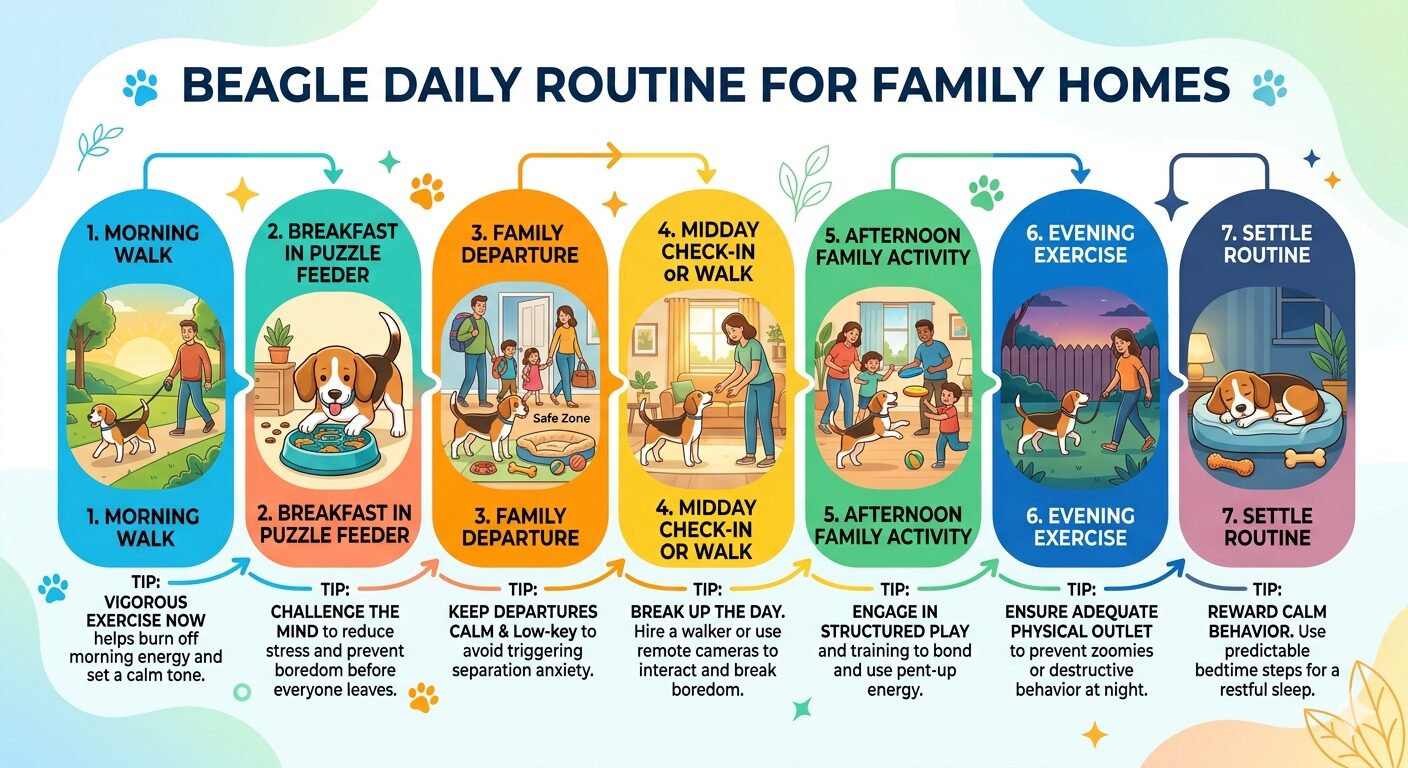
A question families frequently underestimate is what beagle energy levels indoors actually look like on a daily basis. The Beagle is not a high-drive working breed in the same category as a Border Collie or the Corgi — but it is not a low-energy lap dog either. The breed requires a minimum of 45–60 minutes of genuine exercise daily, and an under-exercised Beagle channels its energy into vocal behaviour, destructive chewing, and investigative activity in the house (which invariably involves finding and consuming things it should not).
The Beagle's indoor energy expression differs from high-drive breeds in an important way: it is nose-led rather than movement-led. An under-exercised Corgi will pace and herd. An under-exercised Beagle will sniff out the bin, investigate every kitchen surface, and methodically check every potential food source. This is not aggression or defiance — it is the scent drive looking for an outlet.
Managing Beagle energy indoors:
- Structured twice-daily walks covering a minimum of 2–3 km each, with off-lead sniff time in a secure area incorporated regularly.
- Scent work and nose games indoors: hiding treats or articles and releasing the dog to find them. This is genuinely tiring for scent-oriented breeds in a way that physical exercise alone is not.
- Food puzzle feeders for all meals — this extends the feeding period and engages the dog cognitively in a way that satisfies the food-seeking drive constructively.
- Scheduled quiet time with a long-lasting chew — bully sticks, natural chews, or a stuffed Kong provide sustained, calm engagement
Is a Beagle Easy to Train? An Honest Assessment
The honest answer to whether a Beagle is easy to train is: it depends entirely on what you mean by "easy" and what you are trying to train. Beagles are intelligent, highly food-motivated, and respond well to positive reinforcement. In those conditions, basic obedience — sit, down, stay, recall in a distraction-free environment — comes quickly.
The challenge is that Beagle intelligence is oriented toward scent problems rather than handler focus. A breed that evolved to make independent decisions in the field did not evolve to be a mirror of its owner's preferences. The Beagle will weigh the value of complying against the value of following its nose, and if the scent is interesting enough, the recall will fail regardless of how many times it has been practised at home.
What works in Beagle training:
- Positive reinforcement exclusively. The Beagle's food motivation makes reward-based training highly effective for basic and advanced skills. Aversive methods produce anxiety and shutdown, not compliance, in this breed.
- Short, frequent sessions. Five-minute training sessions four times a day outperform a single thirty-minute session in terms of retention and engagement for Beagles.
- Scent-based task integration. Using nose work as both enrichment and training — asking the dog to find a specific article before a walk, for example — leverages the breed's strongest motivation rather than competing with it.
- Consistent management of the environment. Training a Beagle to ignore the bin is less effective than securing the bin. Designing the environment so the dog cannot self-reward for unwanted behaviour is as important as training the behaviour itself.
The fuller picture of how breed personality shapes the Beagle's learning style and behaviour patterns is covered in the beaglepuppies.co.za Complete Guide to the Beagle.
Beagle Grooming and Maintenance
What the Weekly Commitment Looks Like
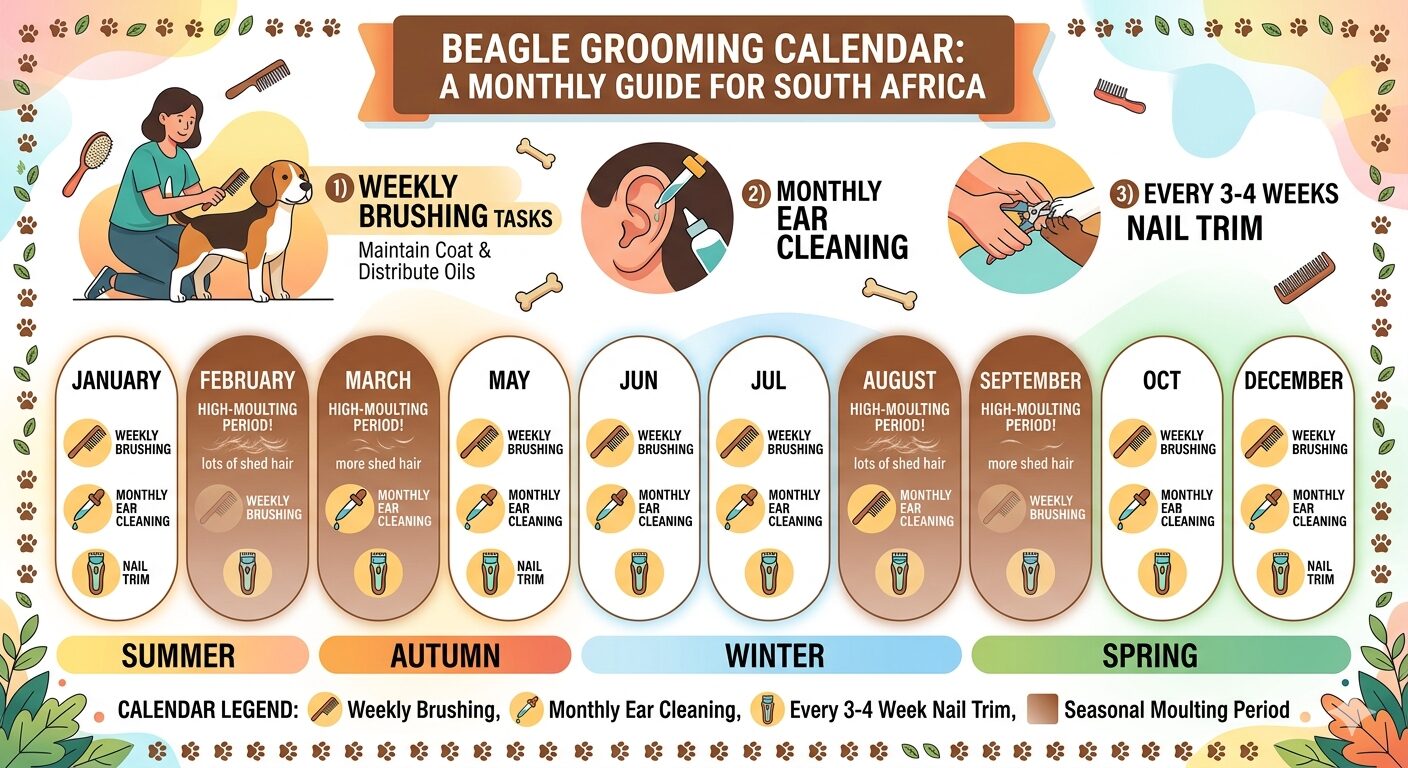
Beagle grooming and maintenance is one of the breed's genuine advantages for families. The short, dense double coat sheds moderately year-round and more heavily in spring and autumn, but requires no specialist grooming, no professional clipping, and no elaborate coat management.
Weekly grooming commitment:
Brushing. 10–15 minutes weekly with a rubber curry brush or bristle brush removes loose coat and reduces shedding in the home. Daily brushing during seasonal moults (August–September and February–March in South Africa) keeps shedding manageable.
Ear cleaning. The Beagle's long, floppy ears restrict airflow and create a warm, moist environment that predisposes the breed to ear infections. Weekly inspection and monthly cleaning with a veterinarian-recommended ear cleaner are standard practice. This is the Beagle's most commonly overlooked routine care requirement.
Nail trimming. Every 3–4 weeks. Beagles that walk on hard surfaces regularly may need less frequent trimming, but nails should not click audibly on flooring.
Teeth. Daily brushing is ideal; a minimum of 3 times per week. The Beagle's compact jaw structure makes dental disease a breed-relevant concern.
Bathing. Every 6–8 weeks, or as needed. The breed's coat is relatively self-cleaning and does not carry the strong odour associated with some other working breeds.
Beagle Separation Anxiety
A Breed-Specific Risk
Beagle separation anxiety is not universal in the breed, but it is a genuine breed-specific risk that prospective families — particularly those with full working days — should consider carefully. The Beagle's pack orientation, which is such an asset in family settings, is also the root of its difficulty with solitude. A breed that evolved to work and live in close social groups does not easily tolerate being left alone for extended periods.
Signs of separation anxiety in Beagles include prolonged barking or howling after the owner's departure, destructive behaviour specifically timed to absences (not present when the owner is home), loss of appetite in the owner's absence, and excessive greeting behaviour on return that takes more than a few minutes to settle.
Families considering a Beagle should assess honestly:
- Is someone home for a significant portion of the day, or will the dog be alone for 8+ hours regularly?
- Is the household set up for a second dog or companion animal that can provide social company?
- Is the family prepared to invest in separation training from puppyhood — gradual absence conditioning, independence-building exercises, and professional support if needed?
Separation anxiety is significantly easier to prevent through early independence training than to treat once established. Families who acquire a Beagle puppy and begin structured alone-time conditioning from week one are in a fundamentally different position from those who begin addressing the issue after six months of full-day absences have established the anxiety pattern.
For families navigating the multi-faceted question of how a Beagle fits into their specific household, the beaglepuppies.co.za resource Beagles in Family Homes examines the full range of domestic scenarios — house size, outdoor space, working hours, children's ages — and how the Beagle adapts to each.
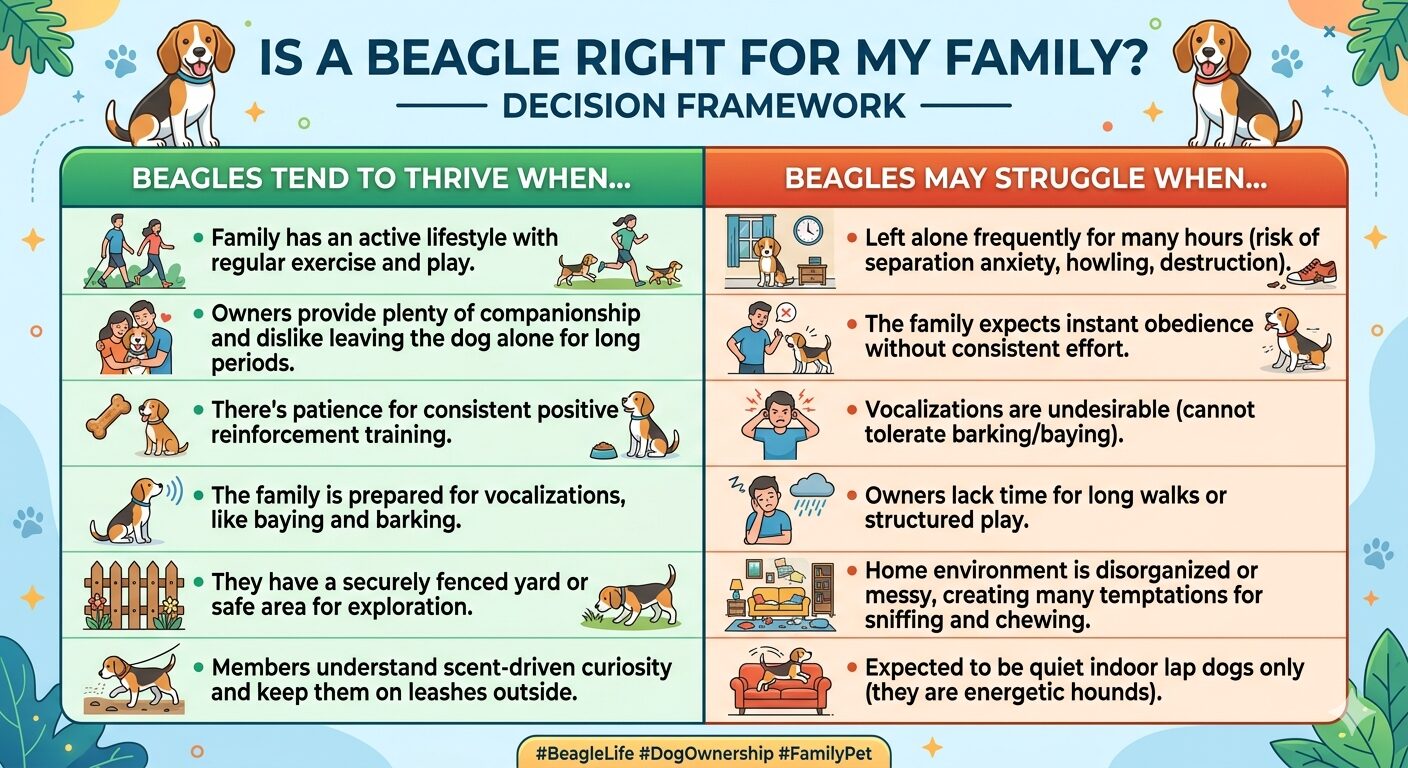
Is a Beagle Right for Your Family? A Decision Framework
Rather than a simple yes or no, the most useful answer to are Beagles good family dogs is a set of honest questions families should ask themselves before making the decision.
The Beagle tends to thrive in families that:
- Have a garden with secure, Beagle-proof fencing.
- Are home for a meaningful portion of the day, or have provisions for company (a dog walker, second pet, or nearby family member).
- Exercise the dog consistently — 45–60 minutes daily is not a preference, it is a requirement.
- Are willing to manage the vocal tendency proactively, and live in a property type where moderate barking is not a relationship-ending problem with neighbours.
- Have children old enough (generally 5+) to understand basic dog interaction boundaries, or are prepared to supervise younger children consistently.
- Understand that training will require patience and consistency rather than producing instant compliance.
The Beagle is likely a challenging fit for families that:
- Live in an apartment or sectional title complex with noise-sensitive neighbours and no private outdoor space.
- Are away from home for 8+ hours daily with no social provision for the dog.
- Are seeking a highly handler-focused, off-lead reliable dog without significant training investment.
- Are not prepared for moderate ongoing maintenance of ears, nails, and dental health.
- Have very small pets (rabbits, birds, guinea pigs) in the home that cannot be comprehensively separated
This is not a discouraging picture — it is an honest one. The families that land in the first category consistently describe Beagle ownership as one of the great joys of their lives. The goal of this guide is to ensure your family is one of them.
For context on how understanding a breed's working background shapes better ownership decisions more broadly, the PemberDiamonds article Why Corgis Thrive on Purpose and Work offers a compelling model for how breed purpose informs modern care needs — directly applicable to thinking about the Beagle's scenthound heritage.
 A Perspective on Beagle Family Suitability From the Breed Community
 A Perspective on Beagle Family Suitability From the Breed Community
"The families that come back to me after two years with a Beagle and say 'this is the best dog we've ever had' are almost never the ones who had the easiest time in year one. They are the ones who did their research, accepted that a Beagle is a dog with opinions, and built a relationship around that reality rather than trying to train it out.
What I always tell prospective Beagle families — particularly those with children under ten — is to think of the Beagle less as a passive companion and more as an active participant in family life. This is a dog that will want to be involved in whatever the family is doing. That quality is wonderful on a Saturday morning walk with the kids. It is less wonderful at 06:00 on a Tuesday when the dog has decided the rubbish bin is worth investigating in detail.
There is also a dimension of Beagle health that families often overlook in the acquisition phase: intervertebral disc disease is present in the Beagle at meaningful rates, as in many longer-bodied breeds. Families should be aware of this and factor it into their thinking about exercise type (lower-impact is better than repetitive jumping), weight management (excess weight dramatically worsens outcomes), and choosing a breeder who tests for relevant conditions and can provide health certificates for both parents. A dog from health-tested parents, kept at an appropriate weight and given regular low-impact exercise, has a significantly different long-term health trajectory than one where these factors have been neglected."
— Perspective from Beagle breed community and family dog ownership experience
 1. Are Beagles good with babies and toddlers?
 1. Are Beagles good with babies and toddlers?
Beagles are generally gentle, tolerant, and playful with young children — qualities that make them one of the more family-compatible medium breeds. However, interactions between any dog and babies or toddlers should always be supervised. Very young children cannot yet read canine body language, and even the most patient dog has a threshold. Toddler-Beagle interaction should be supervised consistently until the child is old enough (typically 5–6 years) to understand basic boundaries.
2. Do Beagles bark a lot?
Yes — barking and howling are characteristic of the breed and should be considered a fixed feature of Beagle ownership rather than a problem to be solved. The Beagle bay is deep, carrying, and fired readily by scent stimulation, boredom, alerting, and the owner's return. In a house with a garden, this is manageable with adequate stimulation and basic training. In an apartment or sectional title property, it is a serious consideration that should inform the ownership decision before acquisition.
3. How much exercise does a Beagle need every day?
A healthy adult Beagle requires a minimum of 45–60 minutes of genuine exercise daily. This should include structured walking and off-lead sniff time in a secure environment. The exercise requirement does not decrease significantly until the senior years. Under-exercised Beagles channel their energy into destructive chewing, vocal behaviour, and food-seeking activity indoors. Exercise is not optional — it is the foundation of manageable Beagle behaviour.
4. Are Beagles easy to train?
Beagles are intelligent and highly food-motivated, which makes basic obedience training straightforward with consistent positive reinforcement. The challenge is that the breed's scent drive can override trained behaviours in high-arousal outdoor situations. Recall reliability in open areas requires significantly more proofing than with handler-focused breeds. Short, positive training sessions with high-value food rewards, combined with environmental management, produce the best outcomes.
5. Can a Beagle be left alone during the day?
Beagles can learn to tolerate moderate alone time if conditioned from puppyhood using gradual absence training. Extended isolation — 8+ hours daily on a routine basis — is not well-suited to this pack-oriented breed and is a significant risk factor for separation anxiety, destructive behaviour, and excessive vocalisation. Families with full working days should consider whether they can provide a companion animal, a dog walker, or doggy day care provisions before acquiring a Beagle.
6. Do Beagles get along with cats?
Many Beagles co-exist well with cats, particularly when raised together from puppyhood. The key factor is the individual Beagle's prey drive intensity and the introduction method. Adult Beagles introduced to cats for the first time require a structured, gradual introduction with the animals separated between sessions. Some Beagles with high chase drive will always require management around cats. Never assume co-existence is safe without supervision in the introductory period.
7. Are Beagles suitable for apartment living?
Beagles can adapt to apartment living only with exceptional management of exercise requirements and vocal behaviour. The breed's tendency to bay and howl makes apartment life in noise-sensitive buildings difficult to sustain without causing conflict with neighbours. If apartment living is the family's situation, the honest advice is to research the building's pet policy, assess the noise tolerance of adjacent units, and commit to twice-daily outdoor exercise sessions. Many Beagle owners in apartments manage successfully — but it requires more daily effort than house living with a garden.
8. How big do Beagles get?
Standard Beagles typically weigh 8–14 kg and stand 33–40 cm at the shoulder, placing them solidly in the medium-small category. There is also a smaller variety (sometimes called a Pocket Beagle or Miniature Beagle, though this is not a separately recognised breed in South Africa under KUSA) that remains smaller. Size varies across individual lines and breeders. A reputable breeder can provide growth projections based on the parents' measurements.
9. What are the most common health issues in Beagles?
The Beagle is a generally hardy breed but carries breed-specific health risks that families should be aware of. Ear infections are the most common routine health issue, a direct consequence of the floppy ear anatomy. Obesity is a significant risk given the breed's food motivation and tendency to eat beyond satiety — weight management is a preventative health measure, not an aesthetic one. Intervertebral disc disease and hypothyroidism are present at meaningful rates in the breed. Hip dysplasia, while not as prevalent as in larger breeds, is worth investigating in breeding lines. Health certificates for both parents from a reputable breeder are a baseline expectation.
10. What is the best age for a Beagle puppy to join a family with young children?
Most breeders recommend a minimum acquisition age of 8 weeks, with 8–10 weeks considered the optimal window for socialisation and bonding. For families with children under five, some breeders and behaviourists suggest waiting until the child is slightly older — not because the Beagle is unsuitable, but because the supervisory demands of managing both a puppy and a toddler simultaneously are significant. If acquiring a puppy while children are very young, structured daily socialisation and a consistent positive reinforcement training plan from day one are essential.
CONCLUSION
Three honest takeaways from this guide. Beagles are genuine family dogs — affectionate, sturdy, sociable, and wonderful with children and other pets when socialised well. Their challenges are specific and predictable rather than unpredictable or dangerous: vocal behaviour, scent-driven independence, separation sensitivity, and food motivation. And the families that thrive with Beagles are not necessarily the ones with the most dog experience — they are the ones who understood what they were signing up for before signing up.
The promise of this article was an honest answer, not a sales pitch. That answer is: yes, Beagles make excellent family dogs for families who fit the profile — active households with secure outdoor space, someone home for a meaningful portion of the day, and an appetite for a dog with personality rather than one that simply waits for instruction.
In the category of lifestyle and activities, the Beagle's place in the family is not a passive one. It is a participant, a personality, a nose-first adventure companion that will embed itself in the rhythms of family life more thoroughly than most breeds. Go in knowing that, and you will not be surprised. You will simply be charmed.

If this guide has helped clarify where your family sits with the Beagle question, the next step is understanding the practical reality of bringing one home. The beaglepuppies.co.za resource Beagles in Family Homes examines the specific domestic scenarios — garden size, living situation, children's ages, daily schedules — and how Beagles adapt to each one. It is the practical companion to everything covered here, and the right next read before you make your decision.