
Socialising Your Beagle Puppy
Beagle puppies arrive with extraordinary social potential — they were bred to work in packs, read other animals, and follow a trail in the company of others. That instinct is an asset. But it does not make socialisation automatic. An under-socialised Beagle is not a problem dog; it is a confident, curious, scent-driven dog whose confidence is pointed in directions you have not yet been able to shape.
Beagle socialisation done well produces a dog who is comfortable with strangers, steady around other animals, unfazed by new environments, and genuinely enjoyable to live with. Done poorly — or not at all — it produces a dog who finds the whole world either alarming or overwhelmingly exciting, and who communicates both states loudly.
This guide gives you the practical framework to socialise your Beagle puppy from the ground up. The developmental windows that matter, the experiences that build real confidence, the approaches that use your Beagle's nose as a social tool, and the step-by-step plan for group classes, puppy playdates, and the crucial skill of handling strangers without anxiety. If you want a well-rounded, steady Beagle, this is where that starts.
QUICK ANSWER (Featured Snippet Target)
What does beagle socialisation involve?
Beagle socialisation means systematically exposing your puppy to a wide range of people, animals, environments, and experiences during their early developmental stage — primarily between 3 and 16 weeks. Using positive reinforcement throughout, the goal is to build genuine confidence rather than simple tolerance, and to shape a Beagle who is curious, calm, and socially reliable as an adult.
Why Socialisation Is Different for a Scent Hound
Most socialisation guides are written with working or companion breeds in mind. Beagles are scent hounds, and that distinction matters practically. A Beagle's primary information channel is olfactory — the world arrives nose-first, before the eyes and ears have fully processed a situation. This means a Beagle puppy encountering a new person, animal, or environment is doing something cognitively different from what a retriever or herding breed puppy is doing in the same situation.
The practical implications for socialisation are:
- Let them sniff first. Restricting a Beagle puppy's access to scent during a new social encounter increases anxiety rather than building confidence. Let the puppy lead with the nose — this is how Beagles confirm safety.
- Scent carries emotional data. A Beagle puppy who smells anxiety or stress on a stranger (elevated cortisol is detectable by dogs) will register that information regardless of how calm the visual presentation is. Choose calm, relaxed people for early stranger interactions.
- Nose-led confidence building is a tool this guide returns to in Section 8 specifically. But the principle applies throughout, where possible, introduce new experiences nose-first.
Beagles are also pack-oriented by history. Early group socialisation — with other puppies, with calm adult dogs — draws on an instinct that is already there. Use it. A Beagle puppy who has positive early experiences with other dogs has a foundation for multi-dog household integration and group class confidence that is stronger than the equivalent experience in many other breeds.
The Developmental Windows That Shape Your Beagle’s Social Future
The socialisation developmental stage — specifically the primary socialisation window from approximately 3 to 16 weeks — is the period during which your Beagle's brain is most plastic and most receptive to new experiences becoming normalised rather than threatening. Experiences within this window become templates; experiences outside it require significantly more repetition and careful management to produce the same effect.
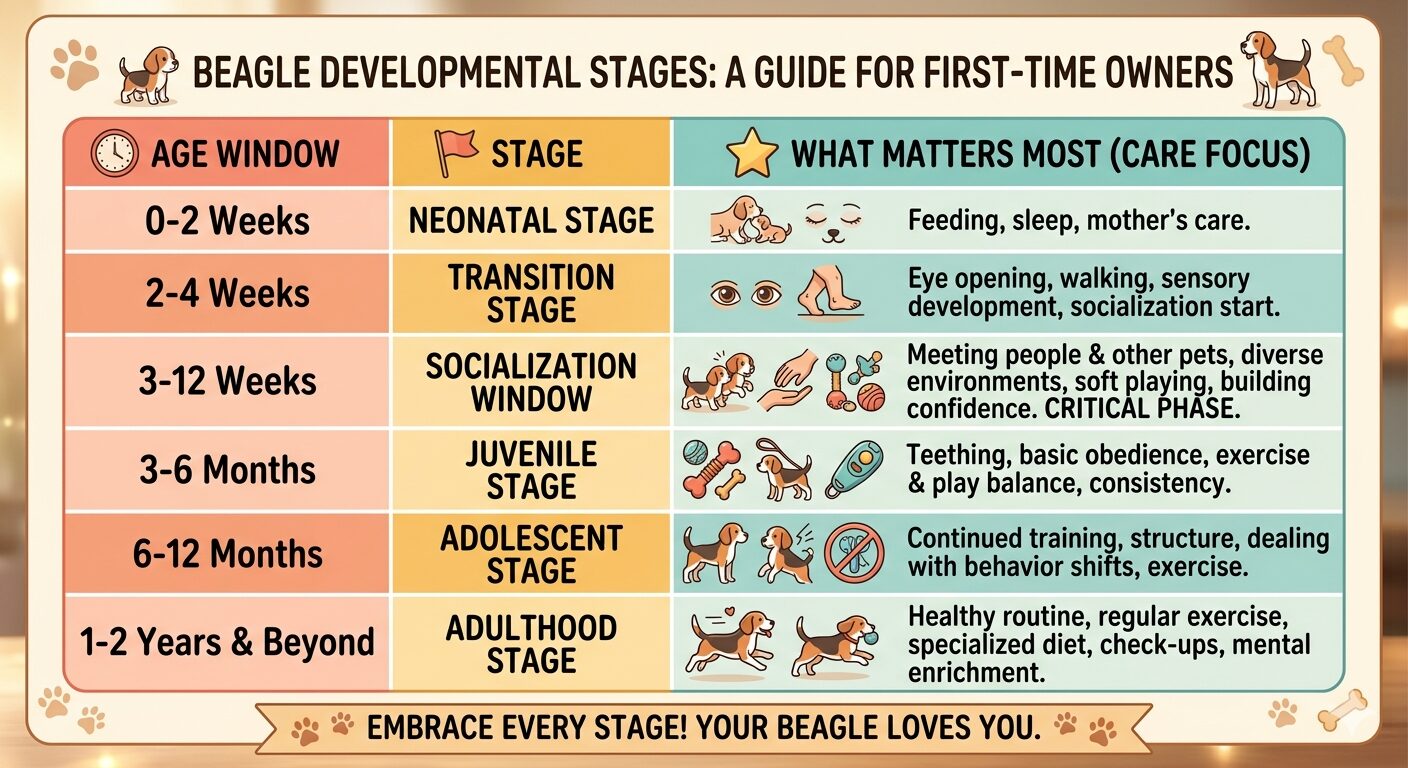
Key developmental stages for Beagle puppies:
Age WindowStageWhat Matters Most
3–4 weeks - Primary socialisation beginsLittermate interaction, dam behaviour, whelping environment
4–8 weeks - Rapid social learningExposure to handling, varied sounds, human contact frequency
8–12 weeks - Peak sensitivity windowMost critical human and animal socialisation period; fear imprints are most intense
12–16 weeks - Socialisation window closingConsolidating exposures; beginning basic obedience foundations6–18 monthsAdolescent periodSocial skills are tested; previous socialisation is foundation, not guarantee
The 8–12 week window is the highest-leverage period in your Beagle's social development. Every positive experience during this period reduces the neural cost of similar experiences later. This does not mean overwhelming the puppy with every possible stimuli — it means ensuring that the experiences provided during this window are positive and varied.
A comprehensive framework on how each developmental stage shapes a puppy's trajectory is available in our Beagle Puppy Socialisation Guide and the Complete Guide to the Beagle.
Building Confidence Through Positive Reinforcement
All socialisation in this guide is built on positive reinforcement — pairing new, potentially uncertain experiences with something the puppy genuinely values. For most Beagles, that is food, the breed's food motivation is a significant asset in socialisation contexts, because it provides a reliable, portable emotional reset tool in situations that might otherwise produce mild anxiety.
How to apply positive reinforcement in socialisation:
- Use high-value treats (small pieces of cooked chicken, cheese, or commercial training treats) specifically for socialisation contexts — not as part of regular feeding. The treat needs to be worth more than the uncertainty of the new experience.
- The sequence is, new stimulus → treat appears → puppy engages (or simply remains calm). The treat is not a bribe to perform — it is a classical conditioning tool that changes the emotional association the puppy has with the new stimulus over time.
- Do not wait for stress. Deliver the treat before the puppy shows anxiety, as a proactive association builder, not as a comfort after the fact.
What positive reinforcement in socialisation is not:
It is not forcing a puppy to approach what it finds frightening by luring with treats. If the puppy is pulling away, retreating, or showing hard stress signals (freezing, whale eye, tucked tail), the distance needs to increase — not the value of the treat. Flooding, however well-intentioned, is the single most reliable way to embed a fear response rather than resolve it.
Puppy Playdates
How to Set Them Up Correctly
Puppy playdates are one of the most effective socialisation tools available — and one of the most frequently set up in ways that undermine the outcome. An overwhelming, chaotic playdate with a mismatched partner can produce fear and defensive behaviour rather than social confidence.
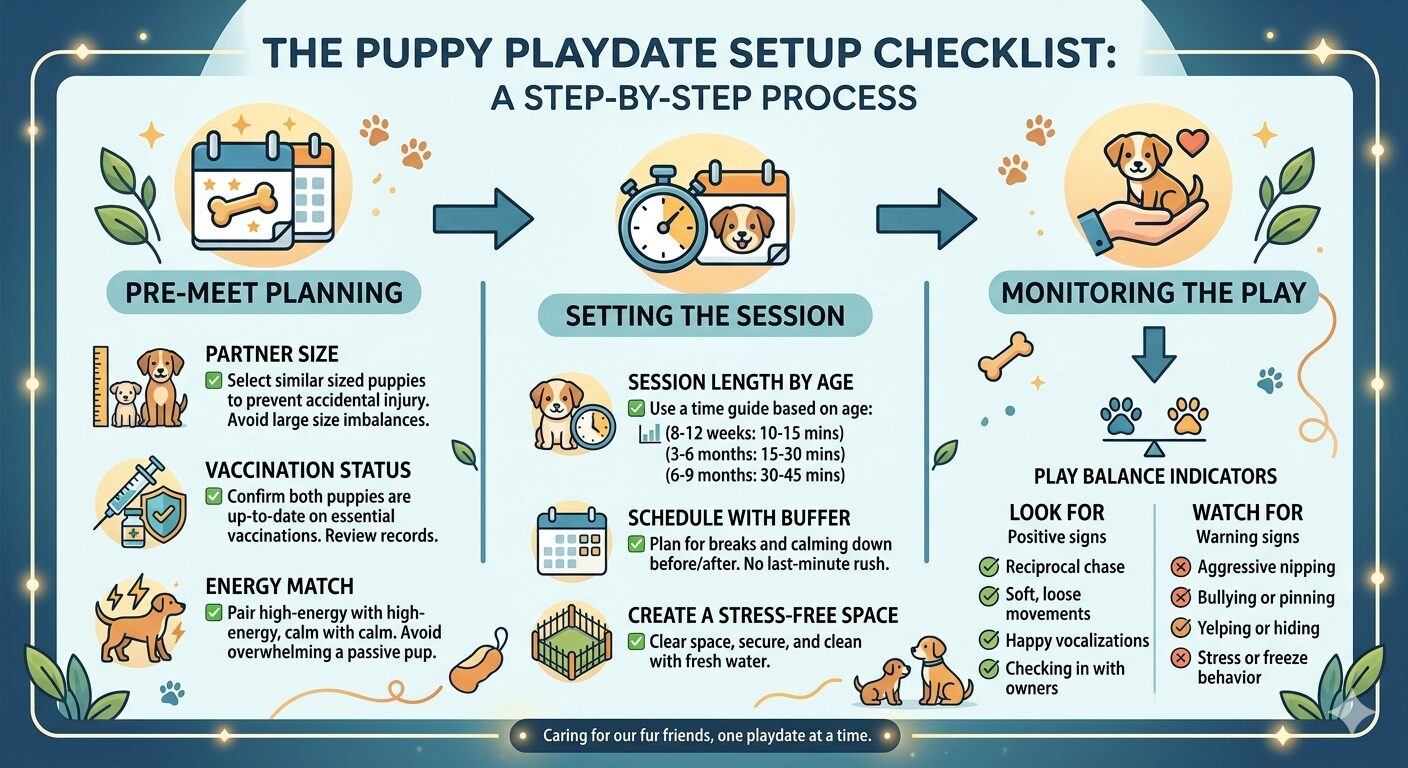
The criteria for a good puppy playdate partner:
- Similar or slightly larger size (significant size mismatches allow bullying or overwhelming physical play regardless of temperament).
- Vaccinated and health-screened (or within the appropriate risk-assessed pre-vaccination window, following veterinary guidance specific to your area's disease prevalence).
- Known social history — ideally a puppy or calm young adult with positive dog-dog interaction history.
- Not overwhelmingly high-energy. A Beagle puppy's first several playdates should be with calm or moderate-energy partners to build confidence, not with dogs who immediately establish a pace the Beagle cannot manage.
Managing the playdate:
- Session length, 10–15 minutes for puppies under 12 weeks, 15–20 minutes up to 16 weeks. Puppies tire quickly and overstimulation produces the same stress response as fear.
- Watch for play balance — both puppies should have roughly equal turns initiating and disengaging. A puppy who is always chased, always pinned, or always trying to escape is not building social confidence.
- Natural breaks are healthy. Two puppies who periodically disengage, sniff the ground, or seek human contact and then re-engage are showing appropriate self-regulation.
End before you think you need to. A clean ending with both puppies still willing and engaged is the goal — not waiting until they are exhausted or fractious.
Group Classes
What to Look For and When to Start
Group puppy classes serve a dual purpose. Early socialisation in a controlled, multi-dog, multi-stimulus environment, and the beginning of basic training. The social and training components reinforce each other — a puppy who is calm and confident around other dogs and people learns faster, and the training context helps establish calm behaviour in social settings.
When to start:
Most veterinary and behaviourist guidance recommends enrolling puppies in group classes from 7–8 weeks of age, with the first class occurring within 7 days of the second vaccination — provided the risk assessment for the facility is sound (clean, low-disease-prevalence area, reputable training facility with clean surfaces). The American Veterinary Society of Animal Behavior states that the risk of under-socialisation is greater than the risk of disease for healthy puppies from responsible breeders when basic sanitary precautions are followed.
What to look for in a class
- Small groups. 6–8 puppies maximum. Larger groups overwhelm and prevent the instructor from monitoring individual dog behaviour accurately.
- Positive reinforcement methodology. If the instructor uses punishment, aversive tools, or alpha-dominance framing, leave.
- Individual attention time and supervised free play with careful monitoring for bully-victim dynamics.
- Clear handling guidance for owners — the class should be as much about training the humans as training the puppies.
What Beagle puppies specifically benefit from in group classes
Beagles in group class environments can become nose-led and distracted. This is breed-normal, not a training failure. A good instructor will know this and provide guidance on maintaining engagement in a scent-rich environment. Request that your Beagle be positioned away from the highest-traffic floor areas — the scent concentration in these spots is particularly distracting for scent hounds.
Handling Strangers
Teaching Your Beagle to Read People Without Anxiety
Confident behaviour around strangers is one of the most practical socialisation outcomes — and one of the most common gaps. A Beagle who barks, retreats, or becomes over-excited with visitors is a dog who has not had enough varied, positive stranger interactions during the critical developmental window.
Building stranger confidence systematically:
- Week 1–4 of socialisation plan. Introduce the puppy to at least 3–5 new people per week, across a variety of presentations — different ages, sizes, voices, hats, glasses, uniforms, mobility aids. The goal is variety, not volume.
- Instruct guests on how to greet the puppy. Crouch or sit at puppy level, let the puppy approach first, offer a flat palm for sniffing before any petting, avoid looming or reaching over the puppy's head.
- Children require specific management. Children move unpredictably, make high-pitched sounds, and reach toward dogs in ways that increase novelty-driven anxiety. Introductions with children should be managed, brief, and heavily reinforced from the beginning.
For the shy or reserved puppy:
Some Beagle puppies — particularly those from lines with more reserved temperaments — will show caution with strangers through the early developmental stage. The approach is the same. Controlled exposure, puppy-led approach distance, positive reinforcement for any engagement, no forcing. Shy puppies typically benefit most from the early stranger interactions happening in their familiar home environment before public or class settings are introduced.
Socialising to Environments, Sounds, and Surfaces
Beagle puppies need social exposure to more than just people and animals. Environmental confidence — comfort with a wide variety of surfaces, sounds, and settings — is as much a part of socialisation as dog-dog interaction.
Environments to introduce in the first 16 weeks (post-vaccination risk-assessed):
- Urban surfaces, pavement, metal grates, wet ground, grass, gravel, shop floors.
- Traffic and vehicle sounds at manageable distance before close exposure.
- Crowds at low-traffic periods (a quiet shopping centre car park is more appropriate than a busy market).
- Veterinary environments, positive, treat-based visits to the vet clinic before any procedure visits — purely for treat delivery and handling practice.
Sound socialisation
Systematic sound socialisation using commercially produced sound CDs or playlists (fireworks, thunderstorms, traffic, baby sounds, power tools) played at low volume during positive activities (feeding, play) builds habituation without the risk of a real-world first exposure being overwhelming. Begin at a barely audible level and increase gradually across days and weeks.
Surface confidence
Beagle puppies who have only walked on carpet and grass frequently show reluctance on slippery floors, metal grates, and outdoor surfaces. A simple protocol — placing high-value treats on novel surfaces and allowing the puppy to approach voluntarily — builds surface confidence quickly and prevents the environmental anxiety that can generalise to other novel stimuli.
Scent Hound Confidence — Using the Nose as a Social Tool
The Beagle's nose is not just a training complication — it is the most powerful engagement tool you have. In socialisation contexts, nose-based activities build confidence, reduce anxiety, and provide an appropriate output for a breed instinct that does not switch off.
Nose work as a confidence-building exercise:
Scatter feeding — scattering small pieces of food on grass or in a sniff mat — puts the Beagle's nose to work in any environment. A puppy who is nose-down searching is a puppy who is in a calm, focused neurological state. Using scatter feeding to introduce a new environment — arriving, scatter feeding for 2–3 minutes before anything else happens — is one of the most effective ways to build positive environmental associations.
Tracking as early socialisation
A simple tracking exercise — the owner laying a short, straight scent trail by walking through grass, dropping food items at intervals, then releasing the puppy to follow the trail — provides mental stimulation, reinforces following the owner, and builds self-confidence through task completion. Even an 8-week-old Beagle will follow a simple food trail with focus and evident satisfaction.
Nose work in stranger introductions
Ask new people to scatter a few high-value treats on the floor before attempting direct engagement with the puppy. The puppy's nose-led investigation of the treat trail brings it physically close to the stranger without requiring direct social negotiation. This is a particularly effective protocol for reserved or cautious puppies who need longer approach distances in stranger introductions.
Scent-based enrichment is a powerful tool across many breeds — the general mental stimulation and confidence-building principles translate well beyond scent hounds, as explored in the training games section of Advanced Corgi Training Techniques from CorgiCrew.
Obedience Basics as a Socialisation Foundation
Early training and socialisation are not separate programmes. They reinforce each other. A Beagle puppy who knows "sit," "look at me," and a basic recall is a puppy who has a trained behaviour available to perform in uncertain social situations — and performing a known behaviour in a new environment is one of the most effective ways to reduce novelty anxiety.
The obedience basics that serve socialisation best:
- "Look at me" / attention cue. Teaches the puppy to redirect focus to the handler on cue. This is the foundation of all distraction management in social settings.
- Sit. A reliable sit in the presence of strangers, other dogs, and novel environments is both a practical tool and a confidence signal — a puppy who can sit calmly in a novel setting is demonstrating and practising emotional regulation simultaneously.
- Recall. A solid recall is a safety net in all socialisation contexts. Begin recall training in the home environment from day one, with high-value treats and enthusiastic delivery. The social confidence to come away from an engaging stimulus is a socialisation outcome as much as a training one.
- Leave it. Particularly relevant for Beagles, whose nose will find things you do not want them consuming. An early "leave it" foundation prevents scent-driven problematic behaviours from establishing.
For a detailed Beagle-specific guide to early development and the full breed profile that contextualises these socialisation and training approaches, the Complete Guide to the Beagle is the recommended companion resource. For the personality-based training approach that can tailor socialisation to your individual Beagle's temperament type,
Enhancing Your Bond Through Personality-Based Training on PemberDiamonds is a valuable read.
When to Slow Down
Reading Your Puppy's Stress Signals
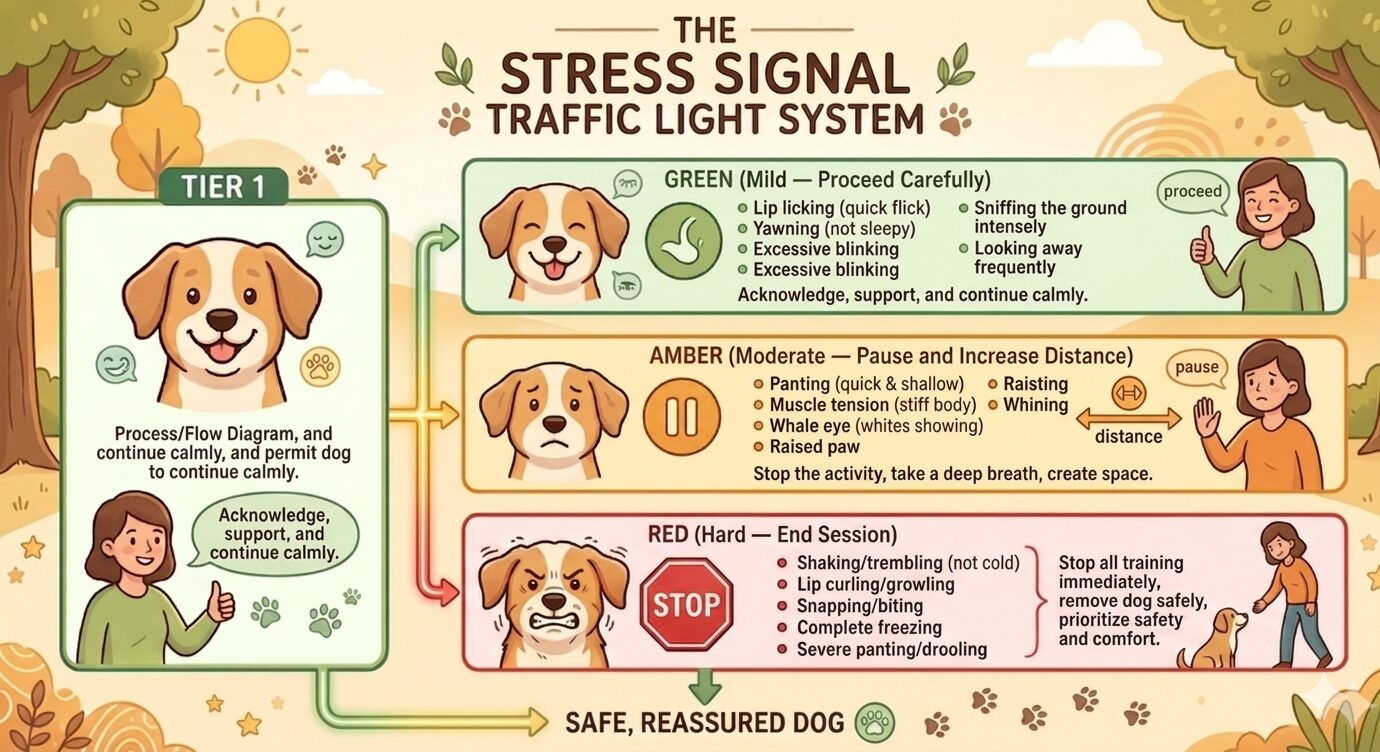
The socialisation plan fails if it is applied without reading the puppy. Exposure that produces sustained stress is not socialisation — it is sensitisation, and it has the opposite effect of the one intended.
Mild stress signals (proceed carefully, reduce intensity):
- Yawning outside of tiredness context
- Lip licking or nose licking
- Turning head away from stimulus
- Slow, deliberate movement away from stimulus
- Sniffing ground (displacement behaviour)
Moderate stress signals (pause, increase distance, return to threshold):
- Panting without physical exertion
- Whale eye (white of eye visible)
- Tail tucked below neutral
- Lowered body posture
- Reluctance to take treats (a Beagle refusing food is a reliable stress indicator)
Hard stress signals (end the session, remove from environment):
- Freezing
- Trembling
- Attempting to escape or hide
- Vocalising with distress tone
- Aggression signals (hard stare, raised hackles, growl, snap)
The rule
If your Beagle is showing moderate or hard stress signals, the current session is over. Not reduced in intensity — over. Return to a comfortable environment, allow full recovery (watch for a normal play-sniff-explore cycle resuming), and note what triggered the response for adjustment in the next session. Socialisation that respects stress signals builds genuine confidence. Socialisation that pushes through stress signals builds a dog who has learned to tolerate its anxiety — which is a fragile state that often breaks at a later developmental moment.
 "What I see most often with Beagle owners who are struggling socially is not that they failed to socialise the puppy — they usually did something. The problem is the gap between exposure and positive association. They took the puppy to the park, but the puppy was stressed and got through it. They introduced it to strangers, but the strangers grabbed at it and it complied. What was built was tolerance, not confidence. Tolerance is brittle — it holds until it doesn't. Genuine confidence, built by letting the Beagle make approach decisions, use its nose, and earn rewards in new environments, is robust. It holds under pressure because it was built under choice. The single most important shift I ask Beagle owners to make is to stop measuring socialisation success by whether the puppy 'coped' and start measuring it by whether the puppy actively chose to engage. Those are different outcomes, and the distinction will determine who your dog is at two years old."
— Certified Canine Behaviour Consultant,
The distinction between tolerance and genuine confidence is one of the most clinically important — and least discussed — concepts in puppy socialisation. A puppy who has learned to tolerate the world is not the same as a puppy who has learned to engage with it. The positive reinforcement framework throughout this guide is designed specifically to produce the second outcome.
 1. When should I start socialising my Beagle puppy?
 1. When should I start socialising my Beagle puppy?
Beagle socialisation begins from the moment the puppy arrives in your home — typically at 8 weeks. The primary socialisation window runs from approximately 3 to 16 weeks. Within your home and garden, and with vaccinated dogs in controlled settings, socialisation can begin immediately. Veterinary guidance on your area's disease prevalence should inform when you extend to public environments.
2. How many new experiences should my Beagle puppy have per week?
A commonly used benchmark is 100 positive experiences in the first 100 days — averaging roughly one new, positive exposure per day. These can be small, a new surface, a new person, a new sound at low volume. Quality of association matters more than quantity — five genuinely positive experiences are worth more than twenty neutral or stressful ones.
3. Can I socialise my Beagle puppy before all vaccinations are complete?
Yes, with appropriate precautions. The American Veterinary Society of Animal Behavior recommends beginning puppy socialisation classes from 7–8 weeks, within 7 days of the second vaccination, in low-risk environments. Carrying your puppy in public spaces (avoiding direct contact with unknown dogs or ground contamination) also allows safe early exposure before the vaccination schedule is complete.
4. My Beagle puppy is very timid with strangers. Is this normal?
Some level of caution with new people is normal, particularly during the 8–12 week peak sensitivity window. For puppies who show consistent wariness, begin stranger introductions in the familiar home environment, ensure the stranger respects the puppy's approach distance, and use the nose-work stranger introduction technique described in Section 8. If significant fearfulness persists past 14–16 weeks, consult a qualified positive reinforcement trainer.
5. How do I socialise my Beagle with cats?
Introduce through a barrier first — a baby gate that allows visual and olfactory contact without physical access. Reward calm behaviour in the Beagle's presence of the cat. Progress to lead-managed shared space only when the Beagle is showing relaxed, investigative behaviour rather than intense chase-focused attention. Never allow unsupervised access until reliable non-chase behaviour is established.
6. What if my Beagle is too excited around other dogs to learn anything?
High arousal in the presence of other dogs is a socialisation challenge, not a character flaw. Increase distance from the trigger until the Beagle can take treats and respond to "look at me." Practise parallel walking (described in the CorgiCrew training guide) before attempting close contact socialisation. The goal is to build the habit of focusing on the handler in the presence of other dogs — which requires working below the arousal threshold consistently.
7. Is the Beagle a good breed for multi-dog households?
Yes, generally — the Beagle's pack-oriented history makes them typically adaptable to multi-dog living. They tend to do well with dogs of similar or higher energy. As with any breed, structured introduction is more important than natural compatibility; follow the two-week integration protocol and manage resources carefully in the early weeks.
8. How do I stop my Beagle from following scent trails off-leash before recall is reliable?
Do not allow off-leash access in non-secure areas before recall is genuinely reliable — which, for a Beagle, typically requires more repetitions in higher-distraction environments than for most other breeds. Use a long line (5–10 metres) for outdoor exploration that allows freedom of movement while maintaining safety. Recall is a long-term training project for the breed; do not shortcut the process.
9. Can nose work help a nervous Beagle become more confident?
Yes, consistently and reliably. Nose work tasks give a nervous dog a familiar, self-directed activity in uncertain environments. A puppy who is sniffing is in a calm neurological state, and a calm neurological state is the precondition for positive association-building. Nose work in new environments — scatter feeding, simple tracking — is one of the most effective confidence-building tools available for anxious scent hounds specifically.
10. What is the difference between socialisation and habituation?
Socialisation refers specifically to developing positive associations with social partners — people, other dogs, other animals. Habituation refers to reducing responsiveness to repeated non-threatening stimuli — sounds, surfaces, environments. Both are necessary components of a complete early development programme, and both are addressed in this guide. The developmental stage window applies to both, the earlier, the more permanent the learning.
CONCLUSION
Beagle socialisation is not a single event or a brief programme — it is a sustained investment in your puppy's capacity to engage confidently with the world. The three most important takeaways from this guide are:
- respect the developmental windows and use the primary socialisation period with intention;
- build genuine confidence through choice and positive reinforcement, not tolerance through exposure; and
- use your Beagle's nose as a tool throughout — it is the most powerful asset you have in making new experiences feel safe.
The promise at the beginning of this guide was a framework for a well-rounded, socially steady Beagle. That dog does not emerge from a handful of park visits — it is shaped by hundreds of small, carefully managed, positive interactions across the entire developmental stage. The effort you invest in the first four to six months returns across the next twelve to fifteen years.
Training and socialisation are inseparable in this breed. The Beagle who sits calmly while a stranger crouches to say hello, who follows a scent trail with focused joy, who comes back reliably even when the world smells extraordinary — that dog was built here, in these early weeks, one positive experience at a time.
 Your Beagle's socialisation journey has a rich set of resources to support it here on BeaglePuppies.co.za. For the full breed-specific context that frames everything covered in this guide, the Complete Guide to the Beagle is essential reading. And for the detailed developmental stage framework that maps your puppy's social windows month by month, the Beagle Puppy Socialisation Guide is your practical companion. Your Beagle's confidence is built one positive experience at a time — this community is here to help you build it well.