
Olfactory Fatigue and Recovery
Managing Your Beagle's Primary Sense
Understanding Scent Receptor Saturation and Optimizing Rest Periods Between Intense Tracking Sessions
If you've ever watched a Beagle work a scent trail — head low, tail up, baying with joyful determination — you've witnessed one of nature's most impressive biological feats. The Beagle's nose is not merely a sensory organ; it is the lens through which the entire world is interpreted. But even the most extraordinary instrument has its limits. Olfactory fatigue — the temporary diminishment of scent detection ability through overuse — is one of the most overlooked challenges facing Beagle owners, hunters, and scent sport competitors alike.
This article takes a deep dive into the science of how your Beagle's nose works, what happens when it becomes saturated, and how to structure rest, recovery, and training schedules to protect and optimize this irreplaceable sense.
The Beagle Nose
An Engineering Marvel
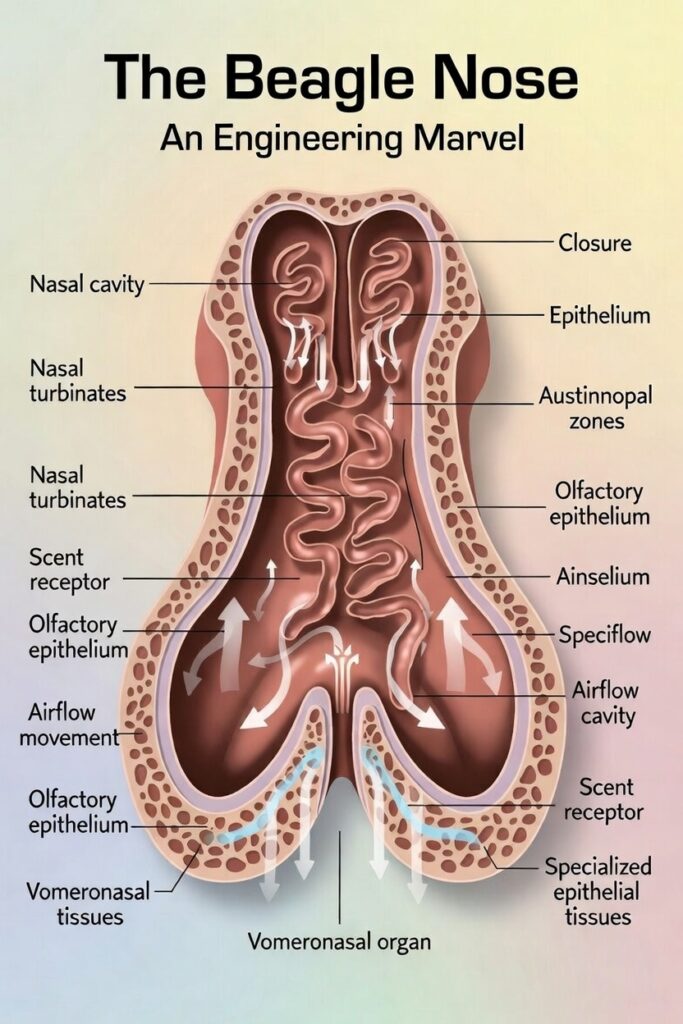 To appreciate olfactory fatigue, you first need to understand what you're working with. The average human nose contains roughly 6 million olfactory receptor cells. A Beagle's nose contains approximately 225 million. This isn't just a quantitative difference — it represents a qualitatively different experience of reality.
A Beagle's nasal anatomy also features a larger olfactory epithelium — the specialized tissue that lines the nasal cavity and houses scent receptors. While a human's olfactory epithelium covers an area roughly the size of a postage stamp, a Beagle's covers an area closer to the size of a standard sheet of paper, all folded intricately within the skull.
The mechanics of scenting are also more sophisticated than many owners realize. When a Beagle inhales, airflow is split: some goes toward the lungs for breathing, and some is diverted into a specialized olfactory recess where scent molecules can be analyzed. The moist lining of the nose dissolves these molecules, and cilia (tiny hair-like structures) transport them to receptor cells, which then fire signals to the olfactory bulb — the part of the brain dedicated to processing smell. In Beagles, this olfactory bulb is proportionally enormous compared to other brain regions.
Add to this the Jacobson's organ (vomeronasal organ) located in the roof of the mouth, and you have a dual-channel scent processing system capable of distinguishing thousands of distinct odor compounds simultaneously.
What Is Olfactory Fatigue?
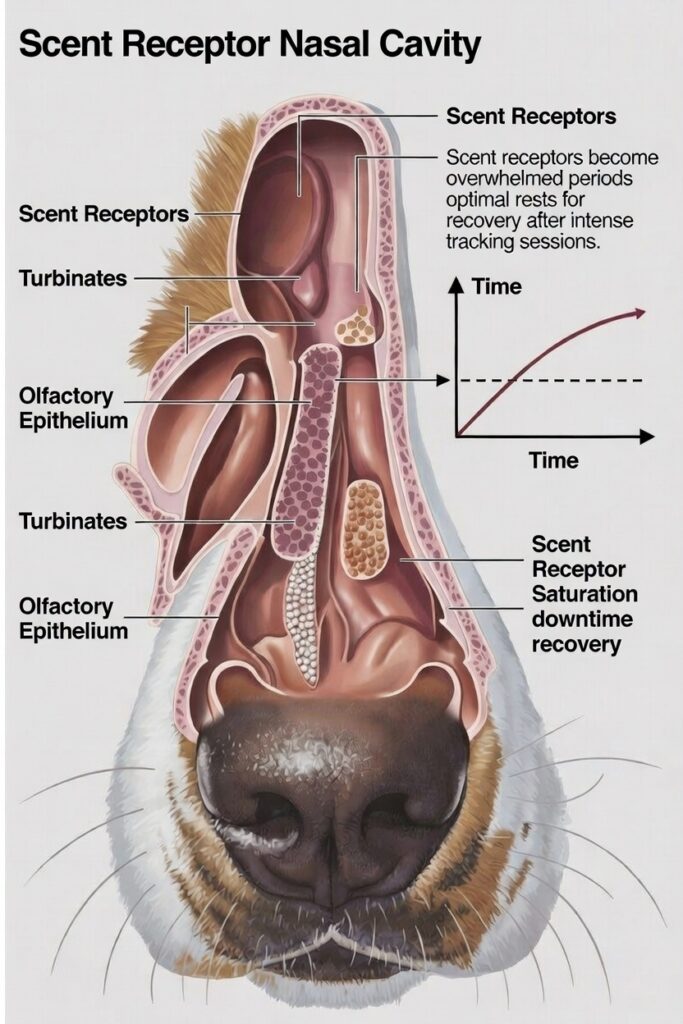
Olfactory fatigue, sometimes called olfactory adaptation or scent receptor saturation, occurs when receptor cells become temporarily desensitized after prolonged or intense exposure to a particular odor stimulus. At the cellular level, this happens through several mechanisms:-
- Receptor downregulation - Olfactory receptor neurons adapt by reducing their sensitivity when continuously stimulated. Ion channels in the receptor cells partially close, and the transmission of electrical signals to the olfactory bulb decreases. The receptor has not been damaged — it has simply shifted into a lower-sensitivity mode to prevent overstimulation.
- Neurotransmitter depletion - The synaptic junctions between olfactory receptor neurons and the olfactory bulb rely on neurotransmitters. Extended periods of intense signaling can deplete these neurotransmitter reserves, reducing the efficiency of signal transmission even if the receptor cells themselves remain responsive.
- Central adaptation - Beyond the receptors themselves, the brain's processing centers can habituate to persistent scent signals. The olfactory cortex begins filtering out what it perceives as "background" information — a survival mechanism that helps animals prioritize new or changing scent information over constant stimuli.
- Mucous membrane exhaustion - The moist nasal lining plays a critical role in dissolving and transporting scent molecules. During intense tracking sessions, particularly in dry or warm conditions, this mucous layer can thin, reducing the nose's ability to capture scent molecules efficiently.
The practical result of these combined effects is a Beagle who is physically present and behaviorally willing but neurologically compromised in their ability to accurately detect and discriminate scents. This is a crucial distinction — the dog hasn't lost interest, and isn't being stubborn. The system has simply reached its temporary functional limit.
Recognizing the Signs of Olfactory Fatigue in Your Beagle
 One of the biggest challenges with olfactory fatigue is that it isn't visible. Your Beagle won't limp, won't stop eating, and probably won't tell you anything is wrong. They may even want to keep working. Recognizing the behavioral signs is essential:
- Loss of scent discrimination - Your Beagle begins following false trails, getting confused at scent crossings, or picking up the wrong track entirely. In competitions or hunting scenarios, this often looks like a sudden drop in accuracy after a period of good work.
- Reduced drive on the trail - A dog who was intensely working the scent begins moving more slowly, losing enthusiasm, or casting wider than necessary. They may keep their nose to the ground but appear to be searching rather than tracking confidently.
- Increased head-up behavior - When a Beagle lifts their head during a trail, it often signals that ground scent is not providing sufficient information. During olfactory fatigue, this may happen more frequently than usual.
- Shorter confident runs - A fatigued dog may still pick up the scent intermittently but is unable to sustain confident trailing for the same distances or durations as when fresh.
- Behavioral frustration - Some Beagles, unable to complete what their instincts are driving them to do, become visibly frustrated — circling, vocalizing more erratically, or appearing confused.
- Physical signs - Dry or warm nasal surfaces can be an early indicator. A Beagle's nose should be cool and moist during work. Panting, even at moderate temperatures, accelerates nasal drying and hastens fatigue.
The Timeline of Olfactory Fatigue and Recovery
Recovery from olfactory fatigue is not instantaneous, and this surprises many handlers. The timeline depends on several variables — the intensity of the session, environmental conditions, the individual dog's physiology, and the dog's overall health and nutrition — but general patterns have emerged from research in canine olfaction and working dog science.
- Mild fatigue (20–40 minute sessions in moderate conditions) - Receptor sensitivity typically recovers within 30 minutes to 1 hour of complete rest from scent work. The dog can usually return to light scent tasks within this window, though peak sensitivity may take longer to restore.
- Moderate fatigue (60–90 minute intense sessions) - Recovery to functional detection levels may take 2–4 hours. Core neurotransmitter reserves and mucous membrane integrity require adequate time to replenish. Continuing to work during this period risks errors and may also reinforce poor tracking behaviors as the dog learns to compensate for reduced capability.
- Significant fatigue (multi-hour field work, competition days) - After an intense full-day event — a field trial, a Search and Rescue deployment, or a long hunting outing — a Beagle may require **24–48 hours** before returning to peak olfactory sensitivity. Many experienced handlers build a mandatory rest day into their schedule after any major scent event.
It is important to note that psychological fatigue often accompanies olfactory fatigue, and the two interact. A mentally tired Beagle may appear to recover physically but still perform below capacity because the cognitive components of processing, filtering, and acting on scent information are also depleted.
Environmental Factors That Accelerate Fatigue
The conditions in which your Beagle works have a dramatic effect on how quickly olfactory fatigue sets in. Understanding these variables lets you make proactive management decisions.
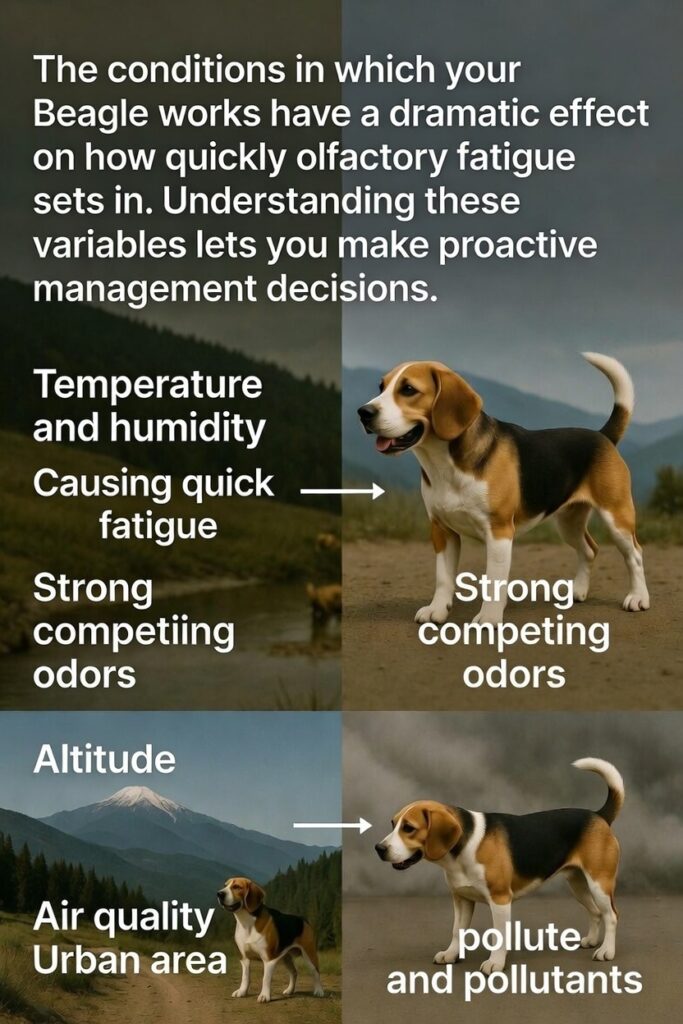
- Temperature and humidity - Scent molecules disperse and volatilize more rapidly in warm, dry conditions. While this can initially make trails easier to detect, it also means receptor cells are being bombarded with higher concentrations of molecules, accelerating saturation. Cold, damp conditions typically support longer, more sustainable scenting sessions.
- Strong competing odors - Working environments saturated with intense scents — livestock, vehicle exhaust, chemicals, or other strong-smelling dogs — create a higher baseline of olfactory stimulation, consuming receptor capacity even before the dog engages with a target scent.
- Altitude - At higher elevations, reduced air density means fewer scent molecules per breath, causing the dog to work harder and inhale more frequently to gather sufficient scent information. This increases physical fatigue and can stress the nasal passages.
- Air quality and pollutants - Dust, smoke, and airborne particulates can coat olfactory epithelium, physically impeding scent detection and accelerating fatigue.
The dog's hydration status - Dehydration reduces mucous production in the nasal passages, directly impairing scent capture. Even mild dehydration measurably degrades olfactory performance.
Structuring Training Sessions to Minimize Fatigue and Maximize Learning
The most effective scent training programs account for olfactory fatigue as a primary scheduling constraint. Here is a framework grounded in canine cognition and olfactory science:
- Keep training sessions short and high-quality - Most scent training researchers and experienced competition handlers recommend keeping individual training sessions to 20–30 minutes for Beagles in intense nose work. A focused 25-minute session with full receptor availability is neurologically and behaviorally more productive than a 90-minute session where the dog spends the final hour working in a compromised state.
- Build in intra-session rest breaks - For working sessions that must run longer, incorporate 10–15 minute complete rest breaks (no scent tasks, no exposure to competing odors) every 30–40 minutes. During this time, encourage the dog to rest in a neutral-smelling environment and ensure access to fresh water.
- Front-load the most complex work - If a training session will cover multiple tasks, schedule the most cognitively and olfactorily demanding exercises first, when the dog is freshest. Simpler reinforcement tasks or known skills can be practiced later in the session when some fatigue has begun to accumulate.
- Separate training days from recovery days - For Beagles in active competition or field training programs, alternate intense scent work days with recovery days. On recovery days, avoid additional scent exposure tasks. Light physical exercise — a walk in a low-scent environment — supports physiological recovery without adding olfactory load.
- Monitor environmental conditions and adjust session length accordingly - On hot, dry days, plan to reduce session length by 30–50% and prioritize hydration before and during work. On ideal cool, humid mornings, you may have a larger window of productive working time.
- End sessions on success, not exhaustion - One of the most important principles in scent sport training is to end while the dog is still performing well, not after performance has degraded. This preserves confident associations with the task and ensures the dog's final scent memory of the session is accurate, rather than fatigued.
Recovery Protocols
Giving Your Beagle's Nose What It Needs
Recovery is not simply the absence of work — it is an active biological process that you can support through deliberate management choices.
- Hydration is paramount - Ensure your Beagle has consistent access to fresh water before, during (on breaks), and after any scent work. Some handlers add a small amount of low-sodium broth to water to encourage drinking after intense sessions. The nasal mucous membranes are the frontline of olfactory function, and they cannot operate effectively without adequate systemic hydration.

2. Rest in a low-scent environment - Recovery is most efficient when the olfactory system is not being stimulated. Rest your Beagle away from strong kitchen odors, heavily perfumed spaces, or other dogs' concentrated scent markings. A quiet, clean-smelling space allows receptor cells to reset without ongoing competition for limited receptor capacity.
3. Prioritize sleep - During sleep, the brain consolidates learning (including scent discrimination learning) and neurotransmitter reserves replenish. Beagles who get adequate sleep between training days learn faster and maintain higher accuracy over training cycles. After intense field days, many experienced handlers ensure their working dogs get 12–14 hours of sleep in the following 24-hour period.
4. Nutritional support - The mucous membranes and olfactory neurons benefit from adequate levels of omega-3 fatty acids, zinc, and vitamin A — all of which support mucosal integrity and cellular function. While a balanced commercial diet formulated for active dogs will typically cover these bases, some handlers working Beagles in demanding sports consult with veterinary nutritionists to fine-tune supplementation.
5. Cool, moist air exposure - Some handlers find that allowing fatigued dogs to rest in naturally cool, humid outdoor environments (a shaded area with moderate humidity) accelerates recovery compared to dry indoor air conditioning. A short, calm walk in dewy morning grass may gently support nasal membrane rehydration.
6. Avoid the temptation to "test" recovery - One of the most common handler mistakes is administering a short test trail to see if the dog has recovered — which inadvertently adds to the olfactory load during what should be a recovery period. Trust the clock and trust the science. Give the nose its time.
Special Considerations for Competition and Field Work
Beagles competing in AKC Beagle Field Trials, UKC Coonhound events, National Beagle Club events, or nose work competitions face unique olfactory demands. Competition days typically involve multiple runs, waiting in close proximity to other dogs, and unfamiliar environments loaded with competing scents — all conditions that accelerate fatigue.
Pre-competition preparation - In the days leading up to a major event, reduce training intensity and scent exposure to allow receptor cells to approach peak sensitivity. Many competition handlers enforce a **48-hour pre-event rest** from any significant scent work. The dog arrives fresh rather than partially fatigued from recent training.
Between-run management at events - At multi-run events, keep your Beagle away from the heavy scent areas between runs. Crate them in a quiet location, offer water consistently, and minimize unnecessary stimulation. Where possible, know your run schedule and allow the maximum possible rest time between performances.
Post-competition recovery - Treat a full competition day as equivalent to significant olfactory fatigue. Plan for 24–48 hours of scent rest afterward, and don't be concerned if performance dips in the first training session after a major event — this is normal and expected.
Building a Long-Term Training Calendar That Respects Olfactory Health
Sustainable performance over a Beagle's working lifetime requires thinking in longer cycles, not just session-by-session.
A well-structured annual training calendar for a competitive or working Beagle typically includes:
Heavy training phases (8–12 weeks) - Frequent sessions building skills, with careful intra-week recovery built in. No more than 3–4 demanding scent sessions per week.
Competition phases - Taper training intensity in the final 1–2 weeks before major events. Maintain sharpness without accumulating fatigue.
Active recovery phases (2–4 weeks) - Post-competition or post-season periods with minimal or no structured scent work. Physical conditioning, socialization, and general life enrichment take center stage.
Off-season - Some handlers completely rest their working Beagles from scent tasks for 4–8 weeks annually. Evidence from working dog research suggests this full reset period may actually enhance peak season performance by allowing a complete neurological reset.
When to Consult a Veterinarian
Olfactory fatigue is a normal physiological process. But certain symptoms should prompt a veterinary consultation rather than simple rest:
Persistent discharge from the nose (clear, yellow, or bloody) can indicate infection, foreign body, or nasal tumor — all of which impair olfaction. A sudden and dramatic loss of scenting ability that does not recover with rest may signal neurological issues. Frequent sneezing, pawing at the face, or apparent nasal discomfort during or after work warrants evaluation. Any Beagle over 7 years of age showing changes in scenting behavior should have a veterinary assessment, as age-related olfactory decline is real and may require adjusting expectations and training protocols.
Your veterinarian, ideally one with experience in working or sport dogs, can also help you assess whether factors like dental disease, allergies, or respiratory issues are contributing to suboptimal olfactory performance.
Conclusion
The Nose Knows — But Only if You Let It Rest
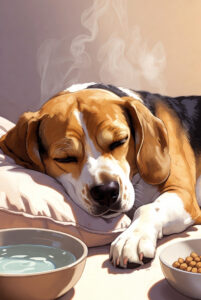 The Beagle's nose is a biological wonder, but it is not indestructible or infinitely sustainable without management. Olfactory fatigue is not a sign of weakness or poor genetics — it is the predictable consequence of asking an extraordinary organ to work beyond its replenishment rate.
The best Beagle handlers understand that their partnership with this remarkable dog extends to understanding and respecting the limits of the animal's physiology. Shorter, focused sessions. Strategic rest breaks. Deliberate recovery periods. Attention to hydration, environment, and the long-term calendar. These aren't concessions to limitation — they are the practices that build a dog who can perform at the highest level year after year.
Your Beagle will always want to go — that drive is hardwired and beautiful. Your job, as the informed handler, is to know when to go, and when the smartest thing you can do for your dog is to give the nose the rest it has earned.
Pingback:Beagle Guide - Tamboeckey Beagles
Pingback:Beagle Health and Wellness Guide - Tamboeckey Beagles