
Beagle Personality Science What's Actually Different About the Beagle
This article builds on Canine Personality: What Science Actually Says — read that first if you're new to the trait/psychometric model referenced throughout below.
The Breed-Specific Question
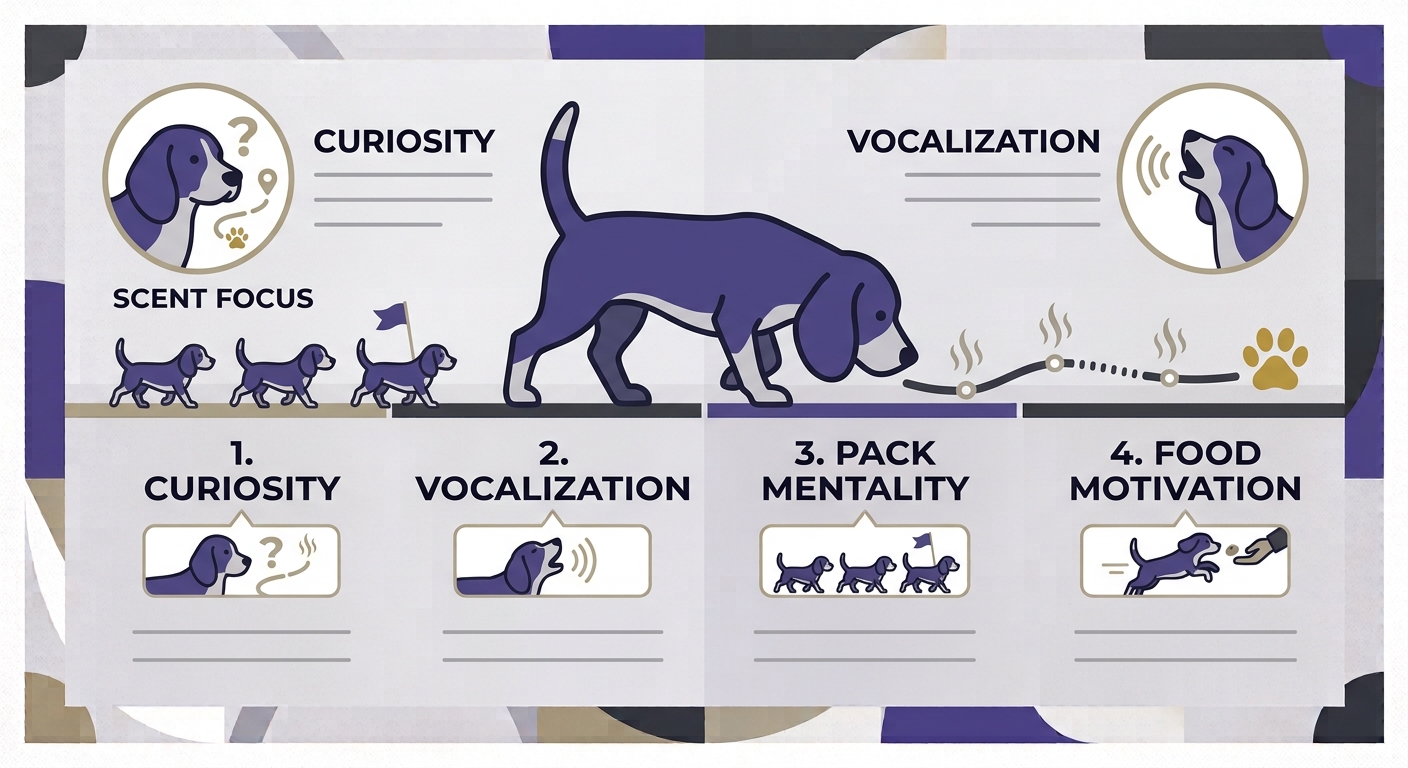
Why does a Beagle that's perfectly obedient in the living room turn into a dog that appears to have never heard its own name the instant its nose catches an interesting trail? And why is that same famously independent dog, notorious among trainers for ignoring recall cues mid-scent, also one of the most reliably friendly, low-aggression, people-and-dog-oriented breeds in most temperament rankings? These two traits look contradictory side by side — independent enough to ignore you, sociable enough to greet a stranger like an old friend — but they come from the same specific piece of working history, and untangling that is what this article actually does.
What's Different About This Breed
The Beagle's personality profile traces back to a working role that is, in one specific way, almost the mirror image of a droving dog like the Corgi covered in this cluster's sibling Applied Pillar: Beagles were bred as scent hounds, developed over centuries in Britain to track and trail small game like hare and rabbit, working in coordinated packs and following a trail largely independently once the hunt was underway, with comparatively little moment-to-moment direction from a human handler. That specific combination — pack cooperation with other dogs, paired with independent decision-making once a scent trail is picked up — produced a trait profile that is genuinely different in structure from a breed selected for constant, close, single-handler direction.
Scent processing that overrides ordinary attention and recall
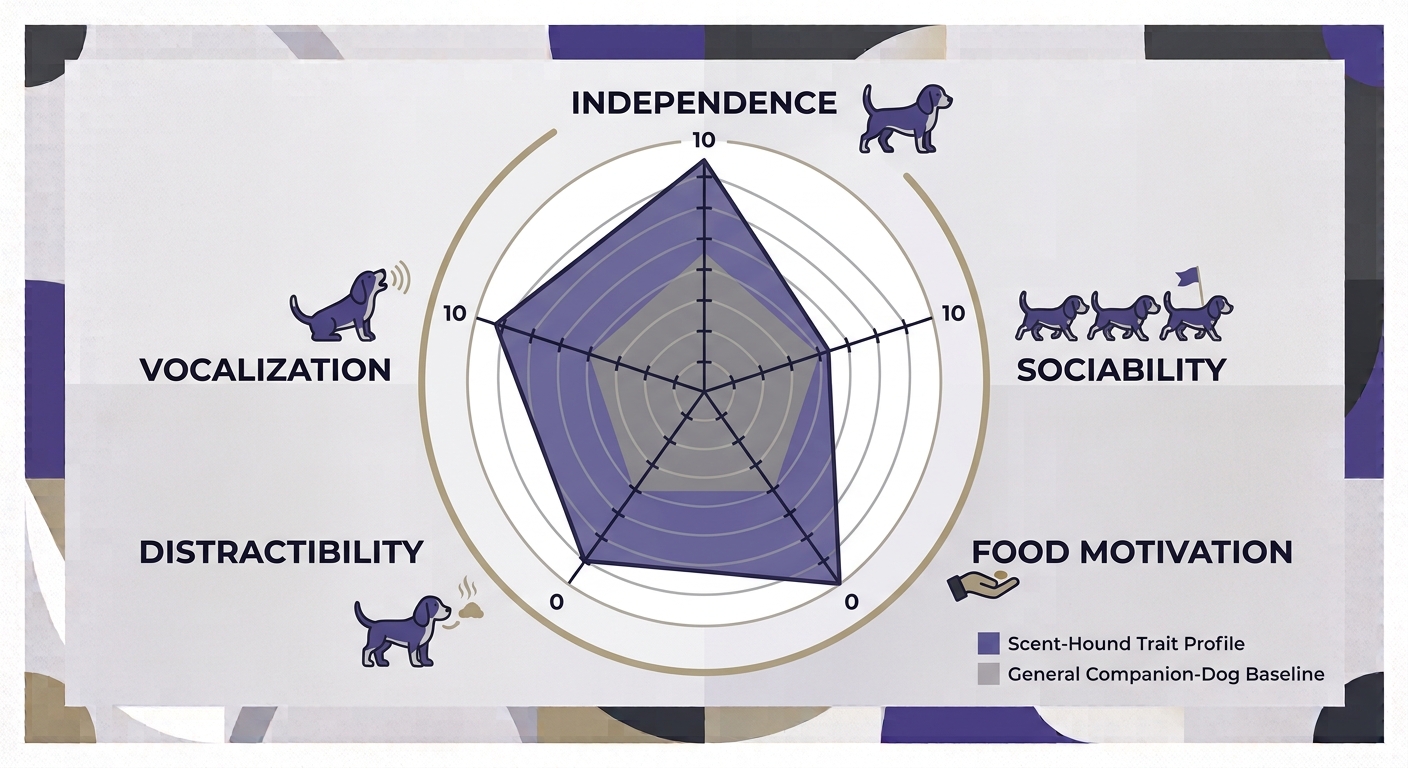
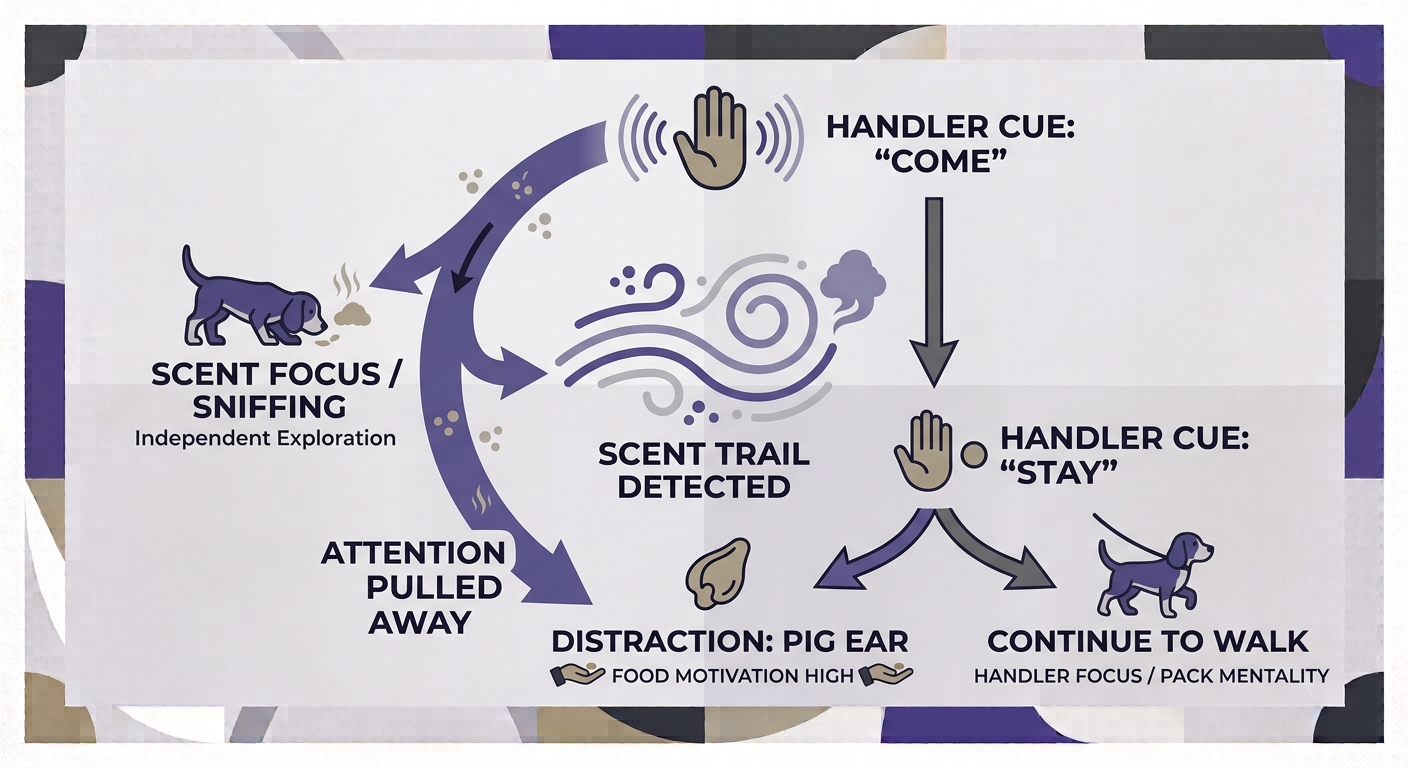
A Beagle's sense of smell is frequently cited as among the most sensitive of any dog breed, and the breed's entire historical function depended on that nose being able to lock onto and hold a scent trail for extended periods without losing it to other distractions — including, functionally, the presence of a human handler calling the dog back. This isn't simply "Beagles are stubborn"; it's a specific attentional and motivational override, well documented informally by trainers and consistent with the breed's working design, in which an engaged scent trail competes with and often outcompetes ordinary recall and attention cues that would readily redirect most companion breeds. Understanding this as a genuine sensory-motivational mechanism rather than defiance changes what kind of training actually works, which the Practical Application section below addresses directly.
Sociability rooted in pack-hunting history
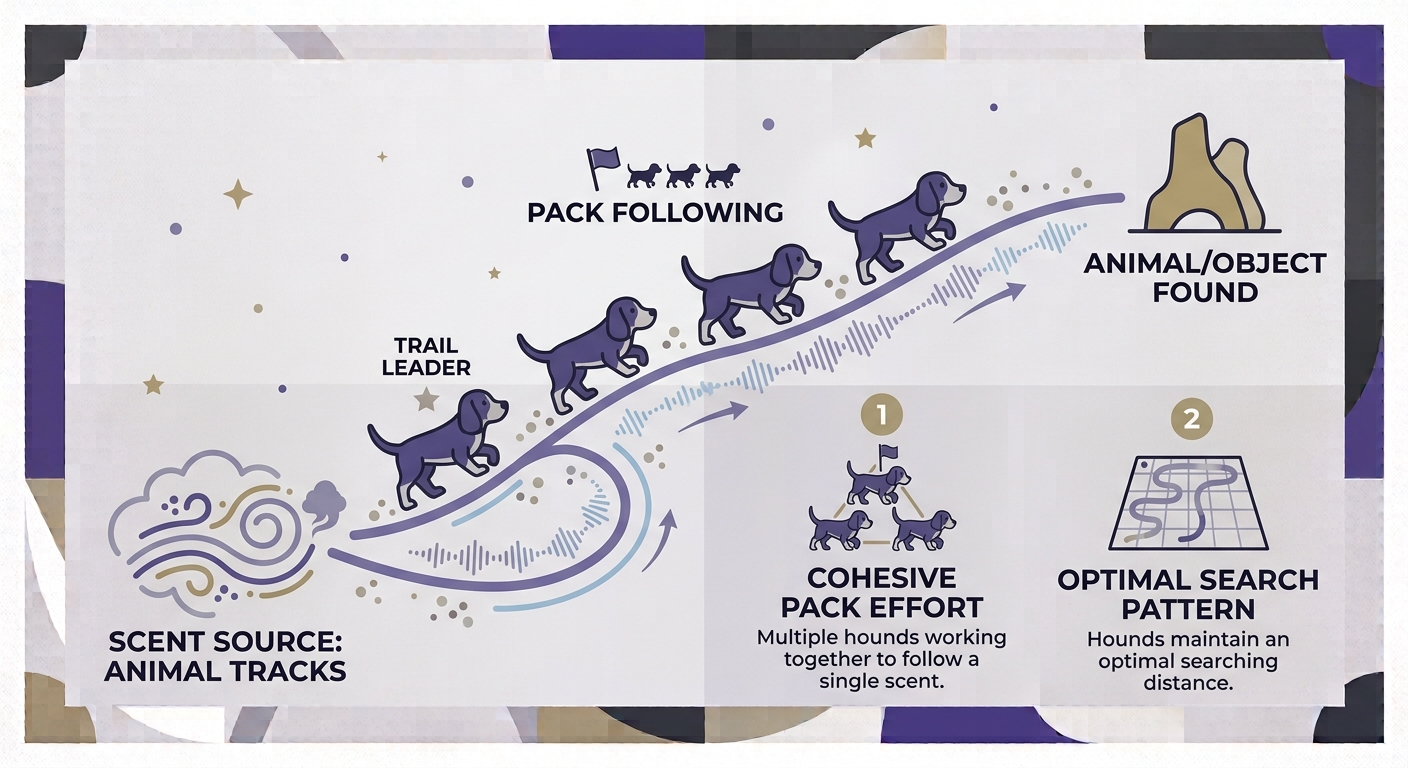
Because Beagles were bred to hunt in coordinated packs rather than working solo alongside one handler, the breed shows a functionally distinct sociability pattern from many single-handler working breeds: strong, well-documented ease around other dogs, a generally low rate of dog-directed aggression relative to many breeds, and a friendly, outgoing baseline toward unfamiliar people that made the breed poorly suited as a guard dog but well suited to communal kennel life and pack hunts involving dozens of hounds working alongside each other and alongside unfamiliar handlers and hunt followers. This pack-oriented sociability is one of the more consistently reported Beagle traits across both breed-club descriptions and behavioral research, and it sits alongside — rather than in tension with — the independence described above; the breed is highly social and highly independent at the same time, because those two traits were selected for different parts of the same working role.
John Paul Scott and John Fuller's classic mid-century breed-comparison research, referenced in general terms in this cluster's Master Pillar, is directly relevant here in a way it isn't for most other breeds, because the Beagle was one of the five specific breeds their research program studied side by side under standardized conditions, alongside a Basenji, a Cocker Spaniel, a Shetland Sheepdog, and a Wire-haired Fox Terrier. Their comparative testing found the Beagles in their sample to be notably scent- and trail-oriented even as puppies, vocal in ways tied to trailing behavior (informally, hounds "giving tongue" or baying when they pick up a scent — a functional signal to pack-mates and a following handler that a trail has been found), and generally even-tempered and sociable relative to some of the other breeds tested, a pattern broadly consistent with the friendly, low-aggression reputation Beagles carry today.
|
 Research Spotlight
A necessary caution: breed explains less than the reputation suggests
As with every breed covered in this cluster, it's worth being precise about how much of this is genuinely breed-driven versus individual. Kathleen Morrill, Elinor Karlsson, and colleagues' large 2022 genomic study in Science, drawing on genetic and behavioral survey data from over 18,000 dogs including thousands of mixed breeds, found that breed identity explains only a modest share of the variation in most individual behavioral traits — the authors estimated roughly 9 percent on average across the behaviors studied, considerably less than breed explains for physical traits like coat length or body size. Their analysis specifically challenged the strength of several popular breed-behavior stereotypes.
|
Holding both pieces of evidence together gives the accurate picture: the Beagle's specific combination of scent-driven independence and pack-rooted sociability is a real, historically grounded pattern documented in breed-specific research, not folklore — while individual Beagles still vary widely enough around that pattern that treating any single dog's temperament as fully predictable from the breed alone would be a mistake.
Life Stage Notes
The general puppy-to-senior trajectory from the Master Pillar applies to Beagles largely unmodified, with one specific breed wrinkle: scent-driven distractibility, rather than being a fixed trait present at full strength from the start, tends to intensify noticeably as a Beagle puppy's nose and trailing instinct mature, typically becoming much more pronounced somewhere around four to eight months of age — often coinciding with, and compounding, the general adolescent independence and reduced responsiveness to cues that many breeds show during this same developmental window. A Beagle puppy that reliably comes when called at ten weeks old is not a strong guarantee the same will be true at seven months, once the full scent-trailing drive has come online; this is normal, breed-typical development rather than a sign that early training has failed.
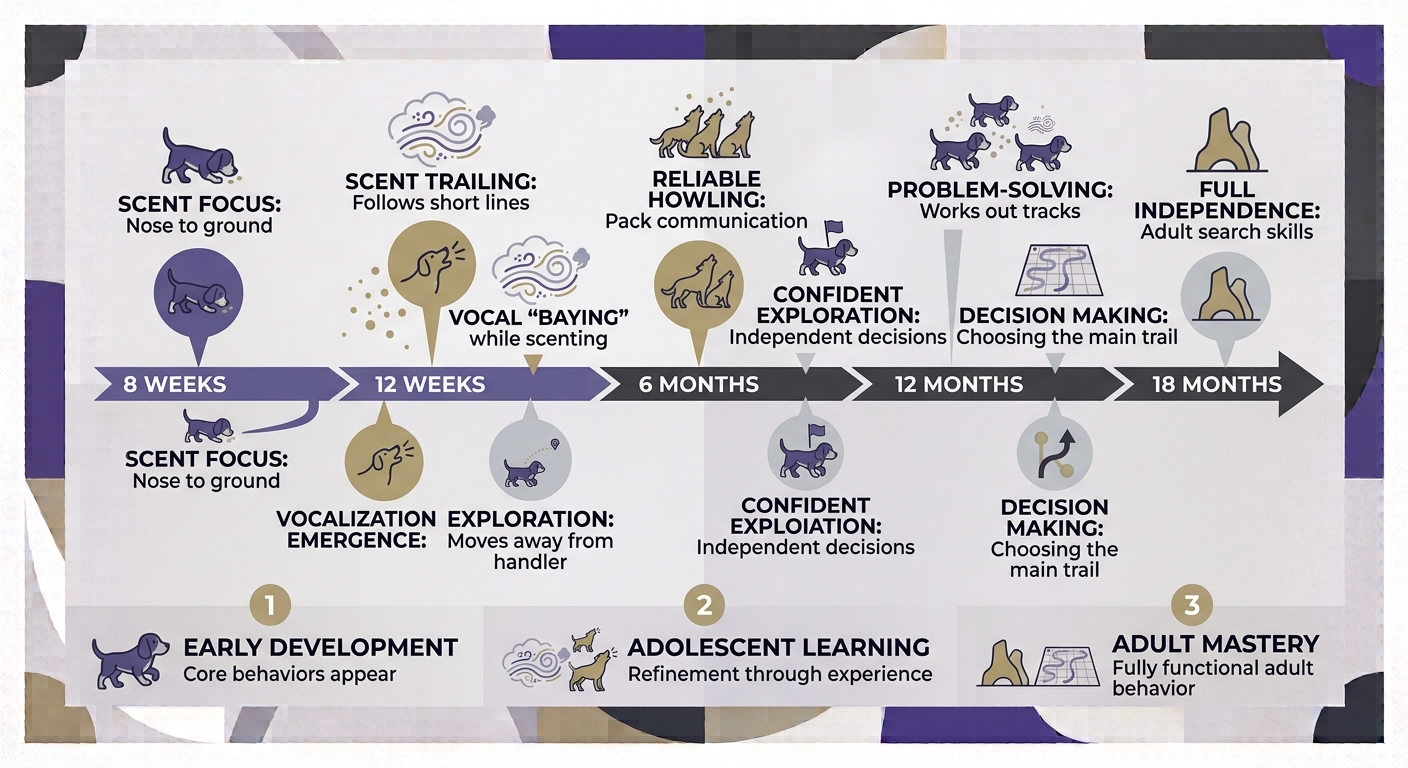
Vocalization — barking, and the distinctive hound "bay" specifically associated with an actively followed scent trail — also tends to increase through this same adolescent window as the trailing instinct strengthens, and it is functionally tied to scent-engagement rather than a separate, unrelated behavior problem; a Beagle baying at a trail in the backyard is displaying the same functional signal a hunting hound used to alert a following handler that a scent had been picked up, not simply making noise. Because both the distractibility and vocalization increases are tied to the same underlying maturing scent-drive, structured scent-work outlets introduced early, before the adolescent peak, tend to produce a calmer adult dog than trying to suppress the behavior once it's already well established.
Practical Application for This Breed
The general graduated-exposure framework from the Master Pillar still applies to Beagles for fear- and anxiety-related traits. What's breed-specific here is building reliable recall and off-leash manageability against a genuinely strong competing drive, and giving that drive a legitimate outlet rather than fighting it head-on.
Train recall as a competing behavior, not a correction
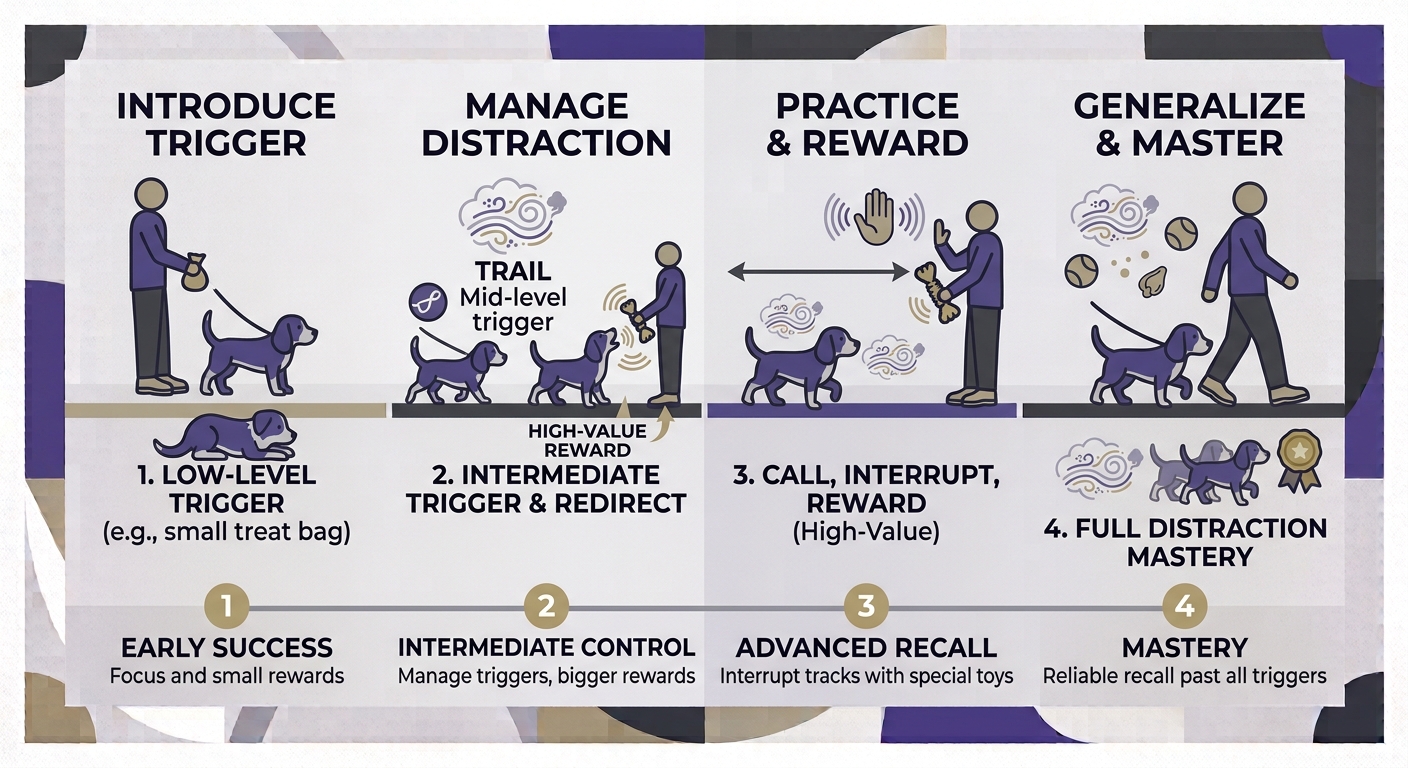
Because an engaged scent trail functions as a powerful, breed-typical competing motivator rather than simple disobedience, punishment-based corrections for ignoring recall tend to be markedly less effective with Beagles than with breeds where recall failures are more often attention lapses. A more effective approach treats recall training as building a genuinely higher-value competing behavior: starting recall practice in low-distraction environments with extremely high-value rewards (something considerably more compelling than the dog's everyday food, given the breed's well-documented food motivation, which is itself a genuine trait-level asset for training rather than a nuisance), and only gradually introducing mild scent distractions before working up to the genuinely difficult scenario of calling a Beagle off an actively engaged trail — a milestone that, realistically, some individual Beagles may never reach 100 percent of the time, which is why leash and secure-fencing management should be treated as a permanent part of the plan rather than a training stage to graduate out of.
Worked example: Dash, a ten-month-old Beagle with unreliable recall
Dash, a hypothetical ten-month-old Beagle, reliably comes when called in the house and yard but consistently ignores recall the moment he picks up an interesting scent trail on off-leash walks, sometimes disappearing after a trail for several minutes at a time. His Owner first confirms this fits the scent-override pattern described above rather than a general training gap: Dash's recall is excellent everywhere except specifically once his nose goes down onto a fresh trail, and his body language in that moment (nose fixed to ground, tail up and working, ignoring other cues entirely) is textbook trailing behavior rather than generalized disobedience.
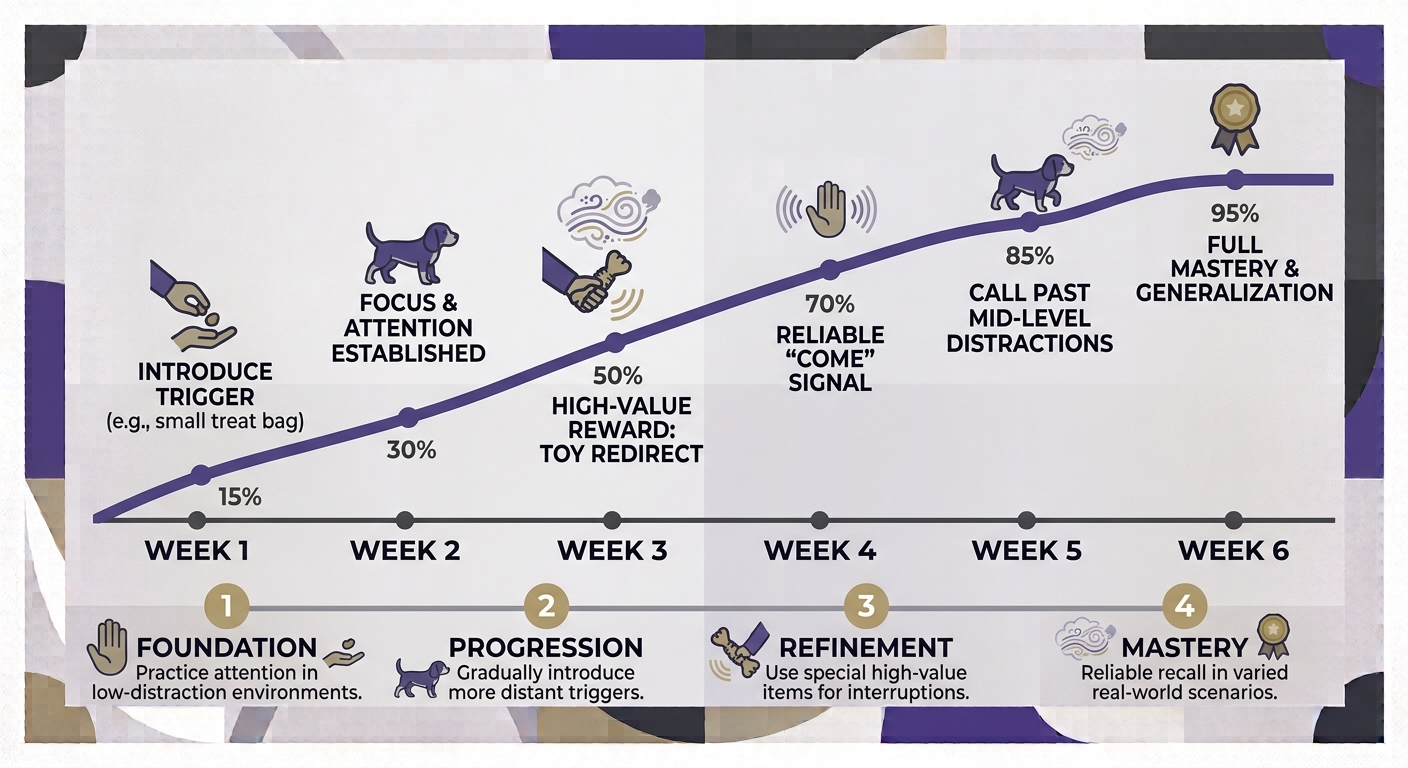
The plan starts on a long training lead rather than fully off-leash, in a moderately scent-rich area, using a recall reward considerably higher-value than Dash's usual treats — small pieces of roast chicken reserved only for this training. Three times a week, Dash's Owner lets him engage lightly with a mild scent trail, then calls him at a low level of engagement, rewarding heavily and immediately for any response, and only proceeds to calling him off a more intensely engaged trail once the easier version is reliable across two consecutive sessions. In parallel, Dash gets a dedicated fifteen-minute structured scent-work session at home several times a week — a simple nose-work game hiding treats around the house or yard — specifically to give his trailing drive a legitimate, satisfying outlet unconnected to the walk-based recall training.
By week four, Dash reliably breaks off a mild scent trail on the long line when called, on the first cue, most of the time. By week six, his recall against a moderately engaging trail has improved enough that his Owner trusts him with a longer line in more scent-rich areas, though full off-leash reliability around a strongly engaged trail is treated as an ongoing management challenge rather than a solved problem — consistent with the caution above that some individual Beagles may never reach fully reliable off-trail recall, regardless of training quality. If Dash's recall had instead gotten worse over the same period, or if he'd begun ranging further before disengaging, that pattern would call for reviewing whether the reward value is genuinely high enough and whether secure-area training, rather than open off-leash walks, needs to become the primary training environment for longer.
ing the breed's sociability, not just managing its independence
The same pack-rooted sociability that makes Beagles historically poor guard dogs makes them, in most cases, genuinely easy to socialize with other dogs and comfortable in group settings like daycare or multi-dog households — a real asset worth actively using rather than only working around the breed's more challenging traits. Structured playgroups and multi-dog play, where safe and well-supervised, tend to work with this breed's trait profile rather than against it, in a way that isn't equally true for every breed in this cluster.
 Related Reading
 Related Reading
Canine Personality: What Science Actually Says — the general trait/psychometric framework this article applies specifically to the Beagle.
Corgi Personality Science (TANYDD, sibling Applied Pillar) — the same framework applied to a very differently-bred working dog, useful for seeing how functional breeding history (close single-handler direction versus independent pack trailing) produces two distinct trait profiles from one shared model.
Canine Temperament Formation — how early temperament and adult personality relate generally, relevant background for the Life Stage Notes above.
 Frequently Asked Questions
 Frequently Asked Questions
Why does my Beagle ignore me completely once they catch a scent?
Because an engaged scent trail is a genuine, breed-typical competing motivator, not simple disobedience — Beagles were bred over centuries specifically to hold and follow a trail independently once a hunt was underway, with limited moment-to-moment direction from a handler. That historical function shows up today as recall and attention cues genuinely losing out to a strong scent trail in the moment, which is why the recall training in this article's Practical Application section treats it as building a higher-value competing behavior rather than correcting disobedience.
Are Beagles actually stubborn, or is something else going on?
"Stubborn" isn't quite the right frame. What looks like stubbornness is more accurately a strong, breed-typical independence that comes from the same working history that gave Beagles their scent-trailing skill — a hound that needed constant handler direction to stay on a trail would have been less useful for hunting than one that could work it out independently. The practical implication is the same either way: training that leans on very high-value rewards and treats recall as competing with a real drive works better than training that assumes the dog is simply being defiant.
Why are Beagles considered such a friendly, non-aggressive breed?
It traces back to their pack-hunting history — Beagles worked in coordinated groups of many dogs, often alongside unfamiliar handlers and hunt followers, which selected against dog-directed and stranger-directed aggression far more strongly than it would in a breed bred to work alone or guard property. This pack-rooted sociability is one of the more consistently documented Beagle traits, including in Scott and Fuller's direct breed-comparison research discussed above.
At what age does a Beagle's scent drive and independence really kick in?
It typically intensifies noticeably somewhere around four to eight months of age, often compounding with the general adolescent independence many breeds show during this window. A Beagle puppy with reliable recall at ten weeks old is not a strong guarantee the same will hold at seven or eight months once the full trailing drive matures — this is normal breed-typical development, not a sign training has failed.
Why does my Beagle howl or bay, and is this connected to their scent drive?
Yes, directly. Baying is a functional signal specifically associated with an actively engaged scent trail, historically used to alert a following handler and pack-mates that a trail had been found. A Beagle baying in the backyard at an interesting scent is expressing the same functional behavior their working ancestors used on a hunt, not making arbitrary noise, which is part of why vocalization tends to rise alongside scent-drive during adolescence.
Is it true that Beagles are especially food motivated, and can that be used in training?
Yes — strong food motivation is a well-documented, genuinely useful Beagle trait, not just a stereotype, and it's a real asset for training specifically because it gives an Owner a high-value reward that can compete with the breed's strong scent-driven distractions. The recall training described in this article's Practical Application section leans specifically on this trait, using especially high-value food rewards to build a competing behavior against scent-trail engagement.
Can a Beagle ever be fully reliable off-leash?
Some individual Beagles reach a very high level of reliability with consistent, well-structured training, but the honest answer, given the breed's genuine scent-override tendency, is that full off-leash reliability around a strongly engaged scent trail is not guaranteed for every dog, regardless of training quality. Treating secure-area management (long lines, fenced areas) as a permanent part of the plan, rather than a stage to eventually graduate out of, is the more realistic approach for many Beagles.
Why is my Beagle so sociable with other dogs but sometimes ignores people during walks?
These come from two related but distinct parts of the same working history: the sociability is rooted in pack-hunting cooperation with other dogs, while the apparent ignoring of people mid-walk is usually the scent-override pattern discussed above rather than genuine antisocial behavior toward people — most Beagles are highly people-friendly once a scent trail isn't actively competing for their attention.
Do Beagles get bored easily, and does that cause behavior problems?
Beagles that don't get an outlet for their strong scent-driven drive can develop problem behaviors — excessive digging, escape attempts, destructive chewing — that are often misread as general boredom but are more specifically under-stimulated scent drive. Structured scent-work games, discussed in Practical Application above, address this more directly and effectively than simply increasing generic exercise volume.
Is it normal for two Beagles from the same litter to have very different personalities?
Yes, and it's expected rather than unusual. The Morrill et al. (2022) genomic research discussed above found breed explains only a modest share of individual behavioral variation on average, meaning two Beagles, even littermates, can land in quite different places on traits like independence, food motivation intensity, or sociability. Breed history shifts the general odds; it doesn't determine the individual outcome.
Why does my Beagle bark or howl when left alone — is this separation anxiety or something breed-specific?
It can be either, and the two aren't mutually exclusive. Genuine separation-related distress follows the same general pattern covered in the Master Pillar regardless of breed, but Beagles' generally vocal, pack-oriented nature means solo confinement in particular can be a harder adjustment for this breed than for a more independently-natured one, since the breed's working history involved almost constant proximity to other dogs. Gradual alone-time conditioning, ideally started early, tends to work well; persistent, escalating distress warrants the same professional evaluation recommended for any dog showing separation-related symptoms.
Are Beagles good with children given their friendly, pack-oriented temperament?
Generally yes — the same pack-rooted sociability that makes Beagles easy around other dogs typically extends to an easygoing, friendly baseline with children, and the breed's historical role never selected for guarding or territorial behavior the way some other breeds' histories did. As with any breed, supervision and teaching children appropriate interaction remain important, particularly given the breed's food motivation, which can create resource-guarding-adjacent friction around food if not managed with clear structure.
Does a Beagle's excellent sense of smell mean they get overwhelmed in scent-rich environments?
It can certainly make scent-rich environments more distracting and harder to maintain focus in, which is a direct, practical implication of the scent-override pattern discussed above, rather than the dog being overwhelmed or stressed in a welfare sense. This is exactly why the Practical Application section above recommends starting recall and focus training in lower-distraction environments before gradually introducing more scent-rich ones.
How does a Beagle's personality compare to a Corgi's, given they're both working breeds?
Quite differently, despite both being working breeds — this is exactly the comparison the sibling Corgi Personality Science article in this cluster is built to make directly. Beagles were bred to work semi-independently in packs, following a scent trail with limited moment-to-moment human direction; Corgis were bred for close, constant, single-handler-directed cooperation with livestock. That difference in working structure predicts much of the difference in adult trait profile between the two breeds — high independence and scent-driven distractibility for the Beagle, versus high trainability and handler-focus for the Corgi.