Understanding Beagle Communication

This article builds on How Dogs Communicate Read that first if you're new to canine body language, vocal signals and scent.
Do Beagles Communicate Differently From Other Dogs?
Short answer: Mostly no. Beagle communication uses the same signals as any dog, but three breed features change how they appear in daily life: a scent-led way of paying attention that competes with looking at you, a hound voice that carries over long distances, and a face and ears that are easy to misread.
Most Beagle Owners meet these features as complaints. He ignores me on walks. She howls the moment I leave. He looks so guilty. Each complaint has a more useful explanation than "Beagles are stubborn".
No published study located for this article measures how often Owners misread Beagles, so no misreading rate is offered. The research does support narrower points. Beagles are among the fastest dogs in a recent large scent-discrimination test (Salamon et al., 2025). Human-directed social behaviour in Beagles is partly heritable (Persson et al., 2015). And hound-type breeds were less skilled at reading human pointing than breeds selected for close cooperation (Gácsi et al., 2009). The general mechanisms behind canine signals sit in the Master Pillar and are not repeated here.
The position taken here is that a Beagle's signals are usually present but are being sent or received through the nose and the voice, not the eyes. Reading one well means asking, for any puzzling behaviour: is the dog's attention on the scent, is it using its voice, or is the face misleading me?
What Makes Beagle Communication Different?
A scent hound’s signalling history
Beagles are scent hounds, commonly described as developed in Britain to hunt hare and rabbit, followed on foot by people and run in packs. Breed standards for the Beagle emphasise this working purpose, and voice is among the qualities they describe. These are breed-standard and breed-club descriptions, not peer-reviewed history, so treat them as context and not as proof of how any behaviour evolved.
What matters for communication is the division of labour. In a trailing pack, the hound's job is to follow a scent line with its nose down, and to tell the humans following on foot where the line is. The voice is the signal across distance, and the nose is the instrument. A dog selected for that job would be expected to keep its head down and to use its voice readily.
That expectation shows up at home as two behaviours that Owners find hard: a dog that does not seem to hear you when it is on a scent, and a dog that uses its voice loudly. Neither is a sign of defiance in the sense most people mean. Both are consistent with a hound doing what hounds were chosen to do.
Two cautions apply. A breed's history predicts individual behaviour only weakly (Morrill et al., 2022, who found breed explained about 9% of behavioural variation among individual dogs, with tendencies aligning weakly with ancestral function). So a given Beagle may be quieter or more people-focused than the stereotype. And "scent hound" is a description of a group, not a guarantee, as the next section shows.
The nose is the dominant channel
Are scent hounds better sniffers than other dogs? The evidence is more nuanced than the label suggests, and the results are relevant to how a Beagle pays attention.
Research Spotlight
Do scent hounds out-sniff other dogs?
Study: Salamon et al. (2025), Scientific Reports 15:2675.
Sample and method: The researchers tested 527 dogs on a graded scent-discrimination task, with 484 dogs in the final analysis and 10 breeds compared directly.
Key Finding: Larger approaching dogs were more likely to approach a long wagging tail than a long still one, and they raised their own head and tail more in response. Dogs showed no difference in response to a short tail, whether it wagged or not.
Why it matters here: A Beagle's nose is excellent, but "scent hound" does not mean every Beagle is equally nose-driven. Your dog's own sniffing pattern, not the breed label, tells you how much the scent will compete with you for its attention. The limits: it was a controlled task, not a walk, and results do not tell you how any one dog behaves in a real park.
 Research Spotlight
Earlier work comparing dog breeds and wolves on a natural detection task asked a similar question (Polgár et al., 2016), and the broad lesson of both studies is the same: breed matters, but individual variation and training history matter as well.
The communication consequence is about attention. A dog with its nose on a scent line is processing information from the ground, not from your face. A call, a gesture or a lead tug may simply arrive while the dog's attention is committed elsewhere. This is informed inference from the scent-work findings and from how attention is generally understood to work, not a measured Beagle result.
It also means that sniffing is communication in both directions. Dogs read information left by other dogs on the ground, and a Beagle on a walk is, in a sense, reading a message board. Cutting the sniffing short is, from the dog's point of view, closing the book before the chapter ends.

Reading you: the Beagle as a receiver
Communication also runs the other way, and the evidence here points to a particular pattern. Gácsi et al. (2009) compared three groups of 30 dogs on a pointing task: 21 "independent worker" breeds (such as hounds and earth dogs), 22 "cooperative worker" breeds selected to work in close visual contact with people (such as sheepdogs and gundogs), and mongrels. The cooperative group's selection history was linked to better comprehension of human pointing and attention cues than the independent workers showed. Beagles were not named in the comparison, but as a hound they fall within the independent-worker category in the paper's framework.
Is social attention to people inherited in Beagles?
Study: Persson et al. (2015), Genes, Brain and Behavior 14:337–344.
Sample and method: The researchers tested 498 research Beagles in an unsolvable-task paradigm, in which a dog cannot get a reward and may look to the human for help, and estimated how much of the variation was heritable.
Key finding: Human-directed social behaviour, such as seeking eye contact and physical contact, showed a significant heritable component. Eye-contact seeking increased with age and experience, and some measures differed by sex.
Why it matters here: Even inside one breed, dogs differ in how much they look to people for help, and part of that difference is inherited. Your Beagle's tendency to check in with you is partly its own, and training can build on it but cannot be assumed. The limits: these were research Beagles, so results may not match pet Beagles in homes.
If you apply this to daily life, the lesson is a simple one. A Beagle that does not check in is not necessarily ignoring you. Some dogs are simply less likely to look to people for guidance, and the habit can be built with practice. Treat check-ins as a skill you reward and strengthen, not as a loyalty test the dog is failing.
The practical reading is also less gloomy than "independent worker" suggests. Independent does not mean unresponsive. It means the dog is more likely to run its own agenda when something interesting is happening, so your signals need to arrive earlier, more clearly and more often than they would for a dog bred to watch your hands.
One consequence follows from the scent findings above. A Beagle with its nose down is not looking at your hands, so a hand signal is likely to be missed, while a sound, such as a distinctive voice marker, whistle or clap, is more likely to reach the dog. That is an inference from how attention is understood to work, not a Beagle-specific trial, but it explains why Owners who rely on silent gestures often feel ignored on walks.
A voice built to carry, bark, bay and howl
Owners and breed guides commonly describe three Beagle sounds. The bark is the short, familiar alert. The bay is a longer, musical, carrying call that hounds give when following a scent. The howl is a drawn-out call, often linked to isolation or to answering distant sounds. This three-way split is a practical framework drawn from breed descriptions, not a classification validated in a Beagle study, so use it as a prompt for observation.
Why would the voice matter so much? In a hunting pack the dogs ran ahead of their handlers, and sound was the only link between them. A hound that gave tongue on the line was telling the humans where the quarry had gone. In a modern home, the same call is aimed at a doorbell, a passing dog, a smell on the breeze or an empty house, and it is just as likely to reach the neighbours.
The acoustics of dog barks carry information that people can read. In a study of barks from Mudi dogs, a Hungarian herding breed, human listeners categorised the situations in which barks were recorded well above chance, and previous dog ownership made almost no difference (Pongrácz et al., 2005). Ratings of emotion followed pitch and the gaps between barks. Mudi are not Beagles, and the study did not include baying or howling, so the lesson is a method rather than a verdict: listen to pitch, speed and spacing, and note the context.
Context is the most reliable key. A Beagle that bays with its nose to the ground in the garden is probably following a smell. One that howls at the front door after you leave is likely distressed or lonely. One that barks in short bursts at the gate while looking at you is probably alerting. Each is communication, and none should be answered with the same response.
A change in a Beagle's voice is also information. A dog that has always been noisy and goes quiet, or a quiet dog that begins to cry out, may be reporting pain, fear or illness. In an older dog, new night-time vocalising can have medical causes. This is general veterinary reasoning and not a Beagle-specific finding, but it is a good reason to treat a change in pattern as more important than the volume itself.
Ears, face and tail
Goodwin et al. (1997) compared 10 breeds chosen for how physically unlike the wolf they are, and found that the number of ancestral dominant and submissive signals ranged from two (Cavalier King Charles Spaniel) to 15 (Siberian Husky), growing with wolf-likeness. The study did not rate the Beagle, so this is indirect, but it suggests a reasonable expectation: heavy drop ears hide some of the ear-position signals that erect ears display so clearly.
For a Beagle, that means ears will tell you less than they would on an erect-eared breed. Their position, base and movement still carry some information, particularly when a dog pricks the base of the ear forward in interest or pins it back in worry. Learn what your own dog's ears do when relaxed and when anxious, because the changes are subtle and easy to miss on a long, soft ear.
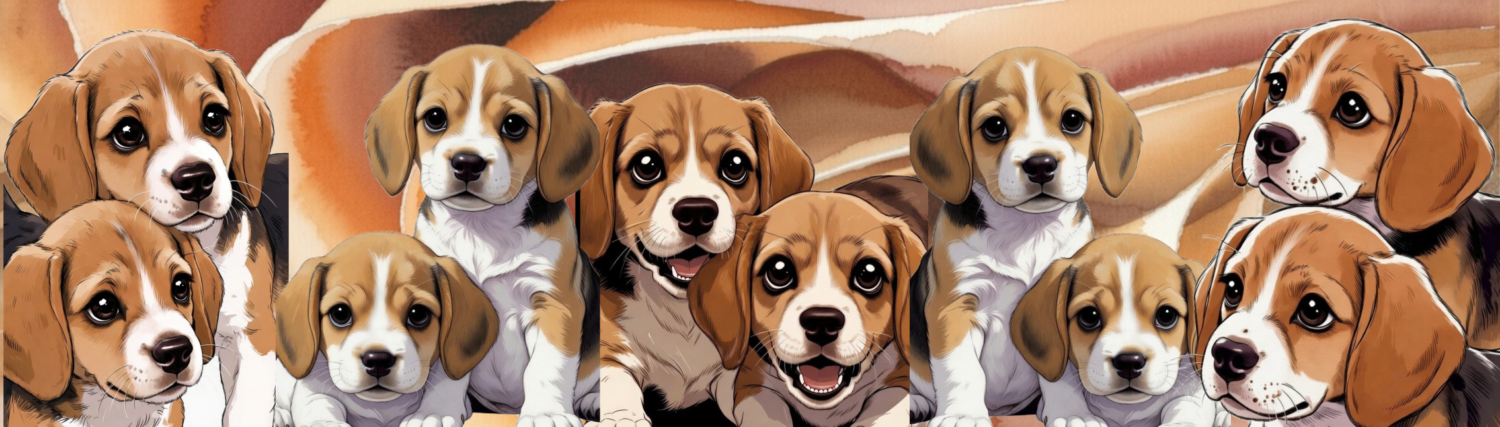
The face adds a second problem. Waller et al. (2013) found that shelter dogs that raised their inner brows more often were rehomed faster, and argued that the movement resembles human sadness and triggers a caring response. The Beagle's soft, round eyes and "pleading" expression can look like permanent appeal even when the dog is neutral. Treat the face as less informative than it looks and read the body beneath it.
The tail is the most reliable visual signal on a Beagle. Beagles typically carry a full-length tail, often with a white tip, which is commonly explained as making hounds easier to see in cover (a commonly stated purpose, not a tested one). A tail held high and moving is easy to read from a distance, and a tail held low or tucked is just as clear. A tail carried up while the dog works a scent line is commonly described as part of the hound's working posture, so a raised tail is not by itself a sign of confidence or of aggression. Check it against the face, the stance and the speed of movement. Direction of wag also carries meaning: Siniscalchi et al. (2013) showed 43 dogs of various breeds videos of dogs wagging more to the left or right, and the left-biased wags were linked to higher heart rates and more anxious behaviour in the watching dogs.
Whining, pacing and other quiet signals
Not every Beagle request is loud. Whining, pacing, pawing, nose-pushing and standing at the door are all common ways a dog asks for something, and they usually come before the bay or the howl. No Beagle-specific study located for this article measures them, so the reading below is informed inference from general dog behaviour.
The practical point is that quiet requests are easy to miss and easy to ignore, and a dog whose quiet requests fail may escalate to the louder channel it was bred to use. Responding early to the soft signal, by opening the door, offering a chew or giving a walk, can prevent the hard one. The same logic cuts both ways: if a whine reliably produces food or attention, the dog learns that whining works, so respond to the need and then reward calm.
Talking to other dogs
Beagles were run in packs, and many are comfortable around other dogs, though that is a tendency and not a rule. Dog-to-dog communication relies heavily on smell and on posture, and a Beagle's greeting usually starts with a nose-to-nose and then nose-to-rear exchange of information. For the Owner, the sensible approach is to let the exchange happen at a relaxed pace, and to watch whether both dogs stay loose.
Two features complicate the picture. Drop ears and a soft face give the other dog fewer visual cues to read, which may make a Beagle's mood less obvious to a stranger (an inference from Goodwin et al., 1997, not a Beagle study). And a Beagle that is nose-down is not monitoring the other dog's body, so it may miss early warning signs such as a stiffening or a stare. If the other dog is tense, a nose-down Beagle can walk into trouble.
A simple rule helps in busy places: when your Beagle is greeting a new dog, keep the lead loose and watch the other dog. Your eyes cover the visual channel the Beagle is not using.
Spinal and neck pain can look like behaviour
Brown et al. (2017) report that breeds with a significantly increased risk of intervertebral disc disease (IVDD) include the Beagle and the Pembroke Welsh Corgi. The same paper identifies an FGF4 retrogene on chromosome 12 as responsible for chondrodystrophy and IVDD, with an odds ratio of 51.23 (95% CI 46.69 to 56.20) for IVDD in carrier dogs across the dogs studied. That figure describes the variant, not the risk for any one Beagle.
Why does that belong in a communication article? Because pain often leaks out as a change in behaviour: a dog that becomes reluctant to jump, yelps when lifted or touched near the neck or back, holds its head low, or becomes irritable. Mills et al. (2020) review pain as a driver of problem behaviour in dogs and cats, which is the right frame: a new behaviour deserves a medical question before a training answer.
In a breed whose reputation is for noise and stubbornness, pain can be missed. A Beagle that cries out is "being dramatic". A Beagle that stops climbing stairs is "being stubborn". Neither label tells you whether the dog hurts. A sudden change in voice or movement is more informative than a stable, long-standing habit.

How it shows up at home
Owners commonly report a short list of presentations. Each is easier to manage once read as a signal.
Not responding when on a scent. A Beagle that does not come when called while sniffing is often described as ignoring its Owner. The better reading, based on the attention findings above, is that the call arrived while attention was committed elsewhere. This is informed inference, not a measured result in Beagles.
Baying at triggers. A doorbell, a passing dog or a smell on the wind can trigger bay-type calls. The dog is reporting what it senses, at a volume built for open country.
Howling when left alone. Howling at departures is commonly reported in hounds and is usually read as distress, though no Beagle-specific study located for this article measured how often it happens. Record the dog while you are out before deciding what it means, because the cause may be boredom, noise outside or true separation distress.
Sniffing the ground at odd moments. Sniffing at a tense moment, such as during a scolding or a close meeting with another dog, is commonly described by behaviourists as a displacement or calming behaviour. In a scent hound the signal is ambiguous, because the dog may simply be investigating. Read the speed, the body tension and the rest of the posture before deciding which.
The guilty look. Horowitz (2009) tested 14 dogs and found that the "guilty look" appeared more when owners scolded, regardless of whether the dog had done anything wrong. A Beagle's soft face makes this reading very tempting. The look signals a dog reacting to your tone, not a dog confessing.

What does not differ
The grammar of dog communication is shared. A play bow still means "what follows is play". Lip-licking, yawning, turning away and freezing read the same in a Beagle as in any dog. Meaning still depends on the whole body and the context, not on a single signal.
Morrill et al. (2022) matter again here. Surveying owners of 18,385 dogs and genotyping 2,155 of them, they found that breed explained about 9% of behavioural variation among individual dogs. That means two Beagles can differ as much from each other as from dogs of other breeds, and nothing in this article should be applied to your dog without checking it against your dog.
The directional-wag research is also less settled than a summary suggests. Siniscalchi et al. (2013) found that dogs reacted differently to left- and right-biased wags, but a robotic-dog study reported that dogs hesitated less when approaching a left-wagging replica (Artelle et al., 2011). The honest conclusion is that wag direction is a clue worth noting, not a rule to apply to a single dog in a single moment.
Individual differences also run deep inside this breed. Persson et al. (2015) found a heritable component to human-directed social behaviour even among research Beagles kept under similar conditions, so a pet Beagle from a different line may differ again. When in doubt, trust the baseline you have recorded for your own dog over any general description, including this article's.
The table below sums up the main differences. It describes tendencies and not certainties.
| Signal area | Universal dog pattern | Beagle pattern |
| Attention | Dogs orient to people and to scent | Nose-down scent attention can override visual and voice cues |
| Voice | Barks vary with context and arousal | Bark, bay and howl are commonly described, and bay carries over distance |
| Ears | Position shows mood | Drop ears hide some ear-position signals |
| Face | Brow and eyes show emotion | A soft, round face can look appealing when neutral |
| Tail | Position and wag direction carry mood | Full tail, often white-tipped, is usually the clearest visual signal |
| Pain | Often shows as behaviour change | Elevated breed-level IVDD risk raises the stakes of "stubborn" |
Do a Beagle’s Signals Change as It Grows?
For most of a Beagle's life, the stages described in the Master Pillar apply as written. Three breed-relevant points are worth adding, labelled by how well they are supported.
Puppyhood and adolescence: check-ins are learned. In the research Beagles studied by Persson et al. (2015), eye-contact seeking increased with age and experience, and some measures differed by sex. For an Owner, that supports starting early: reward every voluntary look and every return to you while the dog is young, because the habit seems to develop with practice. A sensible early habit is to let a puppy hear doorbells, car doors and passing dogs at low volume while it is fed or played with, so that alerting is not rehearsed as the only response. This is informed practice, not a tested protocol. No breed-specific study located for this article documents when baying or howling begins, and online claims giving exact ages are unsourced, so treat any such age as unknown.
Adulthood: the nose usually peaks as a competitor. Adult Beagles are commonly described as most scent-driven when they are fit and active. That is an Owner-reported pattern, not a measured one. If the dog's recall and check-ins fall apart outdoors at this stage, that is usually an attention problem, not an obedience failure, and it is best handled by changing the setup, such as using a long line, rather than repeating commands.
Senior years: voice and movement as messages. Older dogs of any breed can lose hearing, vision or mobility, and each can change how a dog uses and responds to signals. A Beagle that has stopped responding to your voice may simply not hear it, and a dog that cries at night or hesitates on stairs may be reporting pain or confusion. Because Beagles are among the breeds with an elevated risk of intervertebral disc disease (Brown et al., 2017), new reluctance to jump or be lifted deserves a vet check at any age.

How Do I Read and Respond to My Beagle’s Signals?
Each recommendation below ties back to one of three features: the nose, the voice or the face and body. Most are informed practice and not tested treatments, and none replaces advice from a vet or a qualified behaviour professional.
Treat the nose as a channel, not a rival
Because scent attention can override your cues, the most effective move is to schedule it, not fight it. Give the dog a few minutes of unhurried sniffing at the start of each walk, then call it away with a cheerful voice marker and reward it generously for coming. Sniffing becomes the reward for checking in, rather than something you remove.
A "sniff, then check in" routine is simple to teach. When the dog lifts its head from the ground for any reason, mark the moment with a word or a click and give a small treat. Over weeks, the dog learns that looking up pays, which builds the check-in habit that Persson et al. (2015) suggest develops with experience. Scatter feeding on the lawn and short scent games at home add safe outlets for the same drive.
What commonly fails is calling repeatedly while the nose is down. Each unanswered call teaches the dog that your voice is optional, and it makes you louder. Wait until the dog lifts its head, or move closer and use the marker, and keep a long line on in unfenced places until recall is reliable.

Give the nose daily work
A hound with no scent work may invent its own, through bin raids, garden digging or escape attempts that follow a smell. Offering structured nose work gives the same drive a legal outlet. Scatter part of a meal across the lawn, hide treats under cups for a find-it game, or use a snuffle mat, and keep each session short and easy so the dog finishes successfully.
A "sniffari" walk, where the dog chooses the route and sniffs at its own pace, is a simple addition. It does not need to replace exercise, but a slow, nose-led walk can meet needs that a fast one does not. Keep a long line on in unfenced places, and check that nothing in the search area is toxic or sharp. This is common enrichment advice, not a tested treatment, and the amount any one Beagle needs will vary.
Use sound before sight
Because a nose-down dog is not watching your hands, your first signal should be one it can hear. A short, distinctive voice marker, a whistle or a squeaky toy is more likely to reach the dog than a gesture. Pair the sound with something wonderful for several weeks before relying on it in a distracting place.
Keep your signals consistent. If "come" sometimes means a treat and sometimes means the end of the walk, the dog will learn that coming is risky. Use a different cue for "time to leave" and keep "come" for good things. This is informed practice in line with general learning principles, not a Beagle trial.
Build a baseline for the face, ears and tail
Because the ears and face are easy to misread, learn what your own dog looks like when it is calm. Film a few short clips: relaxed at home, greeting you, meeting a new dog or person, and mildly worried at a distance from something unfamiliar. Watch them side by side, then fill in a simple notebook.
| What to watch | Relaxed baseline to record | A change worth a closer look |
| Tail | Usual carriage and wag speed when calm | Held low or clamped, or held rigid and high |
| Ears | Resting position and base | Pinned back, or locked forward for long periods |
| Eyes and brow | Soft eyes and easy blinking | Whites showing, or a fixed stare |
| Mouth | Loose and slightly open | Tightly closed, or repeated lip-licking |
| Nose | Sniffing in a relaxed rhythm | Frantic sniffing, or sniffing in the middle of a tense moment |
| Neck and back | Easy head carriage and jumping | Low head, stiffness, or hesitating at steps |
A baseline works because it replaces a guess about "Beagles in general" with evidence about your dog. It can be repeated every few months, and it makes a real change, such as a new stiffness, much easier to spot and to describe to a vet.
Sort the voice by type
Keep a one-week log with time, trigger, duration and the type of sound: short bark, carrying bay, or drawn-out howl. Patterns usually appear quickly. A dog that bays when it catches a smell in the garden is working. A dog that barks at the gate and looks at you is alerting. A dog that howls after you leave is probably distressed.
Respond to the type, not the volume. What commonly backfires is shouting, which can sound to the dog like joining in, and punishment, which can suppress the warning while leaving the feeling behind. Behaviour professionals commonly advise against aversive anti-bark devices as well, because they treat the sound and not the reason for it. This is widely held professional advice and not a finding specific to Beagles. For alert barking, acknowledge the trigger once and direct the dog to a mat or chew. For scent-baying, reduce the trigger by limiting access to the area or exercising the nose on a long line. For departure howling, see the worked example below. Pongrácz et al. (2005) found that the pitch and spacing of dog barks carry emotional information that people can detect, so a high-pitched, fast, escalating call is more urgent than a slow, steady one.
Introduce other dogs with your eyes, not only the nose
On walks, a nose-down Beagle may not notice the early signs of another dog's tension. Give that job to yourself. When a new dog approaches, shorten the lead slightly while keeping it loose, watch the other dog's body, and let the Beagle greet at a calm pace along a curved path, not head-on. If the other dog stiffens, stares or raises its hackles, increase distance and call your dog away with the voice marker, rewarding it as soon as it arrives.
This is informed practice that follows from the attention findings above, and it fits a hound that is comfortable in groups but not necessarily alert to a stranger's mood. If your Beagle repeatedly gets into trouble with other dogs, a qualified behaviour professional can assess the pattern.
Check the neighbours and the by-laws
Noise travels, and a carrying voice can strain relationships. In Johannesburg, the Dogs and Cats By-law (2006, amended 2019) is reported to prohibit a dog from barking or howling in a way that causes a disturbance, and warning notices are issued before fines. Rules differ by municipality and by complex or body corporate, so check the current text that applies where you live. [verify the current by-law wording and the Owner's own municipality before publishing.]
A practical approach is to tell neighbours you are working on it, to share a contact number, and to keep your log. A written record of what you tried shows good faith, and the log often reveals fixable triggers such as a time of day or a window with a view of the street.
Do not read the face as guilt or as begging
A Beagle's soft face invites a story. Horowitz (2009) found that the "guilty look" was linked to the owner's scolding rather than to the dog's behaviour, so a dog that looks guilty is usually reacting to your posture and tone. Do not punish after the fact, and do not interpret a pleading face as proof that the dog is hungry or sorry.
Instead, read the body. A loose, wiggly Beagle with soft eyes is relaxed. A still body, ears slightly back, a lowered head and a tail held low suggests worry. Compare each reading with what your dog does when you know it is calm.
 Callout: Red flags: contact a vet promptly
Contact a vet the same day for any of the following in a Beagle, and go to an emergency vet if the dog cannot stand or walk normally:
- Sudden crying or yelping when lifted or touched near the neck or back
- A low-held head, a stiff neck or a hunched posture
- New reluctance to jump, climb stairs or move
- A sudden change in voice, such as a normally noisy dog going silent
- New night-time crying or confusion in an older dog
- Wobbliness, dragging a leg, or loss of bladder or bowel control
Worked example: Juno and the departure howl
This is a labelled hypothetical, used to illustrate the method. It is not a real dog or a real case.
Imagine an Owner whose two-year-old Beagle, Juno, howls for most of the morning after the Owner leaves for work. A neighbour has complained. The Owner has been told that Beagles "just howl" and has started to leave the radio on and hope for the best.
Step one is evidence. The Owner sets up a phone to record. The video shows Juno pacing, panting and howling for twenty minutes after the door closes, then settling, then howling again at every passing dog. The pattern suggests distress at departure plus alert-baying at triggers, not a single problem.
Step two is a health check. A vet rules out pain and checks hearing, because pain can show up as vocal change. Step three is setup. The Owner arranges a long, scent-rich walk before leaving, offers a food puzzle on departure, and blocks the window view that triggers the barking.
A scent-rich routine helps because it gives the nose a job while the Owner is away. A food puzzle, a snuffle mat or a few treats scattered in the garden before leaving can occupy a dog that would otherwise pace and call. This is common enrichment advice, not a tested fix for howling, and it will not solve true separation distress on its own.
Step four is gradual practice. The Owner builds up absences from seconds to minutes, keeping each short enough that Juno stays calm, and asks a qualified behaviour professional for help because the distress is clear. The howling shrinks over several weeks. The lesson is that the same loud voice had two different causes, and each needed its own response.

 Success criteria
 Success criteria
You will know this approach is working when:
- Your dog lifts its head from a scent and looks at you without being called, and returns when you use your voice marker.
- You can name whether a call is a bark, a bay or a howl, and what triggered it.
- Departure howling is shorter in your recordings, or you have professional help in place.
- Any sudden change in voice, posture or willingness to jump gets a vet check within days.
 Check your understanding
 Check your understanding
- Why might a Beagle that is sniffing not respond to a hand signal, and what should you try first?
- What are three different jobs of a bark, a bay and a howl?
- What does the "guilty look" actually reflect, according to Horowitz (2009)?
- A normally noisy Beagle goes quiet and holds its head low. What is your first step, and why?
 Where Should I Read Next?
 Where Should I Read Next?
Three links connect this article to the rest of the cluster:
- The foundation: How Dogs Communicate covers the general science of body language, voice and scent that this article builds on.
- The comparison: Understanding Corgi Communication looks at a herding breed whose short tail and low back raise very different signalling questions from the Beagle's nose and voice.
- Beagles are one of the most recognized and cherished dog breeds worldwide. Complete Guide to the Beagle.
 Frequently Asked Questions
 Frequently Asked Questions
Why does my Beagle howl and bay?
Howling and baying are hound sounds, and both are communication. A bay is a longer, carrying call commonly given when following a scent, and a howl is a drawn-out call often linked to isolation or to answering distant sounds. This split comes from breed descriptions, not a Beagle study. Note the context: baying with the nose down in the garden is probably scent-driven, while howling after you leave is more likely distress. Record the dog before deciding what it means, and involve a vet or behaviour professional if distress is clear.
Is it normal for a Beagle to bark so much?
Frequent vocalising is common in Beagles and is usually a signal, not a fault. Hounds were selected to use their voices on a trail, so alerting, baying and calling are easy for the breed to produce. Barks also carry information through pitch and spacing (Pongrácz et al., 2005). Keep a one-week log of time, trigger, duration and sound type. A sudden new pattern, especially crying out when touched, deserves a vet check because it can mean pain.
Why does my Beagle ignore me when it is sniffing?
Most often, the call arrives while the dog's attention is committed to scent. Scent is a rich channel for a hound, and a nose-down dog is not watching your hands. That reading is informed inference, not a Beagle trial. Wait for the dog to lift its head, use a sound-based marker rather than a gesture, and reward every return. Keep a long line on in unfenced places until recall is reliable. Persistent non-response indoors, or sudden deafness, deserves a hearing check.
Why does my Beagle howl when I leave?
Departure howling is commonly reported in hounds and is usually read as distress, though no Beagle-specific study located for this article measures how often it happens. Film the dog while you are out to see whether it paces, pants and calls, or barks at outside triggers. Rule out pain with a vet, give a long walk and a scent puzzle before leaving, and build absences up gradually. If distress is clear, a qualified behaviour professional can design a plan.
What does it mean when my Beagle’s tail is up and wagging?
A raised, moving tail is easy to see and usually signals interest or excitement, but it needs context. Beagles typically carry a full tail, often white-tipped, and a tail carried up while working a scent line is commonly part of the hound's working posture. Direction can matter too: dogs watching left-biased wags showed more anxious responses in one study of 43 dogs (Siniscalchi et al., 2013). Check the face, stance and speed, and compare with your own dog's baseline.
How can I tell if my Beagle is stressed?
Look for a change from your dog's own baseline: a stiff or low body, ears back, whites of the eyes showing, repeated lip-licking, pacing, panting at rest, or sniffing at an odd moment. Because Beagles sniff constantly, sniffing alone is ambiguous, so read its speed and the tension around it. No single sign is proof. If several appear together, remove pressure and give distance, and ask a vet if the pattern is persistent or new.
What does my Beagle’s sad face mean?
Often, nothing. A Beagle's soft, round eyes and drop ears can look pleading even when the dog is neutral. Waller et al. (2013) found that shelter dogs raising their inner brows more were rehomed faster, which suggests humans respond strongly to the look. The face is a weaker guide than it appears, so read the body beneath it: a loose, wiggly dog is at ease, and a still, low dog with ears back is worried.
Why does my Beagle look guilty when I find a mess?
The look is mostly a reaction to you. Horowitz (2009) tested 14 dogs and found the "guilty look" was linked to owners' scolding, not to whether the dog had misbehaved. A Beagle's face makes the look especially convincing. Do not punish after the fact, because the dog is unlikely to connect the scolding with the earlier act. Prevent the mess through management, and reward the behaviour you want when it happens.
Can I train my Beagle to bay less?
Possibly reduced, rarely removed, because voice is a core breed trait. Start by identifying the type of sound and its trigger, then reduce the trigger, such as blocking a window view or limiting scent access. Reward quiet, and give the nose and body enough work each day. Avoid punishment and aversive anti-bark devices, which treat the sound and not the reason. If barking is frequent or distressed, involve a qualified behaviour professional early.
Why does my Beagle sniff the ground when I tell it off?
Behaviourists commonly describe sniffing in a tense moment as a displacement or calming behaviour, a way of lowering pressure. In a scent hound the signal is ambiguous, because the dog may simply be interested in a smell. Read the speed, the body tension and the rest of the posture. If the dog sniffs and then freezes or turns away, treat it as a request for less pressure, and reduce your intensity.
How do Beagles communicate with other dogs?
Mostly through smell and posture, starting with sniffing. Beagles were run in packs and many are comfortable with other dogs, though temperament varies. Drop ears and a soft face give other dogs fewer visual cues to read (an inference from Goodwin et al., 1997), and a nose-down Beagle may miss another dog's stiffening or stare. Keep the lead loose, watch the other dog's body, and let greetings happen at a calm pace along a curved path.
Why does my Beagle yelp when I pick it up?
A yelp on lifting is a pain signal until proven otherwise. Beagles are among the breeds with an increased risk of intervertebral disc disease (Brown et al., 2017), and neck or back pain can show as crying out, a low head, stiffness or reluctance to move. Stop lifting and book a vet check promptly. If the dog cannot walk normally, drags a leg or loses bladder control, go to an emergency vet. Do not wait to see if it passes.
Is my Beagle’s howling a problem for my neighbours in South Africa?
It can be. In Johannesburg, the Dogs and Cats By-law (2006, amended 2019) is reported to cover barking or howling that causes a disturbance, with warnings usually given before fines. Rules differ by municipality and by complex, so check the text that applies to you. Talk to neighbours early, keep a log of triggers and what you have tried, and ask a qualified behaviour professional for help if the howling continues.
Do Beagles read human signals as well as other dogs?
Not necessarily. Hounds belong to the "independent worker" category in a study of 30 dogs per group, and cooperative workers such as sheepdogs were better at reading human pointing (Gácsi et al., 2009). Beagles were not named in that comparison. In research Beagles, eye-contact seeking was partly heritable and grew with age and experience (Persson et al., 2015), so check-ins can be taught. Use clear, consistent cues, and a sound before a gesture.
My older Beagle has become noisy at night. What does it mean?
New night-time vocalising in an older dog can have medical causes, including pain, reduced hearing or vision, and confusion. This is general veterinary reasoning and not a Beagle-specific finding. Book a vet check before assuming it is a habit, and mention any reluctance to jump, changes in appetite or toileting accidents. Keep the dog's sleeping area comfortable and predictable, and avoid scolding a dog that may not understand why it is calling.
 Sources cited
 Sources cited
Working-draft style. Each is to be converted to a hyperlinked citation after the human fact-check.
- Artelle, Dumoulin & Reimchen (2011), Laterality 16:129–135: robotic dog with asymmetric tail wagging. [secondary description only; verify]
- Brown et al. (2017), PNAS 114:11476–11481: FGF4 retrogene on chromosome 12 and IVDD; breeds at increased risk.
- Gácsi et al. (2009), Behav Brain Funct 5:31: selection for cooperation and attention.
- Goodwin, Bradshaw & Wickens (1997), Anim Behav 53:297–304: paedomorphosis and signal repertoire.
- Horowitz (2009), Behav Processes 81:447–452: the "guilty look", 14 dogs. [verify volume and pages]
- Mills et al. (2020), Animals 10:318: pain and problem behaviour in dogs and cats. [cited from memory; verify]
- Morrill et al. (2022), Science 376:eabk0639: breed explains 9% of behavioural variation.
- Persson et al. (2015), Genes Brain Behav 14:337–344: heritable human-directed social behaviour in research Beagles. [verify details against the paper]
- Polgár et al. (2016), PLoS ONE: olfactory capacity across breeds and wolves. [verify]
- Pongrácz et al. (2005), J Comp Psychol 119:136–144: human listeners and Mudi barks.
- Salamon et al. (2025), Sci Rep 15:2675, PMC11751464: breed, group and scent-discrimination performance. [verify numbers against the paper]
- Siniscalchi et al. (2013), Curr Biol 23:2279–2282: dogs see left and right wags differently.
- Waller et al. (2013), PLoS ONE 8:e82686: paedomorphic facial expressions and rehoming. [verify]
- City of Johannesburg, Dogs and Cats By-law (2006, as amended 2019). [verify the current text]
END ARTICLE